On May 21, 2008, Ryan introduced H.R. 6110, the Roadmap for America's Future Act of 2008, commonly referred to as the "Ryan budget."[113] This proposed legislation outlined changes to entitlement spending, including a controversial proposal to replace Medicare with a voucher program for seniors.[6][114][115] The Roadmap found only eight sponsors and did not move past committee.[6][116]
On April 1, 2009, Ryan introduced his alternative to the 2010 United States federal budget. This alternative budget would have eliminated the American Recovery and Reinvestment Act of 2009, lowered the top tax rate to 25%, introduced an 8.5% value-added consumption tax[citation needed], and imposed a five-year spending freeze on all discretionary spending.[117][118] It would have also phased out Medicare's traditional fee-for-service model; instead, starting in 2021, it would offer fixed sums in the form of vouchers, with which Medicare beneficiaries could buy private insurance.[119] The federal government would no longer pay for Medicare benefits for persons born after 1958.[119][not in citation given] The plan attracted criticism since the voucher payments would not be set to increase as medical costs increase, leaving beneficiaries partially uninsured.[119][not in citation given] Ryan's proposed budget would also have allowed taxpayers to opt out of the federal income taxation system with itemized deductions, and instead pay a flat 10 percent of adjusted gross income up to $100,000 and 25 percent on any remaining income.[118] Ryan's proposed budget was criticized by opponents for the lack of concrete numbers.[120] It was ultimately rejected in the House by a vote of 293137, with 38 Republicans in opposition.[121]
On January 27, 2010, Ryan released a modified version of his Roadmap, H.R. 4529: Roadmap for America's Future Act of 2010.[122][123] The modified plan would provide across-the-board tax cuts by reducing income tax rates; eliminate income taxes on capital gains, dividends, and interest; and abolish the corporate income tax, estate tax, and Alternative Minimum Tax.[124] The plan would privatize a portion of Social Security,[125][126] eliminate the tax exclusion for employer-sponsored health insurance,[126] and privatize Medicare.[126] Chief actuary of Medicare Rick Foster compared Ryan's "Roadmap" with the 2010 healthcare reform in congressional hearings, stating that while both had "some potential" to make healthcare prices "more sustainable", he was more "confident" in Ryan's plan.[127]
Economist and columnist Paul Krugman criticized Ryan's plan as making overly optimistic assumptions and proposing tax cuts for the wealthy.[128] Krugman further called the plan a "fraud" saying it relies on severe cuts in domestic discretionary spending without specifying the programs to be cut, and "dismantling Medicare as we know it" by suggesting the voucher system, which he noted was similar to a failed attempt at reform in 1995.[128] In contrast, columnist Ramesh Ponnuru, writing in the National Review, argued that Ryan's plan would lead to less debt than current budgets.[129] Economist Ted Gayer wrote that "Ryan's vision of broad-based tax reform, which essentially would shift us toward a consumption tax... makes a useful contribution to this debate."[130]
On April 11, 2011, Ryan introduced H.Con.Res. 34, a federal budget for fiscal year 2012.[131] The House passed this Ryan Plan on April 15, 2011, by a vote of 235193. Four Republicans joined all House Democrats in voting against it.[132][133] A month later, the bill was defeated in the Senate by a vote of 5740, with five Republicans and most Democrats in opposition.[134]
Ryan with President Obama during a bipartisan meeting on health insurance reform, February 25, 2010
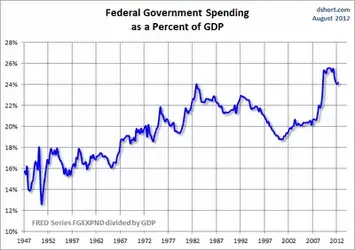
On March 23, 2012 Ryan introduced a new version of his federal budget for the fiscal year 2013.[135] On March 29, 2012, the House of Representatives passed the resolution along partisan lines, 228 yeas to 191 nays; ten Republicans voted against the bill, along with all the House Democrats.[136] Ryan's budget seeks to reduce all discretionary spending in the budget from 12.5% of GDP in 2011 to 3.75% of GDP in 2050.[137]
Ryan has proposed that Medicaid be converted into block grants but with the federal government's share of the cost cut by some $800 billion over the next decade. Currently, Medicaid is administered by the states, subject to federal rules concerning eligibility, and the amount paid by the federal government depends on the number of people who qualify. Under Ryan's plan, the federal share would be based on population and inflation and would not increase because of economic downturns, when more people qualify.[citation needed] His plan would also undo a Reagan-era reform by which the federal government prohibited the states from requiring that a patient's spouse, as well as the patient, deplete all of his or her assets before Medicaid would cover long-term care.[4][5][6][138]
An analysis by the CBO showed that the Ryan plan would not balance the budget for at least 28 years, partly because the changes in Medicare would not affect anyone now older than 55.[139] Former U.S. Comptroller General David Walker and Maya MacGuineas, president of the Committee for a Responsible Federal Budget, praised the budget for making tough choices. Walker believes it needs to go even further, tackling Social Security and defense spending.[140] In contrast, David Stockman, Director of the Office of Management and Budget under President Ronald Reagan, has declared that Ryan's budget "is devoid of credible math or hard policy choices" and would "do nothing to reverse the nation's economic decline and arrest its fiscal collapse."[141] Ezra Klein also criticized the budget for making "unrealistic assumptions."[137] The Center on Budget and Policy Priorities was highly critical of Ryan's budget proposal, stating that it would shift income to the wealthy while increasing poverty and inequality.[142]
Parts of the 2012 Ryan budget were criticized by the United States Conference of Catholic Bishops for its proposed cuts to housing and food stamp programs.[143][144] Faculty and administrators of Georgetown University challenged what they called Ryan's "continuing misuse of Catholic teaching" when defending his plan,[145][146] but Ryan rejected their criticism.[147]
Ryan's budget "envisions continued increases in Pentagon spending" and "significant cuts to the much smaller appropriations for the State Department and foreign aid," with diplomacy and development spending being reduced sharply.[148]