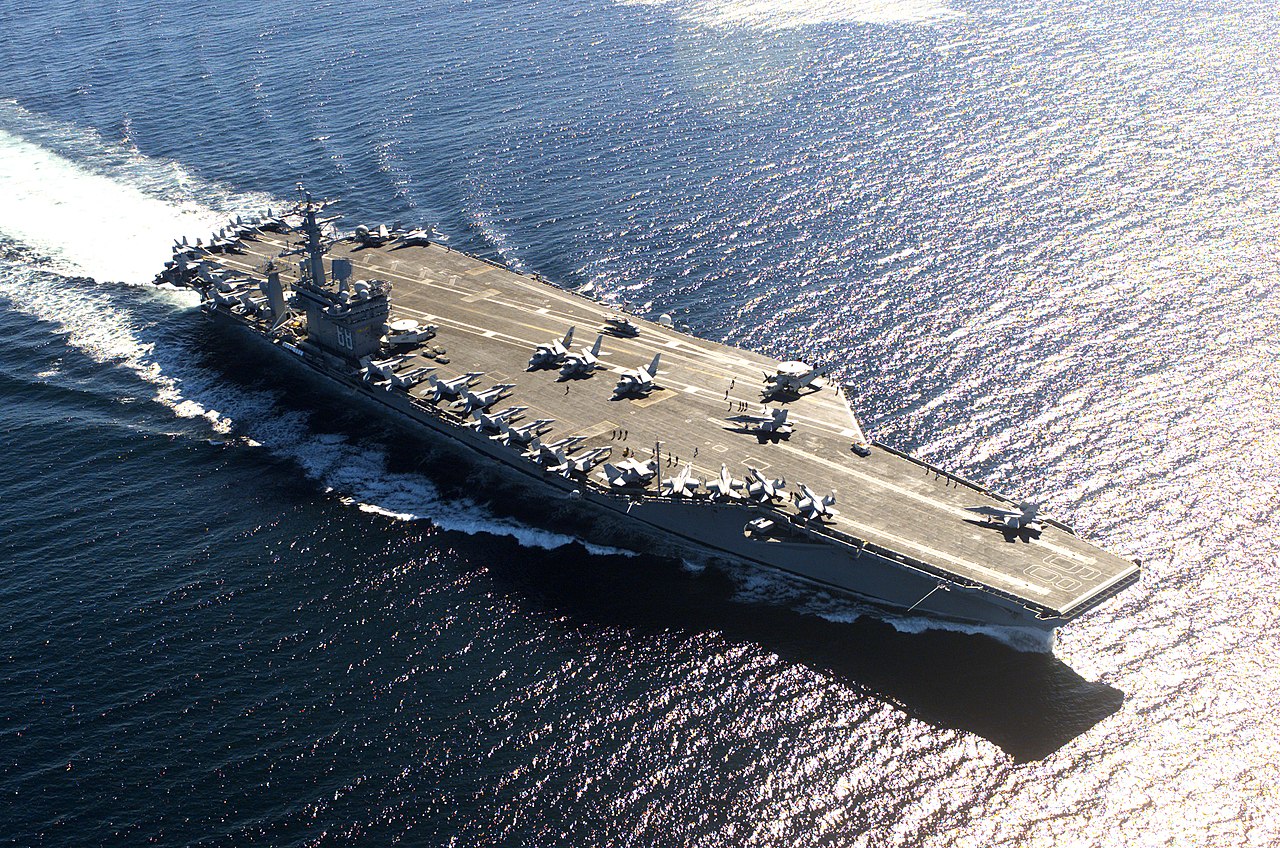
New carrier USS JFK CVN 79 sailed under its own power for the first time yesterday

We have been decommissioning many naval assets, including many carriers. As I said, I remember reading somewhere, I don't recall where, but it wasn't a clown resource like most of the lefts, that we were down to three. So, I just went and asked and this is what was returned.

The United States Navy maintains 11 nuclear-powered aircraft carriers in active service, which form the core of its carrier strike groups. While all 11 are considered active, generally only about 3 to 4 are deployed simultaneously due to maintenance cycles and training, with others in repair, working up, or in port.
Key Operational Details:
  • Total Active Carriers: 11 (10 Nimitz-class, 1 Ford-class).
  • Active Deployment: As of early 2026, carriers like the USS Abraham Lincoln (CVN-72), USS George Washington (CVN-73), and others are typically deployed in regions such as the Indo-Pacific and Middle East.
  • Forward Deployment: One carrier, the USS George Washington, is permanently forward-deployed in Yokosuka, Japan.
  • Maintenance Cycle: The Navy follows a "one-third rule," where for every carrier deployed, others are in training or undergoing maintenance.
  • Status Changes: USS John C. Stennis (CVN-74) is undergoing a midlife refueling/overhaul, with return expected in late 2026.
The fleet is mandated by law to maintain at least 11 operational carriers to meet global, strategic demands.

So, I misremembered. We have 3 Operational carriers. The other 8 are in maintenance cycles and/or training.

So in effect, we have only three, but I'm pretty sure tha tthe Navy can get the other eight out to see inside a fortnight.
There are Fleet Carriers ( Atlantic ) ( Pacific ) usually 2-4 each + with another each in For repairs / Upgrades with at least 1 transitioning between the two via Panama Canal or returning from operations to transition through to whichever Fleet it will be utilized by or docked for . At any given time in last 24 months there are at least 2 Carrier groups In operations far from usual US ports & regions in other oceans or seas
 
Ya see…It is a joke

Let me explain it to you
The guy you voted for likes to name things after himself
Even things named to honor JFK
Your party did that and he is copying it. You are even naming an aircraft carrier after an African American for political purposes when a Destroyer would be honor enough.
 
We have been decommissioning many naval assets, including many carriers. As I said, I remember reading somewhere, I don't recall where, but it wasn't a clown resource like most of the lefts, that we were down to three. So, I just went and asked and this is what was returned.

The United States Navy maintains 11 nuclear-powered aircraft carriers in active service, which form the core of its carrier strike groups. While all 11 are considered active, generally only about 3 to 4 are deployed simultaneously due to maintenance cycles and training, with others in repair, working up, or in port.
Key Operational Details:
  • Total Active Carriers: 11 (10 Nimitz-class, 1 Ford-class).
  • Active Deployment: As of early 2026, carriers like the USS Abraham Lincoln (CVN-72), USS George Washington (CVN-73), and others are typically deployed in regions such as the Indo-Pacific and Middle East.
  • Forward Deployment: One carrier, the USS George Washington, is permanently forward-deployed in Yokosuka, Japan.
  • Maintenance Cycle: The Navy follows a "one-third rule," where for every carrier deployed, others are in training or undergoing maintenance.
  • Status Changes: USS John C. Stennis (CVN-74) is undergoing a midlife refueling/overhaul, with return expected in late 2026.
The fleet is mandated by law to maintain at least 11 operational carriers to meet global, strategic demands.

So, I misremembered. We have 3 Operational carriers. The other 8 are in maintenance cycles and/or training.

So in effect, we have only three, but I'm pretty sure tha tthe Navy can get the other eight out to see inside a fortnight.
From your post;
"Maintenance Cycle: The Navy follows a "one-third rule," where for every carrier deployed, others are in training or undergoing maintenance."

So nominally about 4 CVs on active deployment(at least at a time). Usually another 2-4 are either winding down or working up, so in a "pinch" the USN could surge up to 6-8 on duty. However not for long and that might foul up the one third at a time active cycle. There is usually 2-4 that are in serious down-time, sometimes dry dock, since there are occasions for serious refit/repairs/replacement (of old equipment~systems with newer ones, etc).

Another factor is crews that are available. Some will be assigned to other vessels when their most recent ship is in for extensive down time.
Other factor is availability of Air Groups. These often have their own cycles of refit/replacement/retrain of air crew and ground crew as well as the aircraft in need of major overhaul.
Also, in a desired service life of about 30 years, a vessel will have at least one, maybe two extensive periods of up to a year in dry-dock for major overhaul and refits. Hence the optimal number would be at least 13 commissioned vessels, with twelve in the one third rotation and the 13th in extended downtime.

Then there are also the crews to consider. Like the ships they can fatigue a bit at times hence will need leave on occasion and also periodic retrain and refresher courses.

Carriers (CVs) operate within a Task Force that usually includes 4-6 escorting warships; Destroyers(DD) and Cruisers(CA), along with at least one attack submarine (SSN). Replenishment(re-supply) and refueling ships will also join a Task Force at times as needed.

Note that all this is the "Peace Time" operating systems. In event of a Hot War the routine might be adjusted a bit, especially in terms of increasing numbers of escorting vessels and numbers of aircraft assigned to an Air Group.
 

Naval Flight Officer explains why the US Navy can’t “mothball” aircraft carriers instead of scrapping them​

...

‘As sturdy and reliable as they’ve been, by the time they’re put out to pasture, they’re pretty well used up,’ Andy Burns, Naval Flight Officer.

...
‘The bigger problem is that it’s cost prohibitive to mothball a nuclear plant. Defueling and preserving a plant is extremely expensive and time consuming, and bringing one back online is even more so. Carrier plants aren’t really designed to be refueled more than once in their fifty-year service life. It’s a very lengthy and invasive process, that involves cutting giant holes in several decks to get at the reactor. The mid-life refueling overhaul carriers get takes almost five years typically.’
 

Naval Flight Officer explains why the US Navy can’t “mothball” aircraft carriers instead of scrapping them​

...

‘As sturdy and reliable as they’ve been, by the time they’re put out to pasture, they’re pretty well used up,’ Andy Burns, Naval Flight Officer.

...
‘The bigger problem is that it’s cost prohibitive to mothball a nuclear plant. Defueling and preserving a plant is extremely expensive and time consuming, and bringing one back online is even more so. Carrier plants aren’t really designed to be refueled more than once in their fifty-year service life. It’s a very lengthy and invasive process, that involves cutting giant holes in several decks to get at the reactor. The mid-life refueling overhaul carriers get takes almost five years typically.’
With all due respect, asking an NFO about nuclear carriers is like seeing a gynecologist for a bad tooth.
 
With all due respect, asking an NFO about nuclear carriers is like seeing a gynecologist for a bad tooth.
And your qualifications to comment on nuclear carriers are .... ????

Operating solely on source bias is major reason you wouldn't qualify for a G2/S2 staff slot.
What content within the linked article are your disputing ?
 
And your qualifications to comment on nuclear carriers are .... ????

Operating solely on source bias is major reason you wouldn't qualify for a G2/S2 staff slot.
What content within the linked article are your disputing ?
Qualified nuclear submarine. Stood bridge watches CV-66. Surface Warfare Officer. Escorted carriers all over the world, even a Ruskie. Also rode an LHA with Harriers. Forgotten more about flight ops than you know.

Asking the stewardess about how the plane flies to akin to asking a cruise passenger how to dock the ship in port.
 
15th post
Qualified nuclear submarine. Stood bridge watches CV-66. Surface Warfare Officer. Escorted carriers all over the world, even a Ruskie. Also rode an LHA with Harriers. Forgotten more about flight ops than you know.

Asking the stewardess about how the plane flies to akin to asking a cruise passenger how to dock the ship in port.
But it sounds like you aren't a pilot.
Yet about as qualified as that NFO you object to.

Meanwhile, in course of puffing your hubris, you fail to point out any specific in the linked article you object to.

Do you disagree that fifty years in service might find the vessel and it's metal fatigued ?
Do you think refueling the reactor(s) of a CV are not as invasive as the author claimed ?
 
1769795501389.webp


George Washington Carrier Strike Group formation sails in the Atlantic Ocean
 
But it sounds like you aren't a pilot.
Yet about as qualified as that NFO you object to.

Meanwhile, in course of puffing your hubris, you fail to point out any specific in the linked article you object to.

Do you disagree that fifty years in service might find the vessel and it's metal fatigued ?
Do you think refueling the reactor(s) of a CV are not as invasive as the author claimed ?
That NFO might have one ship's company tour as a shooter at most. Most of what he said was correct. It was a ******* joke you dumbass! Your sense of humor needs an overhaul. The point was that you dont see a gynecologist for a toothache

Someone might as well ask your ******* opinion on climbing Mount Everest. I'm sure you have much experience in that area. When was that again?

You are just being a dick!
 
Back
Top Bottom