Photos of Israeli White Phosphorus attacks on UN schools in Gaza
Some lovely photos of the worlds foremost problem JEWS attack on a UN school with white phosphorous.
You got anything other than biased garbage and propaganda mouthpieces?
Like I said Nazi boy, usage of white phosphorus is not a war crime, the US and many other nations have used it before. Look it up, dork.
White phosphorus is a material made from a common
allotrope of the
chemical element phosphorus that is used in
smoke,
tracer, illumination, and
incendiary munitions.
[1] Other common names include
WP and the slang term "Willie Pete" or "Willie Peter" derived from William Peter, the World War II phonetic alphabet for "WP", which is dated from its use in World War II and Vietnam and is still sometimes used in
military jargon.
[2] As an incendiary weapon, white phosphorus is
pyrophoric (self-igniting), burns fiercely and can ignite cloth, fuel, ammunition, and other combustibles.
In addition to its offensive capabilities, white phosphorus is a highly efficient smoke-producing agent, which burns quickly and produces an immediate blanket of smoke. As a result, smoke-producing white phosphorus munitions are very common, particularly as smoke grenades for
infantry, loaded in grenade launchers on
tanks and other armored vehicles, or as part of the ammunition allotment for
artillery or
mortars. These create
smoke screens to mask from the enemy movement, position,
infrared signatures, or the origin of fire.
Edit

A WP mortar bomb explosion during
maneuvers in France, 15 August 1918.
The British Army introduced the first factory-built WP grenades in late 1916. During World War I, white phosphorus mortar bombs, shells, rockets, and grenades were used extensively by American, Commonwealth, and, to a lesser extent, Japanese forces, in both smoke-generating and antipersonnel roles.
The British military also used white phosphorus bombs against
Kurdish villagers and
Al-Habbaniyah in
Al-Anbar province during the
Great Iraqi Revolution of 1920.
In the interwar years, the
U.S. Army trained using white phosphorus, by artillery shell and air bombardment.
In 1940, when the invasion of Britain seemed imminent, the phosphorus firm of
Albright and Wilson suggested that the British government use a material similar to Fenian fire in several expedient incendiary weapons. The only one fielded was the
Grenade, No. 76 or
Special Incendiary Phosphorus grenade, which consisted of a glass bottle filled with a mixture similar to Fenian fire, plus some
latex (see also
Molotov cocktail,
Greek fire). It came in two versions, one with a red cap intended to be thrown by hand, and a slightly stronger bottle with a green cap, intended to be launched from the
Northover projector (a crude 2.5-inch
black-powder grenade launcher). These were improvised anti-tank weapons, hastily fielded in 1940 when the British were awaiting
a German invasion after losing the bulk of their modern armaments in the
Dunkirk evacuation. Instructions on each crate of SIP grenades included the observations, among other things:
Store bombs (preferably in cases) in cool places, under water if possible.
Stringent precautions must be taken to avoid cracking bombs during handling.
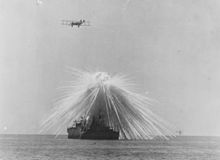 Air burst
 of a white phosphorus bomb over the
USS Alabama during a test exercise conducted by General
Billy Mitchell, September 1921
At the start of the Normandy campaign, 20% of American 81 mm mortar rounds were white phosphorus. At least five American
Medal of Honor citations mention their recipients using white phosphorus grenades to clear enemy positions, and in the 1944
liberation of Cherbourg alone, a single U.S. mortar battalion, the 87th, fired 11,899 white phosphorus rounds into the city. The U.S. Army and
Marines used white phosphorus shells in 107-mm (4.2 inch) mortars. White phosphorus was widely credited by Allied soldiers for breaking up German infantry attacks and creating havoc among enemy troop concentrations during the latter part of the war. US Sherman tanks carried a white phosphorus round intended for artillery spotting, but tank crews found it useful against German tanks. Unable to penetrate German Panther and Tiger tanks at long range, the phosphorus round would adhere to the tank, generate smoke, blind the optics, and often force the crew to abandon the tank or allow US tanks to close to a range where their armor piercing rounds were effective.
When American bombers raided
Negros Island in the
Philippines in 1945, there was a Japanese artillery use of phosphorus bombs during the air raid.
[5]
Incendiary bombs were used extensively by both the
Axis and
Allied air forces against civilian populations and targets of military significance in civilian areas, including
Chongqing,
London,
Coventry,
Hamburg,
Dresden, and
Tokyo. Late in the war, some of these bombs used white phosphorus (about 1–200 grams) in place of magnesium as the igniter for their flammable mixtures. The use of incendiary weapons against civilians was banned by signatory countries in the 1980
Convention on Certain Conventional Weapons Protocol III. The United States signed Protocols I and II on 24 March 1995 under the
Clinton Administration (and the amended article II on 24 May 1999) and later Protocols III, IV, and V, on 21 January 2009 under the
Obama Administration.
Later usesEdit

A
USAF Security Police Squadron member packs an 81 mm white phosphorus smoke-screen mortar round during weapons training, 1980
White phosphorus munitions were used extensively in
Korea,
Vietnam and later by Russian forces in
Chechnya. White phosphorus grenades were used in Vietnam for destroying Viet Cong tunnel complexes as they would burn up all oxygen and suffocate the enemy soldiers sheltering inside.
[6][7] British soldiers also made extensive use of phosphorus grenades during the Falklands conflict to destroy Argentine positions as the peaty soil they were constructed from tended to lessen the impact of fragmentation grenades
[8][9]According to GlobalSecurity.org, during the
December 1994 battle for Grozny in Chechnya, every fourth or fifth Russian artillery or mortar round fired was a smoke or white phosphorus round.
[10]
Use in Iraq (1988)Edit
White phosphorus was used by
Saddam Hussein during the
Halabja poison gas attack. According to an undated
ANSAarticle quoted by an
RAI documentary, on the morning of March 16, 1988, the Iraqi Air Force bombed Halabja several times with a chemical cocktail of
yperite,
tabun,
VX,
napalm and white phosphorus." White phosphorus had not been previously mentioned in other reports on
Halabja, but the use of
napalm was commonly reported.
[11]
Use in Iraq (2004)Edit
In April 2004, during the
First Battle of Fallujah, Darrin Mortenson of California's
North County Times reported that white phosphorus was used as an
incendiary weapon. Embedded with the
2nd Battalion,
1st Marine Regiment, Mortenson described a Marine mortar team using a mixture of
white phosphorus and high explosives to shell a cluster of buildings where insurgents had been spotted throughout the week.
[12]
In November 2004, during the
Second Battle of Fallujah,
Washington Post reporters embedded with Task Force 2-2,
Regimental Combat Team 7, wrote on November 9, 2004 that "Some artillery guns fired
white phosphorus (WP) rounds that create a screen of fire that cannot be extinguished with water."
[13] Insurgents reported being attacked with a substance that melted their skin, a reaction consistent with white phosphorus burns.
[13]
On November 9, 2005 the Italian state-run broadcaster
Radiotelevisione Italiana S.p.A. aired a documentary titled "
Fallujah, The Hidden Massacre", alleging that the United States used white phosphorus as a weapon in Fallujah causing insurgents and civilians to be killed or injured by chemical burns. The filmmakers further claimed that the United States used incendiary
MK-77 bombs in violation of Protocol III of the 1980
Convention on Certain Conventional Weapons. According to the
Organization for the Prohibition of Chemical Weapons, quoted in the documentary, white phosphorus is permitted for use as an illumination device and as a weapon with regard to heat energy, but not permitted as an offensive weapon with regard to its toxic chemical properties.
[14][15] The documentary also included footage which purported to be of white phosphorus being fired from helicopters over Fallujah. It also quoted journalist
Giuliana Sgrena, who had been in Fallujah, as a testimony.
[16]
On November 15, 2005, U.S. Department of Defense spokesman Lieutenant Colonel Barry Venable confirmed to the
BBCthat white phosphorus had been used as an incendiary antipersonnel weapon in Fallujah. Venable stated "When you have enemy forces that are in covered positions that your high explosive artillery rounds are not having an impact on and you wish to get them out of those positions, one technique is to fire a white phosphorus round into the position because the combined effects of the fire and smoke - and in some case the terror brought about by the explosion on the ground - will drive them out of the holes so that you can kill them with high explosives."
[17][18]
On November 16, 2005,
BBC News reported that an article published in the March–April 2005 issue of
Field Artillery, a U.S. Army magazine, noted that white phosphorus had been used during the battle. According to the article written by a captain, a first lieutenant, and a sergeant, "WP [White Phosphorus] proved to be an effective and versatile munition. We used it for screening missions at two breeches and, later in the fight, as a potent psychological weapon against the insurgents in trench lines and spider holes where we could not get effects on them with HE [High Explosives]. We fired "shake and bake" missions at the insurgents, using WP to flush them out and HE to take them out."
[14] BBC News noted that the article had been discovered by bloggers after the US ambassador in London, Robert Holmes Tuttle, stated that US forces do not use napalm or white phosphorus as weapons.
[14]
On November 22, 2005, the Iraqi government stated it would investigate the use of white phosphorus in the battle of Fallujah.
[19] On November 30, 2005, General
Peter Pace stated that white phosphorus munitions were a "legitimate tool of the military" used to illuminate targets and create smokescreens, saying "It is not a chemical weapon. It is an incendiary. And it is well within the law of war to use those weapons as they're being used, for marking and for screening".
[20]


_-_NH_57483.jpg)


