The likelihood of floods is changing with the climate
IN 1979 it was Claudette; in 2001 it was Allison; now it is Harvey: in 50 years, the city of Houston has been hit by three separate “500-year floods”. A 500-year flood does not have to happen only twice a millennium. But a run of three in one place does make it feel as if the past climate were no longer a
reliable guide to the present—as if the climate itself were changing.
So, of course, it is. The world’s average temperature is between 0.6 and 0.7°C (1.1- 1.3°F) higher than it was in 1979. Scientists have understood since the 1850s that hotter air holds more water vapour; a law known as the Clausius-Clapeyron equation states that for every
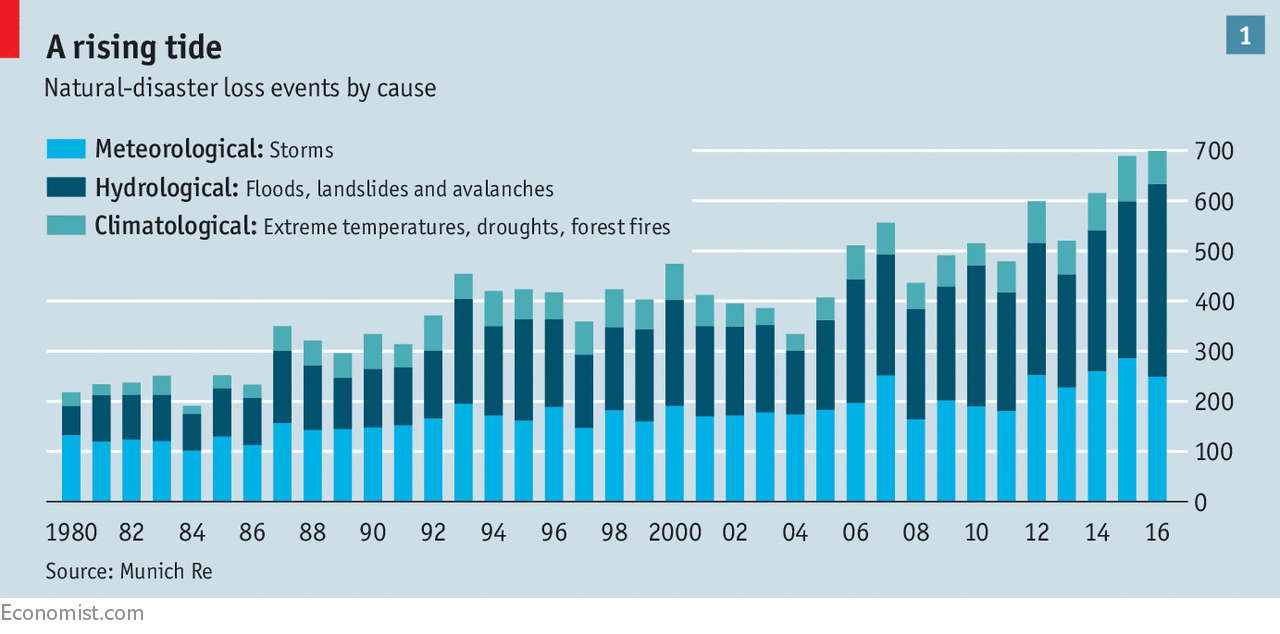
degree Celsius of warming, the atmosphere will hold 7% more moisture. In 1989 two Japanese researchers used computers to model this phenomenon and concluded that this wetter air would lead to more of the heaviest rains rather than, say, near-perpetual drizzle. It is thus no surprise that insurers see an increase in water-related disasters (see chart 1).
Call it any way you want. We are reaping what we have sown.




 . The EPA getting train wrecked! Oh.... and watching every green candidate in the last few midterm elections get their clock cleaned!


