Anti-Syrian Muslim Refugee Rhetoric Mirrors Calls to Reject Jews During Nazi Era
.
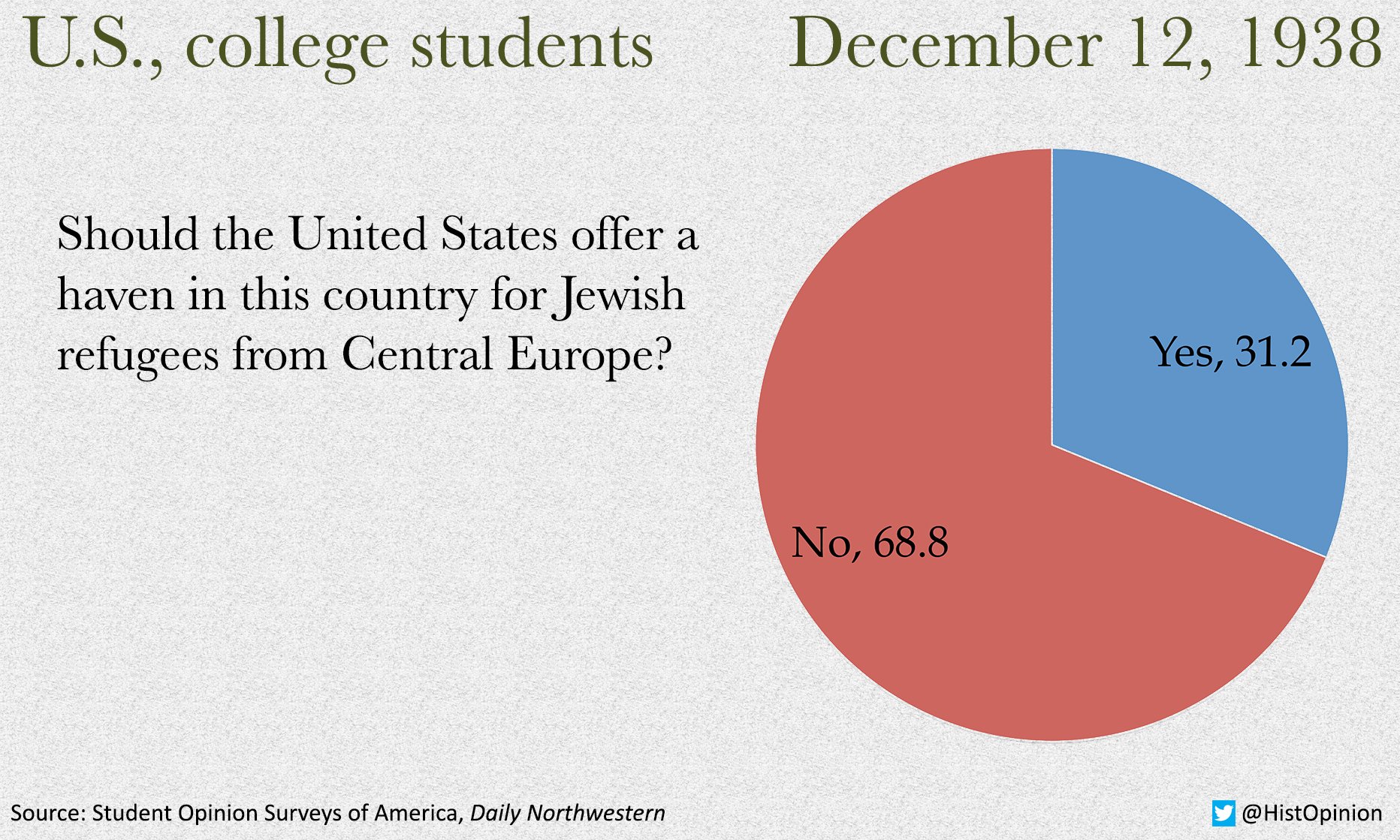
During the 1930s and early 1940s, the United States resisted accepting large numbers of Jewish refugees escaping the Nazi terror sweeping Europe, in large part because of fearmongering by a small but vocal crowd.
They claimed that the refugees were communist or anarchist infiltrators intent on spreading revolution; that refugees were part of a global Jewish-capitalist conspiracy to take control of the United States from the inside; that the refugees were either Nazis in disguise or under the influence of Nazi agents sent to commit acts of sabotage; and that Jewish refugees were out to steal American jobs.
Many rejected Jews simply because they weren’t Christian.
In recent days, similar arguments are being resurrected to reject Syrian refugees fleeing sectarian terrorists and civil war.
From talk radio to the blogosphere to leading American politicians, anti-Syrian rhetoric claims that refugees are simply ISIS
infiltrators; that migrants are Muslim invaders seeking to establish a “
global caliphate” and impose
Sharia law on America; and that Syrian refugees are lying about escaping violence and are focused instead on abusing the American
welfare system.
And in a rehash of history,
politicians are arguing that
only Christian, not Muslim, refugees from Syria should be welcomed.
Jews as dangerous revolutionaries and communists
“I have heard on good authority that an Executive order has given immigration authorities permission to let down the usual bars in favor of the so-called Jewish refugees from Germany,” declared Julia Cantacuzene,
a Republican activist in New York, according to a front page
New York Times article that ran on May 18, 1938. Cantacuzene, the granddaughter of President Ulysses Grant and an ardent opponent of President Franklin Roosevelt, claimed that the Soviet revolution occurred only because Communist agents had snuck into Russia to “instill their insidious poison onto the Russian people.” She claimed that the same would happen here: “Under these lax regulations, many Communists are coming to this country to join the ranks of those who hate our institutions and want to over throw them.”
During congressional debate in 1940, John B. Trevor, a prominent Capitol Hill lobbyist,
argued against a proposal to settle Jewish refugees in Alaska, claiming they would be potential enemies — and charging that Nazi persecution of the Jews had occurred “in very many cases … because of their beliefs in the Marxian philosophy.” Trevor had notably helped author the Immigration Act of 1924, a law designed to curb Jewish migration from Eastern Europe, in part because of anarchist Jewish Americans of Russian descent including Emma Goldman.
Rep. Jacob Thorkelson,
a Republican from Montana, warned at the time that Jewish migrants were part of an “invisible government,” an organization he said was tied to the “communistic Jew” and to “Jewish international financiers.”
William Dudley Pelley, a leading anti-Semite and organizer of the “Silver Shirts” nationalist group, claimed that Jewish migration was part of a Jewish-Communist conspiracy to seize control of the United States. Pelley, whose organization routinely used anti-Semitic smears such as “Yidisher Refugees” and “Refugees Kikes,” attracted up to 50,000 to his organization by 1934. James B. True, an anti-communist activist affiliated with the Silver Shirt movement, coined the term “refu-Jew” to mock refugees, according to researcher David S. Wyman, the author of
Paper Walls: America and the Refugee Crisis 1938-1941.
George Van Horn Moseley, a retired general active in Christian nationalist groups, traveled the country warning that Jews were financing a communist revolution, and that citizens should arm themselves for a coming confrontation. He also protested the resettlement of Jewish refugees and called for forced sterilization of refugees that had arrived in the country.


 I didn't see this person on this thread