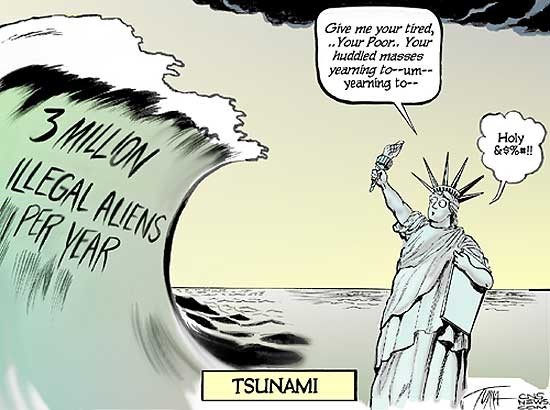
It remains ..... saying you'll get rid of illegals by going around and rounding them up is silly, stupid, and pretty much impossible. And it would cost billions. It could be done cost-free by simply penalizing companies that hire illegals. Add fines, it would become profitable! The illegals would leave of their own accord. But the Republicans won't do that, because they're all talk and nothing else.
I've long agreed with using e-verify and penalties for business. If you have a problem with the current policy I suggest you take it up with the establishment on both sides.
We are attempting to take out the trash, your side.............Not so much.
INS has said that they are now catching or turning back 80% or more of those who try to cross the southern border illegally.
At least half, and probably more now of the illegals who arrive here come legally with a valid visa. We already know who they are when they arrive. The problem is that they just don't leave when their visa time limit is up. We know who they are. We know that they haven't left when they were supposed to leave. We just have not put enough money in the budget to go and find them and send them home. Add another $25 billion to the federal budget and we might have enough to find most of them. Maybe we could simply raise the taxes on the people and companies who hire them to pay the bill?
On the GOP side some candidates have said they want e-verify..........Many have stated that the Border Patrol needs more funding and double to triple the agents................but I guess you don't notice that.
Show me the border control from the Dem candidates...........

The president's 2016 budget request: Customs and Border Protection
February 5, 2015 | By
Dibya Sarkar
SHARE
Comment
Customs and Border Protection, which has the largest budget among all components within the Homeland Security Department, would see a 6.3 percent jump – or about $800 million – under the president's recently unveiled 2016 budget proposal.
The agency, which is responsible for securing U.S. borders and ports of entry, is requesting $13.57 billion for next fiscal year. Of that total budget authority, $11.68 billion is discretionary spending.
Overall, the proposed 2016 budget for DHS is $41.2 billion, up from the estimated $38.2 billion for the current fiscal year. Since the department's 2015 spending plan hasn't been enacted, figures for this fiscal year reflect annualized levels provided by a continuing resolution, which expires Feb. 27.
 Sign up for our FREE newsletter for more news like this sent to your inbox!
Some chunks of the 2016 funding increase will go toward state-of-the art technology, security fencing and new aircraft. For example, about $85 million is earmarked for new non-intrusive inspection equipment such as X-ray/gamma-ray imaging systems that are used to inspect cargo at land and sea ports.
"The requested increase will fund recapitalization of aging systems, which currently include 314 large scale and 4,930 small scale systems," according to the a DHS budget summary (
pdf). "Without this funding increase, maintenance costs would rise, systems would become obsolete, system downtime would rise impacting the effectiveness of inspections, labor costs would increase, and the movement of legitimate trade and travel would be delayed due to the need for manual inspections."
More than $29 million is earmarked for a new program called the Electronic Visa Information Update System, or EVIUS, that will permit non-immigrant visa holders to provide updated biographic and travel information through a public website. CBP wants to pilot EVIUS for tourists and business travelers from China.
About $16 million would be used to buy and deploy at least 10 Mobile Surveillance Capability systems in some areas along the southern border. These MSC systems can provide detection, identification and tracking capabilities in an area, and can be relocated if threat patterns change, according to a DHS document (
pdf) about the systems.
Nearly $45 million will help CBP complete a high-priority fence project along the southwest border. The Naco Primary Fence Replacement Project would involve replacing about 7.5 miles of existing fence in an area that DHS said has been "successfully exploited" by transnational criminal organizations. The fence is located in a populated area and lacks adequate height, foundation and strength.
The budget also provides an increase of more than $44 million for two King Air-350CER Multi-Role Enforcement Aircraft, or MEAs. These MEAs can patrol and monitor land and water and are equipped with modern sensor equipment for detection, tracking and surveillance operations, according to a DHS document (
pdf) about the aircraft.
The agency also wants about $33 million to pay for more than 16,500 flight hours for fiscal 2016 to attain a total of of more than 91,000 flight hours for the year. CBP said the increase in flight hours is is needed to "support the highest priority operations along the southwest border." The money would pay for fuel, parts, supplies, repairs and maintenance, and contract support personnel, among other things.
CBP said it also needs about $29 million to deal with the apprehension and care of up to 104,000 unaccompanied children, most of whom crossed the U.S. border last year. Many were from Central America, fleeing poverty, crime and violence there. Since the agency has had custody of the children longer than expected, the money will go toward food, showers and laundry services, medical care and other services and items.
Additionally, the agency is asking for nearly $79 million to help reduce a backlog of maintenance and repair needs at several of its facilities and other properties. The money will also go toward installation or upgrade of security systems and other requirements at leased facilities.
For more:
-
download DHS's budget-in-brief document for 2016 (pdf)