News Nosh Summary:
Ceasefire gets stuck and Israel suffers the hardest day so far making top news in the Israeli papers today. Israel continues to pound the Gaza Strip, a building is hit near Tel-Aviv for the first time, Jerusalem gets another siren, and Yedioth offers some numbers.
Egyptian President Mohammed Morsi said Tuesday that the conflict would end later that day. The Egyptians are hosting and mediating the indirect negotiations between Israel and Hamas. German Foreign Minister Guido Westerwelle also was involved. He left Israel en route to Cairo yesterday, assumably to introduce amendments to the ceasefire agreement draft, Yedioth's diplomatic affairs correspondent Itamar Eichner wrote. Israel Hayom reported that Morsi also telephoned Iranian President Mahmoud Ahmadinejad to ask him to convince Islamic Jihad head Ramadan Salah to stop attacks on Israel. Hamas, wrote Israel Hayom, was furious because Salah was not being flexible in the talks and is making demands that even the Egyptians do not agree with.
Early yesterday evening, Hamas said a deal was struck and the ceasefire would be announced at 7PM and go into effect at 9PM. But an Israeli government spokesman Mark Regev said, "We're not there yet." Indeed, the ceasefire was delayed. According to Maariv and the Israelis, it was Hamas' fault. According to the nuanced analysis by Nahum Barnea, that is not completely true (see translation below). According to Haaretz, Israeli Prime Minister Binyamin Netanyahu and his Defense Minister Ehud Barak disagreed on the terms. A statement by Hamas and Islamic Jihad said that the imminent lull in the fighting was delayed at the last minute over 'Israeli requests.' One Israeli official told Haaretz that Egypt wants to see gains for Hamas. Maariv writes that Israel demands that a two-stage outline: first stopping the fire and only after will they get the perks.
Maariv's Gaza stringer, Sami Ajrami, wrote in a small piece on the bottom of page eight that all the talk in Gaza was about a ceasefire. "In the evening the conditions were released and at 10PM a press conference was supposed to take place during which it was to be officially announced. Everyone waited for (the ceasefire) to commence at midnight, they hoped. When it became clear that the announcement was delayed, the disappointment was great." Ajrami writes that people in Gaza understand that "Israel's air force has the upper hand and that the Israeli army can do whatever it wants. The hope of the residents is that tomorrow morning everything will change, there will be a ceasefire and it will be the last. That after that there won't be any more bombing. Until that happens, people are passing the time hoping they won't be hurt in the hours that are left."
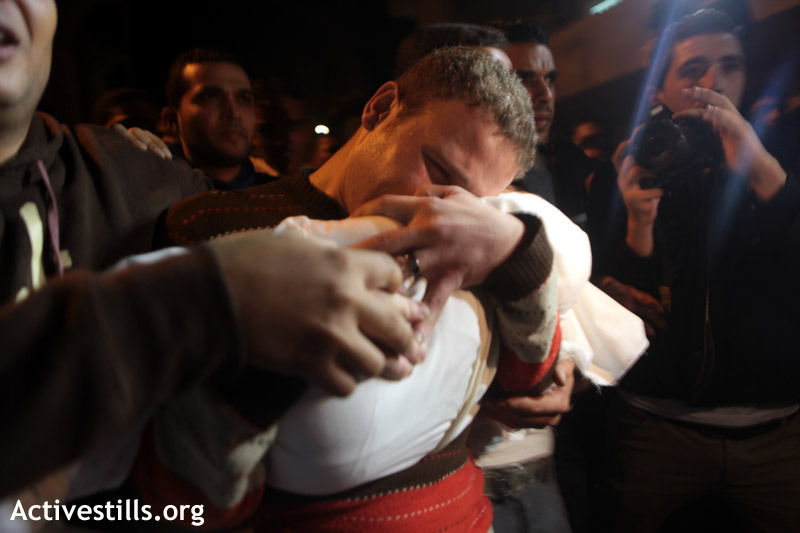
Meanwhile, all day while the back and forth of negotiations took place, Israel made a 'blitz' on Gaza with massive bombing of infrastructure, Maariv wrote. For the most part, Israeli press did not mention how many people were killed in Gaza. Ynet writes that the IDF identified the Islamic Jihad and the Popular Resistance Committees as the perpetrators of Tuesday morning's rocket fire, but that Hamas was responsible for the intense rocket salvo fired at Beersheva. "Despite the ongoing rocket fire, the IDF recognizes a reduction in its scope, noting that most of the rockets aimed at Ashdod and Ashkelon." The IDF also attacked the central bank in Gaza claiming it doubled as a Hamas headquarters. It also struck the homes of Hamas commanders at the levels of company and regiment commander, after shooting preliminary warning shots at the building, which residents were supposed to understand meant that an airstrike was imminent.
Islamic Jihad fired a rocket fired which landed between two Palestinian villages in the West Bank, south of Jerusalem. Some of the Israeli media reported it as if it were a shot on Jerusalem. The first direct hit on a house in the Gush Dan region (Tel-Aviv surroundings) made headlines. No one was hurt.
The papers reported that hundreds demonstrated in Beersheva, Ashkelon and Ashdod against a ceasefire. The demos were organized by students through social media networks and when they saw that few people had showed up, they moved to where the TV stations were broadcasting live and tried to voice their protests on camera while the reporters were giving their live reports, Maariv wrote.
Barak Ravid reported that for the first time, the state ceremony in memory of Israel's first prime minister, David Ben-Gurion, at his Negev kibbutz of Sde Boker, was held under a media blackout because of the concern that Hamas in Gaza would try to target the gravesite where senior Israeli officials gathered. "This may seem an insignificant anecdote, but it says something about the situation in which Israel finds itself at the end of a week of hostilities in the Gaza Strip and on the cusp of a potential cease-fire. When dozens of kilometers from Gaza, the prime minister of Israel was unable to speak live on Israeli television, it's difficult to convince the Israeli public that the Israeli military operation, Pillar of Defense, had been replete with success," writes Ravid.
Haaretz's Amos Harel and Avi Issacharoff write that neither Israel nor Hamas thinks a truce would last forever. Diplomats told them that the hope is for a couple of years of quiet. Indeed, the IDF Spokesman told Ynet that there is no operation that can restore calm 'once and for all.' And the normally war-mongering Foreign Minister Avigdor Lieberman told Ynet: "We can't invade Gaza before elections."
With all the soldiers lined up in waiting outside the rim of the Gaza Strip, it's no wonder that one was killed yesterday by a mortar and there were many complaints from reservists who say they are being used as pawns.