Michael Flynn, the retired Army lieutenant general and intelligence officer who is Donald Trump's pick to serve as his national security adviser, is a harsh critic of Muslim extremism and the religion itself, calling "radical Islam" an existential threat to the United States. In strident speeches and public comments, including a fiery address at the Republican National Convention, Flynn has aggressively argued that Islamic State militants pose a threat on a global scale and demanded a far more aggressive U.S. military campaign against the group. In a June interview with CNN, Flynn complained the U.S. needs to "discredit" radical Islam, but that "we're not allowed to do that right now." But his comments about Islam, a religion practiced by more than 1.5 billion people worldwide, have at times gone beyond condemning radicals inside the faith.
In Flynn's book, "The Field of Fight: How We Can Win the Global War Against Radical Islam and its Allies," he condemned U.S. leaders who have called Islam a religion of peace. "This insistence on denying the existence of jihad led President Obama to the absurd claim that the Islamic State has nothing to do with Islam," Flynn wrote. In August, he spoke at an event in Dallas hosted by the anti-Islamist group Act for America, calling Islam a "cancer" and a "political ideology" that "definitely hides behind being a religion." Muslim Advocates, a civil rights group based in California, said in a statement that Flynn's appointment "signals support for anti-Muslim policies and sentiment that will undermine our nation's security and exacerbate an already unsafe climate for Muslims and all Americans."
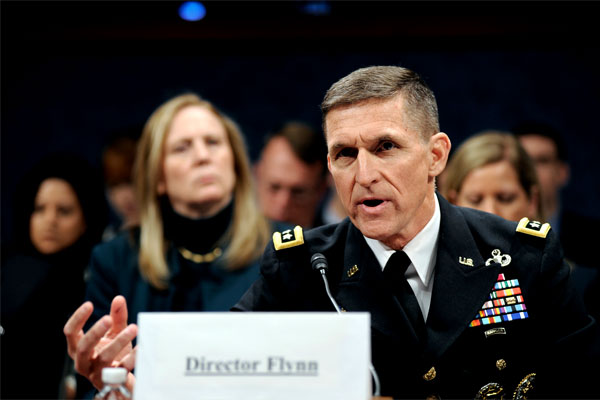
U.S. Army Lt. Gen. Michael Flynn testifies as director of the Defense Intelligence Agency at a Feb. 4, 2014 congressional hearing in Washington
The role of national security adviser has varied by administration, but usually centers on coordinating the policy positions of the secretaries of state, defense, justice and other members of a president's national security team. It is an especially powerful position because of the national security adviser's access to the president in the West Wing of the White House. The adviser acts as a gatekeeper on a wide range of issues, including matters of war and peace as well as diplomacy and intelligence.
Flynn, who turns 58 in December, served for more than three decades in the Army following his commissioning in 1981 as a second lieutenant in military intelligence. His career included a stint as director of intelligence for the Joint Chiefs of Staff and intelligence chief for the U.S.-led International Security Assistance Force in Afghanistan. It ended, however, when he was forced to resign from his post as head of the Defense Intelligence Agency in 2014 after two turbulent years leading the Pentagon's top spy agency.
MORE