Indigenous Palestinians Were JEWS

Status
Not open for further replies.
P F Tinmore, et al,

You did not properly use any of your presentation.

P F Tinmore, et al,

This is just a propaganda mantra to support the Hostile Palestinian Claim that Palestine is from the River to the Sea. Well, its not. Things change. And that claim is not a sufficient "just cause" for a jihad or war.

The questions.

• How far back in time are you accepting evidence of a culture with historical ties to the territory?
• How long does it take for a culture to be in place before it can be considered "Indigenous?"​

Good questions. Can occupations ever be considered indigenous?

Could you provide a link with your answer?
(COMMENT)

You still did not answer the questions.

An Occupation Power is "never" the same as the "indigenous population." The "Occupation Power" is the nation that has actually placed the territory under the authority for the hostile army. (Article 42 of the Hague Convention)

Indigenous population can be the Israelis that have establish a recognized state.

Most Respectfully,
R
So what if Israel has political recognition. It still occupies Palestine.
(COMMENT)

Call it what you will. But your protest is too much: There are two competing theories on sovereignty:
Sovereignty: Two Competing Theories of State Recognition – William Worster

International law is dominated by two competing theories of state recognition, with the “declaratory” view (It is the opposite of the constitutive theory in that it holds that recognition is almost irrelevant because states have little to no discretion in determining whether an entity constitutes a state. The status of statehood is based on fact, not on individual state discretion.) currently in prominence but possibly just beginning its decline in favor of the “constitutive” view (A state is only a state when it is recognized as such and other states have a considerable discretion to recognize or not.). However, if indeed the constitutive view is gaining ground, then its slow and partial re-emergence is forcing us to rethink the nature of the state in international law.
It so happens that in the case of the State of Israel, it meets the condition of both the "declarative" and "constitutive" views. "The majority of contemporary scholars and commentators favor this theory."(*)

(*) James L. Brierly, The Law of Nations: An Introduction to the International Law of Peace (Humphrey Waldock ed., 6th ed. 1963); Ti-Chiang Chen, The International Law of Recognition: With Special Reference to Practice in the United States (L. C. Green ed., 1951); Ian Brownlie, Principles of Public International Law (1990); D. J. Harris, Cases and Materials on International Law (1983).
Most Respectfully,
R
The declaratory theory is the one favored by international law.

The political existence of the state is independent of recognition by the other states. Even before recognition the state has the right to defend its integrity and independence,... ~ Montevideo​

Other principles I will reference is the qualifications of a state: a ) a permanent population; b ) a defined territory; c ) government; and d) capacity to enter into relations with the other states.

Popular sovereignty where the people are the sovereigns and the legitimacy of a government is derived from the consent of the people.

The universal rights of a people inside a defined territory: The right to self determination without external interference. The right to independence and sovereignty. The right to territorial integrity.

So, how do these principles apply to Israel and Palestine?

All of the territories ceded from Turkish rule were called successor states. Palestine's international borders were defined by post war treaties. The LoN considered Palestine to be a state. Palestine was called a country ten times in the Mandate charter. When Britain left Palestine it called Palestine a legal entity. Palestine would still exist but would not be independent because the administration was being passed to the UNPC. Britain could not and did not change the legal status of Palestine as it had no authority to do so.

What was said about a Jewish state? That a Jewish state would not be imposed on Palestine against the wishes of the people.

At the termination of the Mandate Palestine was still there. There was no Jewish state.

On May 15, 1948 the foreign Jewish Agency declared Israel's independence inside Palestine against the wishes of the vast majority of the people. It neither defined nor acquired any territory.

Now look at the Palestinian's declaration of independence.

PALESTINE PROGRESS REPORT OF THE UNITED NATIONS

MEDIATOR ON PALESTINE

CABLEGRAM DATED 28 SEPTEMBER 1948 FROM THE PREMIER AND
ACTING FOREIGN SECRETARY OF ALL-PALESTINE GOVERNMENT
TO THE SECRETARY-GENERAL CONCERNING
CONSTITUTION OF ALL-PALESTINE GOVERNMENT


28 September 1948


I HAVE THE HONOR TO INFORM YOUR EXCELLENCY THAT IN VIRTUE OF THE NATURAL RIGHT OF THE PEOPLE OF PALESTINE FOR SELF-DETERMINATION WHICH PRINCIPLE IS SUPPORTED BY THE CHARTERS OF THE LEAGUE OF NATIONS, THE UNITED NATIONS AND OTHERS AND IN VIEW OF THE TERMINATION OF THE BRITISH MANDATE OVER PALESTINE WHICH HAD PREVENTED THE ARABS FROM EXERCISING THEIR INDEPENDENCE, THE ARABS OF PALESTINE WHO ARE THE OWNERS OF THE COUNTRY AND ITS INDIGENOUS INHABITANTS AND WHO CONSTITUTE THE GREAT MAJORITY OF ITS LEGAL POPULATION HAVE SOLEMNLY RESOLVED TO DECLARE PALESTINE IN ITS ENTIRETY AND WITHIN ITS BOUNDARIES AS ESTABLISHED BEFORE THE TERMINATION OF THE BRITISH MANDATE AN INDEPENDENT STATE AND CONSTITUTED A GOVERNMENT UNDER THE NAME OF THE ALL-PALESTINE GOVERNMENT DERIVING ITS AUTHORITY FROM A REPRESENTATIVE COUNCIL BASED ON DEMOCRATIC PRINCIPLES AND AIMING TO SAFEGUARD THE RIGHTS OF MINORITIES AND FOREIGNERS PROTECT THE HOLY PLACES AND GUARANTEE FREEDOM OF WORSHIP TO ALL COMMUNITIES

AHMED HILMI PASHA
PREMIER AND ACTING FOREIGN SECRETARY​

All 100% legal and in complete compliance with all legal norms and the UN Charter. Even though recognition by other states was not required, five other countries recognized Palestine's independent state.

The 1949 UN armistice agreements recognized the continued existence of Palestine calling the land Palestine and referencing its unchanged international borders. There was no mention of a state called Israel. There was no mention of any land or borders for Israel.
(COMMENT)

The Montevideo Convention (first presentation) did not apply because the declaration was made AFTER the State of Israel was already established.

The Jewish National Council consisting of members of elected representatives of the Jewish Bodies, was the provisional government that declared independence.

The Jewish National Council DID exercise their right to self-determination; but with external interference from the Arab League defying the resolution of the General Assembly and engaged in a deliberate effort to alter by force the settlement envisaged therein.

A country does not confer sovereignty or independence. A country is a region that is identified as a distinct entity in political geography. The political entity was the establishment of Mandatory as the government. The Mandate said: "The Mandatory shall be responsible for exercising such supervision over religious or eleemosynary bodies of all faiths in Palestine as may be required for the maintenance of public order and good government."

The Armistice of Mudros, The Treaty of Sevres, and the Treaty of Lausanne, all agree that the Ottoman Empire and the Turkish Government did have the intent and purpose to "renounces all rights and title whatsoever over or respecting the territories situated outside the frontiers laid down in the present Treaty and the islands other than those over which her sovereignty is recognised by the said Treaty, the future of these territories and islands being settled or to be settled by the parties concerned." The parties concerned being the Allied Powers, not some nonexistent government of the Arabs. By the time the Treaty of Lausanne was signed (JULY 24, 1923), the Mandate and Civil Administration over the territory had been established by the Allied Powers.

The Jewish National Council DID make application to the 1948 successor government, the UN Palestine Commission, IAW with the Steps Preparatory to Independence of the Resolution.

You can believe what you will, the All Palestine Government did not act until three months after the Jewish National Council. Without regard to you interpretation of events, the debate over the territorials were not even issue until the application for admission was considered.

Finally, the Armistice Agreements were made between "ISRAEL" and the four adjacent Arab League nations. No arrangement was made between "ISRAEL" and any entity established by the All Palestine Government.

"He Who Can Destroy a Thing, Controls a Thing" (A quote from DUNE Frank Herbert) By Liberty1955 | Watertown, New York iCNN Report
It is a very applicable quote here and can be directly applied to the All Palestine Government. The APG was dissolved by the Egyptian Government in 1959. The Egypt (your foreign government) was the proponent for the APG. Where as the UN admitted Israel to membership in the United Nations in 1949.

(REALITY)

No matter what argument you present, the reality is that you can look at any contemporary Map and see that there is a physical manifestation called Israel. You can actually travel by air, sea or land, to the border of Israel, manned by Israel Border Police. You can check the record, there is a Resolution 273 (III) Titled the Admission of Israel to membership in the United Nations. And today you can see that there are actually treaties that replaced two of the four Armistice Agreements with Israel and established International Boundaries between the parties.

It is what it is.

I see nothing of a documented or physical nature that establishes or recognizes the State of Palestine until 1988. And that is NOT full recognition of a country that can stand alone. And I see a difference in what one Palestinian Faction may believe over another. Remember, the Western Border of the West Bank is not a permanent border, nor is it an Armistice Line.

Most Respectfully,
R
The Montevideo Convention (first presentation) did not apply because the declaration was made AFTER the State of Israel was already established.​

Palestine defined its territory. What part of that conflicted with Israel's defined territory?
 
P F Tinmore, et al,

You did not properly use any of your presentation.

P F Tinmore, et al,

This is just a propaganda mantra to support the Hostile Palestinian Claim that Palestine is from the River to the Sea. Well, its not. Things change. And that claim is not a sufficient "just cause" for a jihad or war.

(COMMENT)

You still did not answer the questions.

An Occupation Power is "never" the same as the "indigenous population." The "Occupation Power" is the nation that has actually placed the territory under the authority for the hostile army. (Article 42 of the Hague Convention)

Indigenous population can be the Israelis that have establish a recognized state.

Most Respectfully,
R
So what if Israel has political recognition. It still occupies Palestine.
(COMMENT)

Call it what you will. But your protest is too much: There are two competing theories on sovereignty:
Sovereignty: Two Competing Theories of State Recognition – William Worster

International law is dominated by two competing theories of state recognition, with the “declaratory” view (It is the opposite of the constitutive theory in that it holds that recognition is almost irrelevant because states have little to no discretion in determining whether an entity constitutes a state. The status of statehood is based on fact, not on individual state discretion.) currently in prominence but possibly just beginning its decline in favor of the “constitutive” view (A state is only a state when it is recognized as such and other states have a considerable discretion to recognize or not.). However, if indeed the constitutive view is gaining ground, then its slow and partial re-emergence is forcing us to rethink the nature of the state in international law.
It so happens that in the case of the State of Israel, it meets the condition of both the "declarative" and "constitutive" views. "The majority of contemporary scholars and commentators favor this theory."(*)

(*) James L. Brierly, The Law of Nations: An Introduction to the International Law of Peace (Humphrey Waldock ed., 6th ed. 1963); Ti-Chiang Chen, The International Law of Recognition: With Special Reference to Practice in the United States (L. C. Green ed., 1951); Ian Brownlie, Principles of Public International Law (1990); D. J. Harris, Cases and Materials on International Law (1983).
Most Respectfully,
R
The declaratory theory is the one favored by international law.

The political existence of the state is independent of recognition by the other states. Even before recognition the state has the right to defend its integrity and independence,... ~ Montevideo​

Other principles I will reference is the qualifications of a state: a ) a permanent population; b ) a defined territory; c ) government; and d) capacity to enter into relations with the other states.

Popular sovereignty where the people are the sovereigns and the legitimacy of a government is derived from the consent of the people.

The universal rights of a people inside a defined territory: The right to self determination without external interference. The right to independence and sovereignty. The right to territorial integrity.

So, how do these principles apply to Israel and Palestine?

All of the territories ceded from Turkish rule were called successor states. Palestine's international borders were defined by post war treaties. The LoN considered Palestine to be a state. Palestine was called a country ten times in the Mandate charter. When Britain left Palestine it called Palestine a legal entity. Palestine would still exist but would not be independent because the administration was being passed to the UNPC. Britain could not and did not change the legal status of Palestine as it had no authority to do so.

What was said about a Jewish state? That a Jewish state would not be imposed on Palestine against the wishes of the people.

At the termination of the Mandate Palestine was still there. There was no Jewish state.

On May 15, 1948 the foreign Jewish Agency declared Israel's independence inside Palestine against the wishes of the vast majority of the people. It neither defined nor acquired any territory.

Now look at the Palestinian's declaration of independence.

PALESTINE PROGRESS REPORT OF THE UNITED NATIONS

MEDIATOR ON PALESTINE

CABLEGRAM DATED 28 SEPTEMBER 1948 FROM THE PREMIER AND
ACTING FOREIGN SECRETARY OF ALL-PALESTINE GOVERNMENT
TO THE SECRETARY-GENERAL CONCERNING
CONSTITUTION OF ALL-PALESTINE GOVERNMENT


28 September 1948


I HAVE THE HONOR TO INFORM YOUR EXCELLENCY THAT IN VIRTUE OF THE NATURAL RIGHT OF THE PEOPLE OF PALESTINE FOR SELF-DETERMINATION WHICH PRINCIPLE IS SUPPORTED BY THE CHARTERS OF THE LEAGUE OF NATIONS, THE UNITED NATIONS AND OTHERS AND IN VIEW OF THE TERMINATION OF THE BRITISH MANDATE OVER PALESTINE WHICH HAD PREVENTED THE ARABS FROM EXERCISING THEIR INDEPENDENCE, THE ARABS OF PALESTINE WHO ARE THE OWNERS OF THE COUNTRY AND ITS INDIGENOUS INHABITANTS AND WHO CONSTITUTE THE GREAT MAJORITY OF ITS LEGAL POPULATION HAVE SOLEMNLY RESOLVED TO DECLARE PALESTINE IN ITS ENTIRETY AND WITHIN ITS BOUNDARIES AS ESTABLISHED BEFORE THE TERMINATION OF THE BRITISH MANDATE AN INDEPENDENT STATE AND CONSTITUTED A GOVERNMENT UNDER THE NAME OF THE ALL-PALESTINE GOVERNMENT DERIVING ITS AUTHORITY FROM A REPRESENTATIVE COUNCIL BASED ON DEMOCRATIC PRINCIPLES AND AIMING TO SAFEGUARD THE RIGHTS OF MINORITIES AND FOREIGNERS PROTECT THE HOLY PLACES AND GUARANTEE FREEDOM OF WORSHIP TO ALL COMMUNITIES

AHMED HILMI PASHA
PREMIER AND ACTING FOREIGN SECRETARY​

All 100% legal and in complete compliance with all legal norms and the UN Charter. Even though recognition by other states was not required, five other countries recognized Palestine's independent state.

The 1949 UN armistice agreements recognized the continued existence of Palestine calling the land Palestine and referencing its unchanged international borders. There was no mention of a state called Israel. There was no mention of any land or borders for Israel.
(COMMENT)

The Montevideo Convention (first presentation) did not apply because the declaration was made AFTER the State of Israel was already established.

The Jewish National Council consisting of members of elected representatives of the Jewish Bodies, was the provisional government that declared independence.

The Jewish National Council DID exercise their right to self-determination; but with external interference from the Arab League defying the resolution of the General Assembly and engaged in a deliberate effort to alter by force the settlement envisaged therein.

A country does not confer sovereignty or independence. A country is a region that is identified as a distinct entity in political geography. The political entity was the establishment of Mandatory as the government. The Mandate said: "The Mandatory shall be responsible for exercising such supervision over religious or eleemosynary bodies of all faiths in Palestine as may be required for the maintenance of public order and good government."

The Armistice of Mudros, The Treaty of Sevres, and the Treaty of Lausanne, all agree that the Ottoman Empire and the Turkish Government did have the intent and purpose to "renounces all rights and title whatsoever over or respecting the territories situated outside the frontiers laid down in the present Treaty and the islands other than those over which her sovereignty is recognised by the said Treaty, the future of these territories and islands being settled or to be settled by the parties concerned." The parties concerned being the Allied Powers, not some nonexistent government of the Arabs. By the time the Treaty of Lausanne was signed (JULY 24, 1923), the Mandate and Civil Administration over the territory had been established by the Allied Powers.

The Jewish National Council DID make application to the 1948 successor government, the UN Palestine Commission, IAW with the Steps Preparatory to Independence of the Resolution.

You can believe what you will, the All Palestine Government did not act until three months after the Jewish National Council. Without regard to you interpretation of events, the debate over the territorials were not even issue until the application for admission was considered.

Finally, the Armistice Agreements were made between "ISRAEL" and the four adjacent Arab League nations. No arrangement was made between "ISRAEL" and any entity established by the All Palestine Government.

"He Who Can Destroy a Thing, Controls a Thing" (A quote from DUNE Frank Herbert) By Liberty1955 | Watertown, New York iCNN Report
It is a very applicable quote here and can be directly applied to the All Palestine Government. The APG was dissolved by the Egyptian Government in 1959. The Egypt (your foreign government) was the proponent for the APG. Where as the UN admitted Israel to membership in the United Nations in 1949.

(REALITY)

No matter what argument you present, the reality is that you can look at any contemporary Map and see that there is a physical manifestation called Israel. You can actually travel by air, sea or land, to the border of Israel, manned by Israel Border Police. You can check the record, there is a Resolution 273 (III) Titled the Admission of Israel to membership in the United Nations. And today you can see that there are actually treaties that replaced two of the four Armistice Agreements with Israel and established International Boundaries between the parties.

It is what it is.

I see nothing of a documented or physical nature that establishes or recognizes the State of Palestine until 1988. And that is NOT full recognition of a country that can stand alone. And I see a difference in what one Palestinian Faction may believe over another. Remember, the Western Border of the West Bank is not a permanent border, nor is it an Armistice Line.

Most Respectfully,
R
The Montevideo Convention (first presentation) did not apply because the declaration was made AFTER the State of Israel was already established.​
Palestine defined its territory. What part of that conflicted with Israel's defined territory?
[yawn]
 
P F Tinmore, et al,

This is just a propaganda mantra to support the Hostile Palestinian Claim that Palestine is from the River to the Sea. Well, its not. Things change. And that claim is not a sufficient "just cause" for a jihad or war.

P F Tinmore, et al,

You did not answer the questions.

P F Tinmore, et al,

What is the definition of indigenous. Your asking for a definition for which I already said does not exist.

(COMMENT)

The Jewish immigration associate with the Balfour Declaration started nearly century ago. At what point are the Jewish people eligible to be called "indigenous" under your criteria. When, in the course of events, the Arab indigenous population ceases to be a population constituent of the region, and are replaced by the new constituent, is the new constituent the indigenous population? (Americans, for just over two hundred years, have controlled about four-fifths of America to date. At what point are the Americans indigenous to America?)

Israel the territory, for whatever reason, is dominated by Israelis. And the Arab, for whatever reason, have vacated the region. This is a scenario that has been played out a hundred times or more throughout the regional history. When do the Israeli become the "indigenous" population?

Of all the Arab Palestinians registered in the UNRWA CERI Database, how many actually lived in the territory now sovereign to Israel? They would have to be at least 67 years old. And how many will be left in 33 more years (100 years after Israeli Independence)? The number grows smaller all the time. Many of the registered refugees have more of a tie to the Refugee Camp than to any claim they might have had in Israel.

Who is indigenous to where?

Most Respectfully,
R
The questions.

• How far back in time are you accepting evidence of a culture with historical ties to the territory?
• How long does it take for a culture to be in place before it can be considered "Indigenous?"​

Good questions. Can occupations ever be considered indigenous?

Could you provide a link with your answer?
(COMMENT)

You still did not answer the questions.

An Occupation Power is "never" the same as the "indigenous population." The "Occupation Power" is the nation that has actually placed the territory under the authority for the hostile army. (Article 42 of the Hague Convention)

Indigenous population can be the Israelis that have establish a recognized state.

Most Respectfully,
R
So what if Israel has political recognition. It still occupies Palestine.
(COMMENT)

Call it what you will. But your protest is too much: There are two competing theories on sovereignty:
Sovereignty: Two Competing Theories of State Recognition – William Worster

International law is dominated by two competing theories of state recognition, with the “declaratory” view (It is the opposite of the constitutive theory in that it holds that recognition is almost irrelevant because states have little to no discretion in determining whether an entity constitutes a state. The status of statehood is based on fact, not on individual state discretion.) currently in prominence but possibly just beginning its decline in favor of the “constitutive” view (A state is only a state when it is recognized as such and other states have a considerable discretion to recognize or not.). However, if indeed the constitutive view is gaining ground, then its slow and partial re-emergence is forcing us to rethink the nature of the state in international law.
It so happens that in the case of the State of Israel, it meets the condition of both the "declarative" and "constitutive" views. "The majority of contemporary scholars and commentators favor this theory."(*)

(*) James L. Brierly, The Law of Nations: An Introduction to the International Law of Peace (Humphrey Waldock ed., 6th ed. 1963); Ti-Chiang Chen, The International Law of Recognition: With Special Reference to Practice in the United States (L. C. Green ed., 1951); Ian Brownlie, Principles of Public International Law (1990); D. J. Harris, Cases and Materials on International Law (1983).
Most Respectfully,
R
The declaratory theory is the one favored by international law.

The political existence of the state is independent of recognition by the other states. Even before recognition the state has the right to defend its integrity and independence,... ~ Montevideo​

Other principles I will reference is the qualifications of a state: a ) a permanent population; b ) a defined territory; c ) government; and d) capacity to enter into relations with the other states.

Popular sovereignty where the people are the sovereigns and the legitimacy of a government is derived from the consent of the people.

The universal rights of a people inside a defined territory: The right to self determination without external interference. The right to independence and sovereignty. The right to territorial integrity.

So, how do these principles apply to Israel and Palestine?

All of the territories ceded from Turkish rule were called successor states. Palestine's international borders were defined by post war treaties. The LoN considered Palestine to be a state. Palestine was called a country ten times in the Mandate charter. When Britain left Palestine it called Palestine a legal entity. Palestine would still exist but would not be independent because the administration was being passed to the UNPC. Britain could not and did not change the legal status of Palestine as it had no authority to do so.

What was said about a Jewish state? That a Jewish state would not be imposed on Palestine against the wishes of the people.

At the termination of the Mandate Palestine was still there. There was no Jewish state.

On May 15, 1948 the foreign Jewish Agency declared Israel's independence inside Palestine against the wishes of the vast majority of the people. It neither defined nor acquired any territory.

Now look at the Palestinian's declaration of independence.

PALESTINE PROGRESS REPORT OF THE UNITED NATIONS

MEDIATOR ON PALESTINE

CABLEGRAM DATED 28 SEPTEMBER 1948 FROM THE PREMIER AND
ACTING FOREIGN SECRETARY OF ALL-PALESTINE GOVERNMENT
TO THE SECRETARY-GENERAL CONCERNING
CONSTITUTION OF ALL-PALESTINE GOVERNMENT


28 September 1948


I HAVE THE HONOR TO INFORM YOUR EXCELLENCY THAT IN VIRTUE OF THE NATURAL RIGHT OF THE PEOPLE OF PALESTINE FOR SELF-DETERMINATION WHICH PRINCIPLE IS SUPPORTED BY THE CHARTERS OF THE LEAGUE OF NATIONS, THE UNITED NATIONS AND OTHERS AND IN VIEW OF THE TERMINATION OF THE BRITISH MANDATE OVER PALESTINE WHICH HAD PREVENTED THE ARABS FROM EXERCISING THEIR INDEPENDENCE, THE ARABS OF PALESTINE WHO ARE THE OWNERS OF THE COUNTRY AND ITS INDIGENOUS INHABITANTS AND WHO CONSTITUTE THE GREAT MAJORITY OF ITS LEGAL POPULATION HAVE SOLEMNLY RESOLVED TO DECLARE PALESTINE IN ITS ENTIRETY AND WITHIN ITS BOUNDARIES AS ESTABLISHED BEFORE THE TERMINATION OF THE BRITISH MANDATE AN INDEPENDENT STATE AND CONSTITUTED A GOVERNMENT UNDER THE NAME OF THE ALL-PALESTINE GOVERNMENT DERIVING ITS AUTHORITY FROM A REPRESENTATIVE COUNCIL BASED ON DEMOCRATIC PRINCIPLES AND AIMING TO SAFEGUARD THE RIGHTS OF MINORITIES AND FOREIGNERS PROTECT THE HOLY PLACES AND GUARANTEE FREEDOM OF WORSHIP TO ALL COMMUNITIES

AHMED HILMI PASHA
PREMIER AND ACTING FOREIGN SECRETARY​

All 100% legal and in complete compliance with all legal norms and the UN Charter. Even though recognition by other states was not required, five other countries recognized Palestine's independent state.

The 1949 UN armistice agreements recognized the continued existence of Palestine calling the land Palestine and referencing its unchanged international borders. There was no mention of a state called Israel. There was no mention of any land or borders for Israel.


So who signed the treaty, that only applied to the nations that were present, for the Palestinians ? You can hide behand stupidity all you want it wont make any difference.
As for the declaration it was by a foreign group of arab league leaders that only controlled gaza for a short period of time. They tried to declare on land already accepted by the UN as being Israel. The gaza group had no authority from the Palestinian people of Jordan who had already accepted Jordanian rule. Read those armistice treaties again and you see that Israel is mentioned in the titles, but Palestine as a nation is not. You see it was Palestine as a mandate that the treaties referred to and the full title of THE MANDATE FOR PALESTINE was truncated in the first treaty to Palestine, and this was spelt out in the treaty. This became common usage and carried on until the present day. All the links you produce all say the same thing and this is why you are confused. The nation of Palestine did not exist in name until 1988.

By the way look at the UN reply to the letter to see why it was denied.
 
P F Tinmore, et al,

You did not properly use any of your presentation.

P F Tinmore, et al,

This is just a propaganda mantra to support the Hostile Palestinian Claim that Palestine is from the River to the Sea. Well, its not. Things change. And that claim is not a sufficient "just cause" for a jihad or war.

(COMMENT)

You still did not answer the questions.

An Occupation Power is "never" the same as the "indigenous population." The "Occupation Power" is the nation that has actually placed the territory under the authority for the hostile army. (Article 42 of the Hague Convention)

Indigenous population can be the Israelis that have establish a recognized state.

Most Respectfully,
R
So what if Israel has political recognition. It still occupies Palestine.
(COMMENT)

Call it what you will. But your protest is too much: There are two competing theories on sovereignty:
Sovereignty: Two Competing Theories of State Recognition – William Worster

International law is dominated by two competing theories of state recognition, with the “declaratory” view (It is the opposite of the constitutive theory in that it holds that recognition is almost irrelevant because states have little to no discretion in determining whether an entity constitutes a state. The status of statehood is based on fact, not on individual state discretion.) currently in prominence but possibly just beginning its decline in favor of the “constitutive” view (A state is only a state when it is recognized as such and other states have a considerable discretion to recognize or not.). However, if indeed the constitutive view is gaining ground, then its slow and partial re-emergence is forcing us to rethink the nature of the state in international law.
It so happens that in the case of the State of Israel, it meets the condition of both the "declarative" and "constitutive" views. "The majority of contemporary scholars and commentators favor this theory."(*)

(*) James L. Brierly, The Law of Nations: An Introduction to the International Law of Peace (Humphrey Waldock ed., 6th ed. 1963); Ti-Chiang Chen, The International Law of Recognition: With Special Reference to Practice in the United States (L. C. Green ed., 1951); Ian Brownlie, Principles of Public International Law (1990); D. J. Harris, Cases and Materials on International Law (1983).
Most Respectfully,
R
The declaratory theory is the one favored by international law.

The political existence of the state is independent of recognition by the other states. Even before recognition the state has the right to defend its integrity and independence,... ~ Montevideo​

Other principles I will reference is the qualifications of a state: a ) a permanent population; b ) a defined territory; c ) government; and d) capacity to enter into relations with the other states.

Popular sovereignty where the people are the sovereigns and the legitimacy of a government is derived from the consent of the people.

The universal rights of a people inside a defined territory: The right to self determination without external interference. The right to independence and sovereignty. The right to territorial integrity.

So, how do these principles apply to Israel and Palestine?

All of the territories ceded from Turkish rule were called successor states. Palestine's international borders were defined by post war treaties. The LoN considered Palestine to be a state. Palestine was called a country ten times in the Mandate charter. When Britain left Palestine it called Palestine a legal entity. Palestine would still exist but would not be independent because the administration was being passed to the UNPC. Britain could not and did not change the legal status of Palestine as it had no authority to do so.

What was said about a Jewish state? That a Jewish state would not be imposed on Palestine against the wishes of the people.

At the termination of the Mandate Palestine was still there. There was no Jewish state.

On May 15, 1948 the foreign Jewish Agency declared Israel's independence inside Palestine against the wishes of the vast majority of the people. It neither defined nor acquired any territory.

Now look at the Palestinian's declaration of independence.

PALESTINE PROGRESS REPORT OF THE UNITED NATIONS

MEDIATOR ON PALESTINE

CABLEGRAM DATED 28 SEPTEMBER 1948 FROM THE PREMIER AND
ACTING FOREIGN SECRETARY OF ALL-PALESTINE GOVERNMENT
TO THE SECRETARY-GENERAL CONCERNING
CONSTITUTION OF ALL-PALESTINE GOVERNMENT


28 September 1948


I HAVE THE HONOR TO INFORM YOUR EXCELLENCY THAT IN VIRTUE OF THE NATURAL RIGHT OF THE PEOPLE OF PALESTINE FOR SELF-DETERMINATION WHICH PRINCIPLE IS SUPPORTED BY THE CHARTERS OF THE LEAGUE OF NATIONS, THE UNITED NATIONS AND OTHERS AND IN VIEW OF THE TERMINATION OF THE BRITISH MANDATE OVER PALESTINE WHICH HAD PREVENTED THE ARABS FROM EXERCISING THEIR INDEPENDENCE, THE ARABS OF PALESTINE WHO ARE THE OWNERS OF THE COUNTRY AND ITS INDIGENOUS INHABITANTS AND WHO CONSTITUTE THE GREAT MAJORITY OF ITS LEGAL POPULATION HAVE SOLEMNLY RESOLVED TO DECLARE PALESTINE IN ITS ENTIRETY AND WITHIN ITS BOUNDARIES AS ESTABLISHED BEFORE THE TERMINATION OF THE BRITISH MANDATE AN INDEPENDENT STATE AND CONSTITUTED A GOVERNMENT UNDER THE NAME OF THE ALL-PALESTINE GOVERNMENT DERIVING ITS AUTHORITY FROM A REPRESENTATIVE COUNCIL BASED ON DEMOCRATIC PRINCIPLES AND AIMING TO SAFEGUARD THE RIGHTS OF MINORITIES AND FOREIGNERS PROTECT THE HOLY PLACES AND GUARANTEE FREEDOM OF WORSHIP TO ALL COMMUNITIES

AHMED HILMI PASHA
PREMIER AND ACTING FOREIGN SECRETARY​

All 100% legal and in complete compliance with all legal norms and the UN Charter. Even though recognition by other states was not required, five other countries recognized Palestine's independent state.

The 1949 UN armistice agreements recognized the continued existence of Palestine calling the land Palestine and referencing its unchanged international borders. There was no mention of a state called Israel. There was no mention of any land or borders for Israel.
(COMMENT)

The Montevideo Convention (first presentation) did not apply because the declaration was made AFTER the State of Israel was already established.

The Jewish National Council consisting of members of elected representatives of the Jewish Bodies, was the provisional government that declared independence.

The Jewish National Council DID exercise their right to self-determination; but with external interference from the Arab League defying the resolution of the General Assembly and engaged in a deliberate effort to alter by force the settlement envisaged therein.

A country does not confer sovereignty or independence. A country is a region that is identified as a distinct entity in political geography. The political entity was the establishment of Mandatory as the government. The Mandate said: "The Mandatory shall be responsible for exercising such supervision over religious or eleemosynary bodies of all faiths in Palestine as may be required for the maintenance of public order and good government."

The Armistice of Mudros, The Treaty of Sevres, and the Treaty of Lausanne, all agree that the Ottoman Empire and the Turkish Government did have the intent and purpose to "renounces all rights and title whatsoever over or respecting the territories situated outside the frontiers laid down in the present Treaty and the islands other than those over which her sovereignty is recognised by the said Treaty, the future of these territories and islands being settled or to be settled by the parties concerned." The parties concerned being the Allied Powers, not some nonexistent government of the Arabs. By the time the Treaty of Lausanne was signed (JULY 24, 1923), the Mandate and Civil Administration over the territory had been established by the Allied Powers.

The Jewish National Council DID make application to the 1948 successor government, the UN Palestine Commission, IAW with the Steps Preparatory to Independence of the Resolution.

You can believe what you will, the All Palestine Government did not act until three months after the Jewish National Council. Without regard to you interpretation of events, the debate over the territorials were not even issue until the application for admission was considered.

Finally, the Armistice Agreements were made between "ISRAEL" and the four adjacent Arab League nations. No arrangement was made between "ISRAEL" and any entity established by the All Palestine Government.

"He Who Can Destroy a Thing, Controls a Thing" (A quote from DUNE Frank Herbert) By Liberty1955 | Watertown, New York iCNN Report
It is a very applicable quote here and can be directly applied to the All Palestine Government. The APG was dissolved by the Egyptian Government in 1959. The Egypt (your foreign government) was the proponent for the APG. Where as the UN admitted Israel to membership in the United Nations in 1949.

(REALITY)

No matter what argument you present, the reality is that you can look at any contemporary Map and see that there is a physical manifestation called Israel. You can actually travel by air, sea or land, to the border of Israel, manned by Israel Border Police. You can check the record, there is a Resolution 273 (III) Titled the Admission of Israel to membership in the United Nations. And today you can see that there are actually treaties that replaced two of the four Armistice Agreements with Israel and established International Boundaries between the parties.

It is what it is.

I see nothing of a documented or physical nature that establishes or recognizes the State of Palestine until 1988. And that is NOT full recognition of a country that can stand alone. And I see a difference in what one Palestinian Faction may believe over another. Remember, the Western Border of the West Bank is not a permanent border, nor is it an Armistice Line.

Most Respectfully,
R
The Montevideo Convention (first presentation) did not apply because the declaration was made AFTER the State of Israel was already established.​

Palestine defined its territory. What part of that conflicted with Israel's defined territory?
Your prior cut and paste refutes your newer slobbering that "Palestine defined its territory".
 
P F Tinmore, et al,

You did not properly use any of your presentation.

P F Tinmore, et al,

This is just a propaganda mantra to support the Hostile Palestinian Claim that Palestine is from the River to the Sea. Well, its not. Things change. And that claim is not a sufficient "just cause" for a jihad or war.

(COMMENT)

You still did not answer the questions.

An Occupation Power is "never" the same as the "indigenous population." The "Occupation Power" is the nation that has actually placed the territory under the authority for the hostile army. (Article 42 of the Hague Convention)

Indigenous population can be the Israelis that have establish a recognized state.

Most Respectfully,
R
So what if Israel has political recognition. It still occupies Palestine.
(COMMENT)

Call it what you will. But your protest is too much: There are two competing theories on sovereignty:
Sovereignty: Two Competing Theories of State Recognition – William Worster

International law is dominated by two competing theories of state recognition, with the “declaratory” view (It is the opposite of the constitutive theory in that it holds that recognition is almost irrelevant because states have little to no discretion in determining whether an entity constitutes a state. The status of statehood is based on fact, not on individual state discretion.) currently in prominence but possibly just beginning its decline in favor of the “constitutive” view (A state is only a state when it is recognized as such and other states have a considerable discretion to recognize or not.). However, if indeed the constitutive view is gaining ground, then its slow and partial re-emergence is forcing us to rethink the nature of the state in international law.
It so happens that in the case of the State of Israel, it meets the condition of both the "declarative" and "constitutive" views. "The majority of contemporary scholars and commentators favor this theory."(*)

(*) James L. Brierly, The Law of Nations: An Introduction to the International Law of Peace (Humphrey Waldock ed., 6th ed. 1963); Ti-Chiang Chen, The International Law of Recognition: With Special Reference to Practice in the United States (L. C. Green ed., 1951); Ian Brownlie, Principles of Public International Law (1990); D. J. Harris, Cases and Materials on International Law (1983).
Most Respectfully,
R
The declaratory theory is the one favored by international law.

The political existence of the state is independent of recognition by the other states. Even before recognition the state has the right to defend its integrity and independence,... ~ Montevideo​

Other principles I will reference is the qualifications of a state: a ) a permanent population; b ) a defined territory; c ) government; and d) capacity to enter into relations with the other states.

Popular sovereignty where the people are the sovereigns and the legitimacy of a government is derived from the consent of the people.

The universal rights of a people inside a defined territory: The right to self determination without external interference. The right to independence and sovereignty. The right to territorial integrity.

So, how do these principles apply to Israel and Palestine?

All of the territories ceded from Turkish rule were called successor states. Palestine's international borders were defined by post war treaties. The LoN considered Palestine to be a state. Palestine was called a country ten times in the Mandate charter. When Britain left Palestine it called Palestine a legal entity. Palestine would still exist but would not be independent because the administration was being passed to the UNPC. Britain could not and did not change the legal status of Palestine as it had no authority to do so.

What was said about a Jewish state? That a Jewish state would not be imposed on Palestine against the wishes of the people.

At the termination of the Mandate Palestine was still there. There was no Jewish state.

On May 15, 1948 the foreign Jewish Agency declared Israel's independence inside Palestine against the wishes of the vast majority of the people. It neither defined nor acquired any territory.

Now look at the Palestinian's declaration of independence.

PALESTINE PROGRESS REPORT OF THE UNITED NATIONS

MEDIATOR ON PALESTINE

CABLEGRAM DATED 28 SEPTEMBER 1948 FROM THE PREMIER AND
ACTING FOREIGN SECRETARY OF ALL-PALESTINE GOVERNMENT
TO THE SECRETARY-GENERAL CONCERNING
CONSTITUTION OF ALL-PALESTINE GOVERNMENT


28 September 1948


I HAVE THE HONOR TO INFORM YOUR EXCELLENCY THAT IN VIRTUE OF THE NATURAL RIGHT OF THE PEOPLE OF PALESTINE FOR SELF-DETERMINATION WHICH PRINCIPLE IS SUPPORTED BY THE CHARTERS OF THE LEAGUE OF NATIONS, THE UNITED NATIONS AND OTHERS AND IN VIEW OF THE TERMINATION OF THE BRITISH MANDATE OVER PALESTINE WHICH HAD PREVENTED THE ARABS FROM EXERCISING THEIR INDEPENDENCE, THE ARABS OF PALESTINE WHO ARE THE OWNERS OF THE COUNTRY AND ITS INDIGENOUS INHABITANTS AND WHO CONSTITUTE THE GREAT MAJORITY OF ITS LEGAL POPULATION HAVE SOLEMNLY RESOLVED TO DECLARE PALESTINE IN ITS ENTIRETY AND WITHIN ITS BOUNDARIES AS ESTABLISHED BEFORE THE TERMINATION OF THE BRITISH MANDATE AN INDEPENDENT STATE AND CONSTITUTED A GOVERNMENT UNDER THE NAME OF THE ALL-PALESTINE GOVERNMENT DERIVING ITS AUTHORITY FROM A REPRESENTATIVE COUNCIL BASED ON DEMOCRATIC PRINCIPLES AND AIMING TO SAFEGUARD THE RIGHTS OF MINORITIES AND FOREIGNERS PROTECT THE HOLY PLACES AND GUARANTEE FREEDOM OF WORSHIP TO ALL COMMUNITIES

AHMED HILMI PASHA
PREMIER AND ACTING FOREIGN SECRETARY​

All 100% legal and in complete compliance with all legal norms and the UN Charter. Even though recognition by other states was not required, five other countries recognized Palestine's independent state.

The 1949 UN armistice agreements recognized the continued existence of Palestine calling the land Palestine and referencing its unchanged international borders. There was no mention of a state called Israel. There was no mention of any land or borders for Israel.
(COMMENT)

The Montevideo Convention (first presentation) did not apply because the declaration was made AFTER the State of Israel was already established.

The Jewish National Council consisting of members of elected representatives of the Jewish Bodies, was the provisional government that declared independence.

The Jewish National Council DID exercise their right to self-determination; but with external interference from the Arab League defying the resolution of the General Assembly and engaged in a deliberate effort to alter by force the settlement envisaged therein.

A country does not confer sovereignty or independence. A country is a region that is identified as a distinct entity in political geography. The political entity was the establishment of Mandatory as the government. The Mandate said: "The Mandatory shall be responsible for exercising such supervision over religious or eleemosynary bodies of all faiths in Palestine as may be required for the maintenance of public order and good government."

The Armistice of Mudros, The Treaty of Sevres, and the Treaty of Lausanne, all agree that the Ottoman Empire and the Turkish Government did have the intent and purpose to "renounces all rights and title whatsoever over or respecting the territories situated outside the frontiers laid down in the present Treaty and the islands other than those over which her sovereignty is recognised by the said Treaty, the future of these territories and islands being settled or to be settled by the parties concerned." The parties concerned being the Allied Powers, not some nonexistent government of the Arabs. By the time the Treaty of Lausanne was signed (JULY 24, 1923), the Mandate and Civil Administration over the territory had been established by the Allied Powers.

The Jewish National Council DID make application to the 1948 successor government, the UN Palestine Commission, IAW with the Steps Preparatory to Independence of the Resolution.

You can believe what you will, the All Palestine Government did not act until three months after the Jewish National Council. Without regard to you interpretation of events, the debate over the territorials were not even issue until the application for admission was considered.

Finally, the Armistice Agreements were made between "ISRAEL" and the four adjacent Arab League nations. No arrangement was made between "ISRAEL" and any entity established by the All Palestine Government.

"He Who Can Destroy a Thing, Controls a Thing" (A quote from DUNE Frank Herbert) By Liberty1955 | Watertown, New York iCNN Report
It is a very applicable quote here and can be directly applied to the All Palestine Government. The APG was dissolved by the Egyptian Government in 1959. The Egypt (your foreign government) was the proponent for the APG. Where as the UN admitted Israel to membership in the United Nations in 1949.

(REALITY)

No matter what argument you present, the reality is that you can look at any contemporary Map and see that there is a physical manifestation called Israel. You can actually travel by air, sea or land, to the border of Israel, manned by Israel Border Police. You can check the record, there is a Resolution 273 (III) Titled the Admission of Israel to membership in the United Nations. And today you can see that there are actually treaties that replaced two of the four Armistice Agreements with Israel and established International Boundaries between the parties.

It is what it is.

I see nothing of a documented or physical nature that establishes or recognizes the State of Palestine until 1988. And that is NOT full recognition of a country that can stand alone. And I see a difference in what one Palestinian Faction may believe over another. Remember, the Western Border of the West Bank is not a permanent border, nor is it an Armistice Line.

Most Respectfully,
R
The Montevideo Convention (first presentation) did not apply because the declaration was made AFTER the State of Israel was already established.​

Palestine defined its territory. What part of that conflicted with Israel's defined territory?


Because it defined the 22% of Palestine in its entirety after Israel had also declared independence. If this was accepted then I could have declared independence on the same land 3 months after the gaza group did and stirred up the hornets nest
 
P F Tinmore, et al,

Defined Territory was discussed in the "declarations and explanations" references to A/RES/273 (III).

P F Tinmore, et al,

(COMMENT)

The Montevideo Convention (first presentation) did not apply because the declaration was made AFTER the State of Israel was already established.
Palestine defined its territory. What part of that conflicted with Israel's defined territory?
(COMMENT)

The original Declaration of Independence (14/15/MAY 48) was under the Resolution adopted by General Assembly [181 (II)] as it was outline in Part II Section B --- The Jewish State. That was the initial condition at the opening of the 1948 War as initiated by the Arab League Forces as supplemented by the the Irregular Forces (Arab Liberation Army and the Holy War Army).

The altered conditions, as set by the combat outcomes, wherein the Armistice Arrangements (Green Line) traced the FEBA (Forward Edge of the Battle Area) and would remain in force until a peaceful settlement between the Parties is achieved. Israel reached Peaceful Settlements with Jordan (A/50/73 S/1995/83 27 January 1995) and Egypt (Peace Treaty) which reset the international boundary between Israel and Jordan in Article III and the permanent boundary between Egypt and Israel in Article II. Both boundaries were declared the "recognized international boundary."

To date, neither the Lebanese, Syrians, or Palestinians have entered good faith negotiation to establish a permanent peace on appropriate boundaries. The Palestinian Liberation Organization (PLO) did (unilaterally) make public its recognition that "[t]he 1967 border is the internationally-recognized border between Israel and the oPt;" not further identified. For all intent and practical purposes, [t]he Green Line is the boundary with the Palestinian territories; with the exception of East Jerusalem, which Israel annexed after capturing it in the Six-Day War of 1967.

The PLO, in an exchange of letters between the Prime Minister of Israel and the Chairman of the PLO, confirmed that the "PLO recognizes the right of the State of Israel to exist in peace and security." How valid this affirmation is today, is anyone's guess.


NEW YORK CITY (CNN) — Palestinian Authority President Mahmoud Abbas accused Israel of not committing to peace agreements known as the Oslo Accords and declared that Palestinians "cannot continue to be bound by these agreements."

"We therefore declare that we cannot continue to be bound by these agreements (Oslo Accords) and that Israel must assume all of its responsibilities as an occupying power, because the status quo cannot continue," Abbas said.

Most Respectfully,
R
 
P F Tinmore, et al,

This is just a propaganda mantra to support the Hostile Palestinian Claim that Palestine is from the River to the Sea. Well, its not. Things change. And that claim is not a sufficient "just cause" for a jihad or war.

The questions.

• How far back in time are you accepting evidence of a culture with historical ties to the territory?
• How long does it take for a culture to be in place before it can be considered "Indigenous?"​

Good questions. Can occupations ever be considered indigenous?

Could you provide a link with your answer?
(COMMENT)

You still did not answer the questions.

An Occupation Power is "never" the same as the "indigenous population." The "Occupation Power" is the nation that has actually placed the territory under the authority for the hostile army. (Article 42 of the Hague Convention)

Indigenous population can be the Israelis that have establish a recognized state.

Most Respectfully,
R
So what if Israel has political recognition. It still occupies Palestine.
(COMMENT)

Call it what you will. But your protest is too much: There are two competing theories on sovereignty:
Sovereignty: Two Competing Theories of State Recognition – William Worster

International law is dominated by two competing theories of state recognition, with the “declaratory” view (It is the opposite of the constitutive theory in that it holds that recognition is almost irrelevant because states have little to no discretion in determining whether an entity constitutes a state. The status of statehood is based on fact, not on individual state discretion.) currently in prominence but possibly just beginning its decline in favor of the “constitutive” view (A state is only a state when it is recognized as such and other states have a considerable discretion to recognize or not.). However, if indeed the constitutive view is gaining ground, then its slow and partial re-emergence is forcing us to rethink the nature of the state in international law.
It so happens that in the case of the State of Israel, it meets the condition of both the "declarative" and "constitutive" views. "The majority of contemporary scholars and commentators favor this theory."(*)

(*) James L. Brierly, The Law of Nations: An Introduction to the International Law of Peace (Humphrey Waldock ed., 6th ed. 1963); Ti-Chiang Chen, The International Law of Recognition: With Special Reference to Practice in the United States (L. C. Green ed., 1951); Ian Brownlie, Principles of Public International Law (1990); D. J. Harris, Cases and Materials on International Law (1983).
Most Respectfully,
R
The declaratory theory is the one favored by international law.

The political existence of the state is independent of recognition by the other states. Even before recognition the state has the right to defend its integrity and independence,... ~ Montevideo​

Other principles I will reference is the qualifications of a state: a ) a permanent population; b ) a defined territory; c ) government; and d) capacity to enter into relations with the other states.

Popular sovereignty where the people are the sovereigns and the legitimacy of a government is derived from the consent of the people.

The universal rights of a people inside a defined territory: The right to self determination without external interference. The right to independence and sovereignty. The right to territorial integrity.

So, how do these principles apply to Israel and Palestine?

All of the territories ceded from Turkish rule were called successor states. Palestine's international borders were defined by post war treaties. The LoN considered Palestine to be a state. Palestine was called a country ten times in the Mandate charter. When Britain left Palestine it called Palestine a legal entity. Palestine would still exist but would not be independent because the administration was being passed to the UNPC. Britain could not and did not change the legal status of Palestine as it had no authority to do so.

What was said about a Jewish state? That a Jewish state would not be imposed on Palestine against the wishes of the people.

At the termination of the Mandate Palestine was still there. There was no Jewish state.

On May 15, 1948 the foreign Jewish Agency declared Israel's independence inside Palestine against the wishes of the vast majority of the people. It neither defined nor acquired any territory.

Now look at the Palestinian's declaration of independence.

PALESTINE PROGRESS REPORT OF THE UNITED NATIONS

MEDIATOR ON PALESTINE

CABLEGRAM DATED 28 SEPTEMBER 1948 FROM THE PREMIER AND
ACTING FOREIGN SECRETARY OF ALL-PALESTINE GOVERNMENT
TO THE SECRETARY-GENERAL CONCERNING
CONSTITUTION OF ALL-PALESTINE GOVERNMENT


28 September 1948


I HAVE THE HONOR TO INFORM YOUR EXCELLENCY THAT IN VIRTUE OF THE NATURAL RIGHT OF THE PEOPLE OF PALESTINE FOR SELF-DETERMINATION WHICH PRINCIPLE IS SUPPORTED BY THE CHARTERS OF THE LEAGUE OF NATIONS, THE UNITED NATIONS AND OTHERS AND IN VIEW OF THE TERMINATION OF THE BRITISH MANDATE OVER PALESTINE WHICH HAD PREVENTED THE ARABS FROM EXERCISING THEIR INDEPENDENCE, THE ARABS OF PALESTINE WHO ARE THE OWNERS OF THE COUNTRY AND ITS INDIGENOUS INHABITANTS AND WHO CONSTITUTE THE GREAT MAJORITY OF ITS LEGAL POPULATION HAVE SOLEMNLY RESOLVED TO DECLARE PALESTINE IN ITS ENTIRETY AND WITHIN ITS BOUNDARIES AS ESTABLISHED BEFORE THE TERMINATION OF THE BRITISH MANDATE AN INDEPENDENT STATE AND CONSTITUTED A GOVERNMENT UNDER THE NAME OF THE ALL-PALESTINE GOVERNMENT DERIVING ITS AUTHORITY FROM A REPRESENTATIVE COUNCIL BASED ON DEMOCRATIC PRINCIPLES AND AIMING TO SAFEGUARD THE RIGHTS OF MINORITIES AND FOREIGNERS PROTECT THE HOLY PLACES AND GUARANTEE FREEDOM OF WORSHIP TO ALL COMMUNITIES

AHMED HILMI PASHA
PREMIER AND ACTING FOREIGN SECRETARY​

All 100% legal and in complete compliance with all legal norms and the UN Charter. Even though recognition by other states was not required, five other countries recognized Palestine's independent state.

The 1949 UN armistice agreements recognized the continued existence of Palestine calling the land Palestine and referencing its unchanged international borders. There was no mention of a state called Israel. There was no mention of any land or borders for Israel.


So who signed the treaty, that only applied to the nations that were present, for the Palestinians ? You can hide behand stupidity all you want it wont make any difference.
As for the declaration it was by a foreign group of arab league leaders that only controlled gaza for a short period of time. They tried to declare on land already accepted by the UN as being Israel. The gaza group had no authority from the Palestinian people of Jordan who had already accepted Jordanian rule. Read those armistice treaties again and you see that Israel is mentioned in the titles, but Palestine as a nation is not. You see it was Palestine as a mandate that the treaties referred to and the full title of THE MANDATE FOR PALESTINE was truncated in the first treaty to Palestine, and this was spelt out in the treaty. This became common usage and carried on until the present day. All the links you produce all say the same thing and this is why you are confused. The nation of Palestine did not exist in name until 1988.

By the way look at the UN reply to the letter to see why it was denied.
By the way look at the UN reply to the letter to see why it was denied.​

Link please. I haven't seen it.
 
P F Tinmore, et al,

Defined Territory was discussed in the "declarations and explanations" references to A/RES/273 (III).

P F Tinmore, et al,

(COMMENT)

The Montevideo Convention (first presentation) did not apply because the declaration was made AFTER the State of Israel was already established.
Palestine defined its territory. What part of that conflicted with Israel's defined territory?
(COMMENT)

The original Declaration of Independence (14/15/MAY 48) was under the Resolution adopted by General Assembly [181 (II)] as it was outline in Part II Section B --- The Jewish State. That was the initial condition at the opening of the 1948 War as initiated by the Arab League Forces as supplemented by the the Irregular Forces (Arab Liberation Army and the Holy War Army).

The altered conditions, as set by the combat outcomes, wherein the Armistice Arrangements (Green Line) traced the FEBA (Forward Edge of the Battle Area) and would remain in force until a peaceful settlement between the Parties is achieved. Israel reached Peaceful Settlements with Jordan (A/50/73 S/1995/83 27 January 1995) and Egypt (Peace Treaty) which reset the international boundary between Israel and Jordan in Article III and the permanent boundary between Egypt and Israel in Article II. Both boundaries were declared the "recognized international boundary."

To date, neither the Lebanese, Syrians, or Palestinians have entered good faith negotiation to establish a permanent peace on appropriate boundaries. The Palestinian Liberation Organization (PLO) did (unilaterally) make public its recognition that "[t]he 1967 border is the internationally-recognized border between Israel and the oPt;" not further identified. For all intent and practical purposes, [t]he Green Line is the boundary with the Palestinian territories; with the exception of East Jerusalem, which Israel annexed after capturing it in the Six-Day War of 1967.

The PLO, in an exchange of letters between the Prime Minister of Israel and the Chairman of the PLO, confirmed that the "PLO recognizes the right of the State of Israel to exist in peace and security." How valid this affirmation is today, is anyone's guess.


NEW YORK CITY (CNN) — Palestinian Authority President Mahmoud Abbas accused Israel of not committing to peace agreements known as the Oslo Accords and declared that Palestinians "cannot continue to be bound by these agreements."

"We therefore declare that we cannot continue to be bound by these agreements (Oslo Accords) and that Israel must assume all of its responsibilities as an occupying power, because the status quo cannot continue," Abbas said.

Most Respectfully,
R
The original Declaration of Independence (14/15/MAY 48) was under the Resolution adopted by General Assembly [181 (II)]​

No it wasn't. What else you got.

You ducked the question.
 
P F Tinmore, et al,

You did not read the entire answer. You stopped where its was most convenience.

P F Tinmore, et al,

Defined Territory was discussed in the "declarations and explanations" references to A/RES/273 (III).

P F Tinmore, et al,

(COMMENT)

The Montevideo Convention (first presentation) did not apply because the declaration was made AFTER the State of Israel was already established.
Palestine defined its territory. What part of that conflicted with Israel's defined territory?
(COMMENT)

The original Declaration of Independence (14/15/MAY 48) was under the Resolution adopted by General Assembly [181 (II)] as it was outline in Part II Section B --- The Jewish State. That was the initial condition at the opening of the 1948 War as initiated by the Arab League Forces as supplemented by the the Irregular Forces (Arab Liberation Army and the Holy War Army).

The altered conditions, as set by the combat outcomes, wherein the Armistice Arrangements (Green Line) traced the FEBA (Forward Edge of the Battle Area) and would remain in force until a peaceful settlement between the Parties is achieved. Israel reached Peaceful Settlements with Jordan (A/50/73 S/1995/83 27 January 1995) and Egypt (Peace Treaty) which reset the international boundary between Israel and Jordan in Article III and the permanent boundary between Egypt and Israel in Article II. Both boundaries were declared the "recognized international boundary."

To date, neither the Lebanese, Syrians, or Palestinians have entered good faith negotiation to establish a permanent peace on appropriate boundaries. The Palestinian Liberation Organization (PLO) did (unilaterally) make public its recognition that "[t]he 1967 border is the internationally-recognized border between Israel and the oPt;" not further identified. For all intent and practical purposes, [t]he Green Line is the boundary with the Palestinian territories; with the exception of East Jerusalem, which Israel annexed after capturing it in the Six-Day War of 1967.

The PLO, in an exchange of letters between the Prime Minister of Israel and the Chairman of the PLO, confirmed that the "PLO recognizes the right of the State of Israel to exist in peace and security." How valid this affirmation is today, is anyone's guess.


NEW YORK CITY (CNN) — Palestinian Authority President Mahmoud Abbas accused Israel of not committing to peace agreements known as the Oslo Accords and declared that Palestinians "cannot continue to be bound by these agreements."

"We therefore declare that we cannot continue to be bound by these agreements (Oslo Accords) and that Israel must assume all of its responsibilities as an occupying power, because the status quo cannot continue," Abbas said.

Most Respectfully,
R
The original Declaration of Independence (14/15/MAY 48) was under the Resolution adopted by General Assembly [181 (II)]​

No it wasn't. What else you got.
You ducked the question.
(COMMENT)

I didn't duck the question at all.

The original Declaration of Independence (14/15/MAY 48) was under the Resolution adopted by General Assembly [181 (II)] as it was outline in Part II Section B --- The Jewish State. That was the initial condition at the opening of the 1948 War as initiated by the Arab League Forces as supplemented by the the Irregular Forces (Arab Liberation Army and the Holy War Army).

The altered conditions, as set by the combat outcomes, wherein the Armistice Arrangements (Green Line) traced the FEBA (Forward Edge of the Battle Area) and would remain in force until a peaceful settlement between the Parties is achieved.

It was corroborated by the UN and UN Palestinian Commission.

During today's brief meeting, Dr. Eduardo Morgan (Panama) said that this resolution of the Assembly merely "relieves responsibility. The Commission has not been dissolved. In fact the resolution of last November 29 has been implemented." SOURCE: Press Release PAL/169 17 May 1948

If there was even the remotest question about the veracity of the issue, the UN would have been more conservative and placed a disclaimer of a sorts on the UNPC statement. But instead, they made it a matter of open record --- and released it to the general public; amplifying the notice.

Since you cannot get past this point, there is no reason to talk about the discord between career diplomatic corps and the White House.

Most Respectfully,
R
 
Last edited:
The Pali supporters actually want Israel to declare its borders. Unbelievable they could be that stupid. So to please them let Israel declare borders from Syria to Egypt to the Jordan river. Bye bye Palestine.
 
That would be the best thing for the non-Jews you idiot. Israel would not be able to hide behind their Bantustan defense. And, even the U.S. could not stop the worldwide sanctions.
 
P F Tinmore, et al,

You did not read the entire answer. You stopped where its was most convenience.

P F Tinmore, et al,

Defined Territory was discussed in the "declarations and explanations" references to A/RES/273 (III).

P F Tinmore, et al,

(COMMENT)

The Montevideo Convention (first presentation) did not apply because the declaration was made AFTER the State of Israel was already established.
Palestine defined its territory. What part of that conflicted with Israel's defined territory?
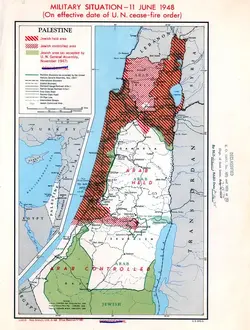
(COMMENT)

The original Declaration of Independence (14/15/MAY 48) was under the Resolution adopted by General Assembly [181 (II)] as it was outline in Part II Section B --- The Jewish State. That was the initial condition at the opening of the 1948 War as initiated by the Arab League Forces as supplemented by the the Irregular Forces (Arab Liberation Army and the Holy War Army).

The altered conditions, as set by the combat outcomes, wherein the Armistice Arrangements (Green Line) traced the FEBA (Forward Edge of the Battle Area) and would remain in force until a peaceful settlement between the Parties is achieved. Israel reached Peaceful Settlements with Jordan (A/50/73 S/1995/83 27 January 1995) and Egypt (Peace Treaty) which reset the international boundary between Israel and Jordan in Article III and the permanent boundary between Egypt and Israel in Article II. Both boundaries were declared the "recognized international boundary."

To date, neither the Lebanese, Syrians, or Palestinians have entered good faith negotiation to establish a permanent peace on appropriate boundaries. The Palestinian Liberation Organization (PLO) did (unilaterally) make public its recognition that "[t]he 1967 border is the internationally-recognized border between Israel and the oPt;" not further identified. For all intent and practical purposes, [t]he Green Line is the boundary with the Palestinian territories; with the exception of East Jerusalem, which Israel annexed after capturing it in the Six-Day War of 1967.

The PLO, in an exchange of letters between the Prime Minister of Israel and the Chairman of the PLO, confirmed that the "PLO recognizes the right of the State of Israel to exist in peace and security." How valid this affirmation is today, is anyone's guess.


NEW YORK CITY (CNN) — Palestinian Authority President Mahmoud Abbas accused Israel of not committing to peace agreements known as the Oslo Accords and declared that Palestinians "cannot continue to be bound by these agreements."

"We therefore declare that we cannot continue to be bound by these agreements (Oslo Accords) and that Israel must assume all of its responsibilities as an occupying power, because the status quo cannot continue," Abbas said.

Most Respectfully,
R
The original Declaration of Independence (14/15/MAY 48) was under the Resolution adopted by General Assembly [181 (II)]​

No it wasn't. What else you got.
You ducked the question.
(COMMENT)

I didn't duck the question at all.

The original Declaration of Independence (14/15/MAY 48) was under the Resolution adopted by General Assembly [181 (II)] as it was outline in Part II Section B --- The Jewish State. That was the initial condition at the opening of the 1948 War as initiated by the Arab League Forces as supplemented by the the Irregular Forces (Arab Liberation Army and the Holy War Army).

The altered conditions, as set by the combat outcomes, wherein the Armistice Arrangements (Green Line) traced the FEBA (Forward Edge of the Battle Area) and would remain in force until a peaceful settlement between the Parties is achieved.

It was corroborated by the UN and UN Palestinian Commission.

During today's brief meeting, Dr. Eduardo Morgan (Panama) said that this resolution of the Assembly merely "relieves responsibility. The Commission has not been dissolved. In fact the resolution of last November 29 has been implemented." SOURCE: Press Release PAL/169 17 May 1948

If there was even the remotest question about the veracity of the issue, the UN would have been more conservative and placed a disclaimer of a sorts on the UNPC statement. But instead, they made it a matter of open record --- and released it to the general public; amplifying the notice.

Since you cannot get past this point, there is no reason to talk about the discord between career diplomatic corps and the White House.

Most Respectfully,
R
The question you ducked.

Palestine defined its territory. What part of that conflicted with Israel's defined territory?​

Your quote.

The original Declaration of Independence (14/15/MAY 48) was under the Resolution adopted by General Assembly [181 (II)]​

From your link:

The State of Israel, in its present form, directly contravened the previous recommendations of the United Nations in at least three important respects: in its attitude on the problem of Arab refugees, on the delimitation of its territorial boundaries, and on the question of Jerusalem.

The United Nations had certainly not intended that the Jewish State should rid itself of its Arab citizens. On the contrary, section C of part I of the Assembly's 1947 resolution had explicitly provided guarantees of minority rights in each of the two States. For example, it had prohibited the expropriation of land owned by an Arab in the Jewish State except for public purposes, and then only upon payment of full compensation. Yet the fact was that 90 per cent of the Arab population of Israel had been driven outside its boundaries by military operations, had been forced to seek refuge in neighbouring Arab territories, had been reduced to misery and destitution, and had been prevented by Israel from returning to their homes. Their homes and property had been seized and were being used by thousands of European Jewish immigrants.​

And there are more violations of resolution 181 besides those mentioned. Israel didn't have anything to do with resolution 181.
 
Arabs start hostilities.
Arabs get asses kicked.
Arabs revise history.
Arabs start hostilities.
Arabs get asses kicked.
Arabs revise history.
Arabs start hostilities.
Arabs get asses kicked.
Arabs revise history.
Arabs start hostilities.
Arabs get asses kicked.
Arabs revise history.
Arabs start hostilities.
Arabs get asses kicked.
Arabs revise history.
Arabs start hostilities.
Arabs get asses kicked.
Arabs revise history.
etc...
 
P F Tinmore, et al,

Yes, that was true quote, but only one of many that the discussion had.

The question you ducked.

Palestine defined its territory. What part of that conflicted with Israel's defined territory?​

Your quote.

The original Declaration of Independence (14/15/MAY 48) was under the Resolution adopted by General Assembly [181 (II)]​

From your link:

The State of Israel, in its present form, directly contravened the previous recommendations of the United Nations in at least three important respects: in its attitude on the problem of Arab refugees, on the delimitation of its territorial boundaries, and on the question of Jerusalem.

The United Nations had certainly not intended that the Jewish State should rid itself of its Arab citizens. On the contrary, section C of part I of the Assembly's 1947 resolution had explicitly provided guarantees of minority rights in each of the two States. For example, it had prohibited the expropriation of land owned by an Arab in the Jewish State except for public purposes, and then only upon payment of full compensation. Yet the fact was that 90 per cent of the Arab population of Israel had been driven outside its boundaries by military operations, had been forced to seek refuge in neighbouring Arab territories, had been reduced to misery and destitution, and had been prevented by Israel from returning to their homes. Their homes and property had been seized and were being used by thousands of European Jewish immigrants.​

And there are more violations of resolution 181 besides those mentioned. Israel didn't have anything to do with resolution 181.
(COMMENT)

At the end of the day, UN Resolution 273(III) (Admission) was approved without territorial revision on 11 May; one month after the Armistice lines went into effect.

Mil Situation 6 APR 49.webp

Now were there dissenting opinions? Of course. Not everyone was in agreement then; and I very much doubt that they are totally in agreement now. After all, this territory has been revised several times since the original Armistice Agreements were set. And I suspect that there will be more adjustments to come.

BTW, you cannot "violate" a Resolution that was (as you are so often fond of pointing out) NON-BINDING in the first place. While it may have been the correct interpretation prior to the Arab Invasion, after the end of hostilities - through the period to present, the political and military situation has changed several time.

Most Respectfully,
R
 

Attachments

  • Class Map Palestine.webp
    Class Map Palestine.webp
    106.5 KB · Views: 79
P F Tinmore, et al,

Yes, that was true quote, but only one of many that the discussion had.

The question you ducked.

Palestine defined its territory. What part of that conflicted with Israel's defined territory?​

Your quote.

The original Declaration of Independence (14/15/MAY 48) was under the Resolution adopted by General Assembly [181 (II)]​

From your link:

The State of Israel, in its present form, directly contravened the previous recommendations of the United Nations in at least three important respects: in its attitude on the problem of Arab refugees, on the delimitation of its territorial boundaries, and on the question of Jerusalem.

The United Nations had certainly not intended that the Jewish State should rid itself of its Arab citizens. On the contrary, section C of part I of the Assembly's 1947 resolution had explicitly provided guarantees of minority rights in each of the two States. For example, it had prohibited the expropriation of land owned by an Arab in the Jewish State except for public purposes, and then only upon payment of full compensation. Yet the fact was that 90 per cent of the Arab population of Israel had been driven outside its boundaries by military operations, had been forced to seek refuge in neighbouring Arab territories, had been reduced to misery and destitution, and had been prevented by Israel from returning to their homes. Their homes and property had been seized and were being used by thousands of European Jewish immigrants.​

And there are more violations of resolution 181 besides those mentioned. Israel didn't have anything to do with resolution 181.
(COMMENT)

At the end of the day, UN Resolution 273(III) (Admission) was approved without territorial revision on 11 May; one month after the Armistice lines went into effect.


Now were there dissenting opinions? Of course. Not everyone was in agreement then; and I very much doubt that they are totally in agreement now. After all, this territory has been revised several times since the original Armistice Agreements were set. And I suspect that there will be more adjustments to come.

BTW, you cannot "violate" a Resolution that was (as you are so often fond of pointing out) NON-BINDING in the first place. While it may have been the correct interpretation prior to the Arab Invasion, after the end of hostilities - through the period to present, the political and military situation has changed several time.

Most Respectfully,
R
Nice 1949 map of Palestine, thanks.

Every map that I have seen shows Israel inside the 1949 armistice lines. The armistice lines were specifically not to be considered in any way to be political or territorial boundaries. Why don't they show Israel's defined territory on any map? How can we tell if Palestine's defined territory conflicts with Israel's defined territory If Israel's is not shown?

You say that Israel's territory was not revised. Revised from what?
 
P F Tinmore, et al,

You did not properly use any of your presentation.

P F Tinmore, et al,

This is just a propaganda mantra to support the Hostile Palestinian Claim that Palestine is from the River to the Sea. Well, its not. Things change. And that claim is not a sufficient "just cause" for a jihad or war.

(COMMENT)

You still did not answer the questions.

An Occupation Power is "never" the same as the "indigenous population." The "Occupation Power" is the nation that has actually placed the territory under the authority for the hostile army. (Article 42 of the Hague Convention)

Indigenous population can be the Israelis that have establish a recognized state.

Most Respectfully,
R
So what if Israel has political recognition. It still occupies Palestine.
(COMMENT)

Call it what you will. But your protest is too much: There are two competing theories on sovereignty:
Sovereignty: Two Competing Theories of State Recognition – William Worster

International law is dominated by two competing theories of state recognition, with the “declaratory” view (It is the opposite of the constitutive theory in that it holds that recognition is almost irrelevant because states have little to no discretion in determining whether an entity constitutes a state. The status of statehood is based on fact, not on individual state discretion.) currently in prominence but possibly just beginning its decline in favor of the “constitutive” view (A state is only a state when it is recognized as such and other states have a considerable discretion to recognize or not.). However, if indeed the constitutive view is gaining ground, then its slow and partial re-emergence is forcing us to rethink the nature of the state in international law.
It so happens that in the case of the State of Israel, it meets the condition of both the "declarative" and "constitutive" views. "The majority of contemporary scholars and commentators favor this theory."(*)

(*) James L. Brierly, The Law of Nations: An Introduction to the International Law of Peace (Humphrey Waldock ed., 6th ed. 1963); Ti-Chiang Chen, The International Law of Recognition: With Special Reference to Practice in the United States (L. C. Green ed., 1951); Ian Brownlie, Principles of Public International Law (1990); D. J. Harris, Cases and Materials on International Law (1983).
Most Respectfully,
R
The declaratory theory is the one favored by international law.

The political existence of the state is independent of recognition by the other states. Even before recognition the state has the right to defend its integrity and independence,... ~ Montevideo​

Other principles I will reference is the qualifications of a state: a ) a permanent population; b ) a defined territory; c ) government; and d) capacity to enter into relations with the other states.

Popular sovereignty where the people are the sovereigns and the legitimacy of a government is derived from the consent of the people.

The universal rights of a people inside a defined territory: The right to self determination without external interference. The right to independence and sovereignty. The right to territorial integrity.

So, how do these principles apply to Israel and Palestine?

All of the territories ceded from Turkish rule were called successor states. Palestine's international borders were defined by post war treaties. The LoN considered Palestine to be a state. Palestine was called a country ten times in the Mandate charter. When Britain left Palestine it called Palestine a legal entity. Palestine would still exist but would not be independent because the administration was being passed to the UNPC. Britain could not and did not change the legal status of Palestine as it had no authority to do so.

What was said about a Jewish state? That a Jewish state would not be imposed on Palestine against the wishes of the people.

At the termination of the Mandate Palestine was still there. There was no Jewish state.

On May 15, 1948 the foreign Jewish Agency declared Israel's independence inside Palestine against the wishes of the vast majority of the people. It neither defined nor acquired any territory.

Now look at the Palestinian's declaration of independence.

PALESTINE PROGRESS REPORT OF THE UNITED NATIONS

MEDIATOR ON PALESTINE

CABLEGRAM DATED 28 SEPTEMBER 1948 FROM THE PREMIER AND
ACTING FOREIGN SECRETARY OF ALL-PALESTINE GOVERNMENT
TO THE SECRETARY-GENERAL CONCERNING
CONSTITUTION OF ALL-PALESTINE GOVERNMENT


28 September 1948


I HAVE THE HONOR TO INFORM YOUR EXCELLENCY THAT IN VIRTUE OF THE NATURAL RIGHT OF THE PEOPLE OF PALESTINE FOR SELF-DETERMINATION WHICH PRINCIPLE IS SUPPORTED BY THE CHARTERS OF THE LEAGUE OF NATIONS, THE UNITED NATIONS AND OTHERS AND IN VIEW OF THE TERMINATION OF THE BRITISH MANDATE OVER PALESTINE WHICH HAD PREVENTED THE ARABS FROM EXERCISING THEIR INDEPENDENCE, THE ARABS OF PALESTINE WHO ARE THE OWNERS OF THE COUNTRY AND ITS INDIGENOUS INHABITANTS AND WHO CONSTITUTE THE GREAT MAJORITY OF ITS LEGAL POPULATION HAVE SOLEMNLY RESOLVED TO DECLARE PALESTINE IN ITS ENTIRETY AND WITHIN ITS BOUNDARIES AS ESTABLISHED BEFORE THE TERMINATION OF THE BRITISH MANDATE AN INDEPENDENT STATE AND CONSTITUTED A GOVERNMENT UNDER THE NAME OF THE ALL-PALESTINE GOVERNMENT DERIVING ITS AUTHORITY FROM A REPRESENTATIVE COUNCIL BASED ON DEMOCRATIC PRINCIPLES AND AIMING TO SAFEGUARD THE RIGHTS OF MINORITIES AND FOREIGNERS PROTECT THE HOLY PLACES AND GUARANTEE FREEDOM OF WORSHIP TO ALL COMMUNITIES

AHMED HILMI PASHA
PREMIER AND ACTING FOREIGN SECRETARY​

All 100% legal and in complete compliance with all legal norms and the UN Charter. Even though recognition by other states was not required, five other countries recognized Palestine's independent state.

The 1949 UN armistice agreements recognized the continued existence of Palestine calling the land Palestine and referencing its unchanged international borders. There was no mention of a state called Israel. There was no mention of any land or borders for Israel.
(COMMENT)

The Montevideo Convention (first presentation) did not apply because the declaration was made AFTER the State of Israel was already established.

The Jewish National Council consisting of members of elected representatives of the Jewish Bodies, was the provisional government that declared independence.

The Jewish National Council DID exercise their right to self-determination; but with external interference from the Arab League defying the resolution of the General Assembly and engaged in a deliberate effort to alter by force the settlement envisaged therein.

A country does not confer sovereignty or independence. A country is a region that is identified as a distinct entity in political geography. The political entity was the establishment of Mandatory as the government. The Mandate said: "The Mandatory shall be responsible for exercising such supervision over religious or eleemosynary bodies of all faiths in Palestine as may be required for the maintenance of public order and good government."

The Armistice of Mudros, The Treaty of Sevres, and the Treaty of Lausanne, all agree that the Ottoman Empire and the Turkish Government did have the intent and purpose to "renounces all rights and title whatsoever over or respecting the territories situated outside the frontiers laid down in the present Treaty and the islands other than those over which her sovereignty is recognised by the said Treaty, the future of these territories and islands being settled or to be settled by the parties concerned." The parties concerned being the Allied Powers, not some nonexistent government of the Arabs. By the time the Treaty of Lausanne was signed (JULY 24, 1923), the Mandate and Civil Administration over the territory had been established by the Allied Powers.

The Jewish National Council DID make application to the 1948 successor government, the UN Palestine Commission, IAW with the Steps Preparatory to Independence of the Resolution.

You can believe what you will, the All Palestine Government did not act until three months after the Jewish National Council. Without regard to you interpretation of events, the debate over the territorials were not even issue until the application for admission was considered.

Finally, the Armistice Agreements were made between "ISRAEL" and the four adjacent Arab League nations. No arrangement was made between "ISRAEL" and any entity established by the All Palestine Government.

"He Who Can Destroy a Thing, Controls a Thing" (A quote from DUNE Frank Herbert) By Liberty1955 | Watertown, New York iCNN Report
It is a very applicable quote here and can be directly applied to the All Palestine Government. The APG was dissolved by the Egyptian Government in 1959. The Egypt (your foreign government) was the proponent for the APG. Where as the UN admitted Israel to membership in the United Nations in 1949.

(REALITY)

No matter what argument you present, the reality is that you can look at any contemporary Map and see that there is a physical manifestation called Israel. You can actually travel by air, sea or land, to the border of Israel, manned by Israel Border Police. You can check the record, there is a Resolution 273 (III) Titled the Admission of Israel to membership in the United Nations. And today you can see that there are actually treaties that replaced two of the four Armistice Agreements with Israel and established International Boundaries between the parties.

It is what it is.

I see nothing of a documented or physical nature that establishes or recognizes the State of Palestine until 1988. And that is NOT full recognition of a country that can stand alone. And I see a difference in what one Palestinian Faction may believe over another. Remember, the Western Border of the West Bank is not a permanent border, nor is it an Armistice Line.

Most Respectfully,
R
The Montevideo Convention (first presentation) did not apply because the declaration was made AFTER the State of Israel was already established.​

Palestine defined its territory. What part of that conflicted with Israel's defined territory?


Because it didn't as the group doing the defining only had control of gaza . Plus they could not declare on land already declared so they did not define any land
 
15th post
Yet you have posted a link to it haven't you in the past
 
Just posting your POV without explanation is not valid, so explain why the Israelis did not use 181 and the terms of the mandate to declare independence.

Your question was answered just that the answer is not the one you wanted to see
 
But it is shown as the red lines marking the armistice lines agreed by Israel and the other nations extant at the time. Sorry to say but palestine was not one of them and so was not included in any talks. You cant keep saying that the borders set down by the LoN as the mandate for Palestine are the borders of the nation of Palestine when no nation existed until 1988.
 
P F Tinmore, et al,

You did not read the entire answer. You stopped where its was most convenience.

P F Tinmore, et al,

Defined Territory was discussed in the "declarations and explanations" references to A/RES/273 (III).

P F Tinmore, et al,

(COMMENT)

The Montevideo Convention (first presentation) did not apply because the declaration was made AFTER the State of Israel was already established.
Palestine defined its territory. What part of that conflicted with Israel's defined territory?
(COMMENT)

The original Declaration of Independence (14/15/MAY 48) was under the Resolution adopted by General Assembly [181 (II)] as it was outline in Part II Section B --- The Jewish State. That was the initial condition at the opening of the 1948 War as initiated by the Arab League Forces as supplemented by the the Irregular Forces (Arab Liberation Army and the Holy War Army).

The altered conditions, as set by the combat outcomes, wherein the Armistice Arrangements (Green Line) traced the FEBA (Forward Edge of the Battle Area) and would remain in force until a peaceful settlement between the Parties is achieved. Israel reached Peaceful Settlements with Jordan (A/50/73 S/1995/83 27 January 1995) and Egypt (Peace Treaty) which reset the international boundary between Israel and Jordan in Article III and the permanent boundary between Egypt and Israel in Article II. Both boundaries were declared the "recognized international boundary."

To date, neither the Lebanese, Syrians, or Palestinians have entered good faith negotiation to establish a permanent peace on appropriate boundaries. The Palestinian Liberation Organization (PLO) did (unilaterally) make public its recognition that "[t]he 1967 border is the internationally-recognized border between Israel and the oPt;" not further identified. For all intent and practical purposes, [t]he Green Line is the boundary with the Palestinian territories; with the exception of East Jerusalem, which Israel annexed after capturing it in the Six-Day War of 1967.

The PLO, in an exchange of letters between the Prime Minister of Israel and the Chairman of the PLO, confirmed that the "PLO recognizes the right of the State of Israel to exist in peace and security." How valid this affirmation is today, is anyone's guess.


NEW YORK CITY (CNN) — Palestinian Authority President Mahmoud Abbas accused Israel of not committing to peace agreements known as the Oslo Accords and declared that Palestinians "cannot continue to be bound by these agreements."

"We therefore declare that we cannot continue to be bound by these agreements (Oslo Accords) and that Israel must assume all of its responsibilities as an occupying power, because the status quo cannot continue," Abbas said.

Most Respectfully,
R
The original Declaration of Independence (14/15/MAY 48) was under the Resolution adopted by General Assembly [181 (II)]​

No it wasn't. What else you got.
You ducked the question.
(COMMENT)

I didn't duck the question at all.

The original Declaration of Independence (14/15/MAY 48) was under the Resolution adopted by General Assembly [181 (II)] as it was outline in Part II Section B --- The Jewish State. That was the initial condition at the opening of the 1948 War as initiated by the Arab League Forces as supplemented by the the Irregular Forces (Arab Liberation Army and the Holy War Army).

The altered conditions, as set by the combat outcomes, wherein the Armistice Arrangements (Green Line) traced the FEBA (Forward Edge of the Battle Area) and would remain in force until a peaceful settlement between the Parties is achieved.

It was corroborated by the UN and UN Palestinian Commission.

During today's brief meeting, Dr. Eduardo Morgan (Panama) said that this resolution of the Assembly merely "relieves responsibility. The Commission has not been dissolved. In fact the resolution of last November 29 has been implemented." SOURCE: Press Release PAL/169 17 May 1948

If there was even the remotest question about the veracity of the issue, the UN would have been more conservative and placed a disclaimer of a sorts on the UNPC statement. But instead, they made it a matter of open record --- and released it to the general public; amplifying the notice.

Since you cannot get past this point, there is no reason to talk about the discord between career diplomatic corps and the White House.

Most Respectfully,
R
The question you ducked.

Palestine defined its territory. What part of that conflicted with Israel's defined territory?​

Your quote.

The original Declaration of Independence (14/15/MAY 48) was under the Resolution adopted by General Assembly [181 (II)]​

From your link:

The State of Israel, in its present form, directly contravened the previous recommendations of the United Nations in at least three important respects: in its attitude on the problem of Arab refugees, on the delimitation of its territorial boundaries, and on the question of Jerusalem.

The United Nations had certainly not intended that the Jewish State should rid itself of its Arab citizens. On the contrary, section C of part I of the Assembly's 1947 resolution had explicitly provided guarantees of minority rights in each of the two States. For example, it had prohibited the expropriation of land owned by an Arab in the Jewish State except for public purposes, and then only upon payment of full compensation. Yet the fact was that 90 per cent of the Arab population of Israel had been driven outside its boundaries by military operations, had been forced to seek refuge in neighbouring Arab territories, had been reduced to misery and destitution, and had been prevented by Israel from returning to their homes. Their homes and property had been seized and were being used by thousands of European Jewish immigrants.​

And there are more violations of resolution 181 besides those mentioned. Israel didn't have anything to do with resolution 181.


So how come after 1949 the arab muslims were still living in Israel while the Jews had been evicted from the west bank and gaza. A contravention of 181 and the mandate and the UN charter.

The only arab muslims driven out were those that took up arms against the Jews and became traitors to the nation of Israel, this was covered by Intermnetinal laws of the time and was outside the scope of 1871.

No legal right of return is embodied in international law, if it was then mecca. medina and Jerusalem would be wholly Jewish again

The homes and property of Jews in gaza and the west bank were also seized and used by tens of thousands of "refugees" from Syria, Egypt, Iran, Iraq and Saudi that stayed after the failed invasion and genocide.

Yes there are many more violations of 181 that mean nothing as it was just a recommendation and was not empowered in law.
 
Status
Not open for further replies.
Back
Top Bottom