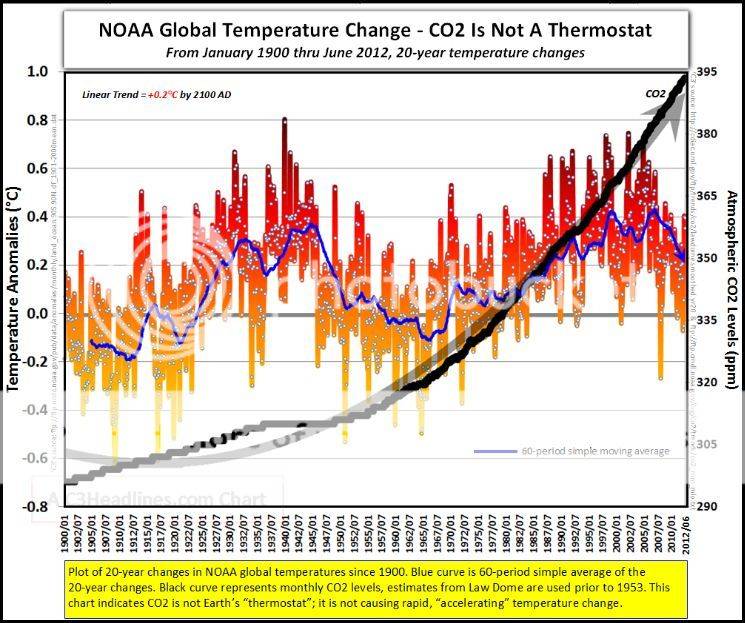
Well, let us present how the physicists address it.
The Carbon Dioxide Greenhouse Effect
No sense in re-inventing the wheel.
http://pubs.giss.nasa.gov/docs/1981/1981_Hansen_etal_1.pdf
Summary. The global temperature rose by 0.20C between the middle 1960's and
1980, yielding a warming of 0.4°C in the past century. This temperature increase is
consistent with the calculated greenhouse effect due to measured increases of
atmospheric carbon dioxide. Variations of volcanic aerosols and possibly solar
luminosity appear to be primary causes of observed fluctuations about the mean trend
of increasing temperature. It is shown that the anthropogenic carbon dioxide warming
should emerge from the noise level of natural climate variability by the end of the
century, and there is a high probability of warming in the 1980's. Potential effects on
climate in the 21st century include the creation of drought-prone regions in North
America and central Asia as part of a shifting of climatic zones, erosion of the West
Antarctic ice sheet with a consequent worldwide rise in sea level, and opening of the
fabled Northwest Passage.
..................................................................................................................................
The greenhouse theory can be tested by examination of several planets, which provide an ensemble of experiments over a wide range of conditions. The atmospheric composition of Mars, Earth, and Venus lead to mean radiating levels of about 1, 6, and 70 km, and lapse rates of F 50o, 5.50, and 7°C km-, respectively. Observed surface temperatures of these planets confirm the existence and order of magnitude of the
predicted greenhouse effect (Eq. 3). Data now being collected by spacecraft at Venus and Mars (12) will permit more precise analyses of radiative and dynamical
mechanisms that affect greenhouse warming.
Dr. James Hansen is probably the most respected atmospheric physicist on earth at present.
James Edward Hansen (born March 29, 1941) is an American adjunct professor in the Department of Earth and Environmental Sciences at Columbia University. Hansen is best known for his research in the field of climatology, his testimony on climate change to congressional committees in 1988 that helped raise broad awareness of global warming, and his advocacy of action to avoid dangerous climate change. In recent years, Hansen has become an activist for action to mitigate the effects of climate change, which on a few occasions has led to his arrest.
After graduate school, Hansen continued his work with radiative transfer models, attempting to understand the Venusian atmosphere. Later he applied and refined these models to understand the Earth's atmosphere, in particular, the effects that aerosols and trace gases have on Earth's climate. Hansen's development and use of global climate models has contributed to the further understanding of the Earth's climate. In 2009 his first book, Storms of My Grandchildren, was published.[1] In 2012 he presented a 2012 TED Talk: Why I must speak out about climate change.[2]
From 1981 to 2013, he was the head of the NASA Goddard Institute for Space Studies in New York City, a part of the Goddard Space Flight Center in Greenbelt, Maryland.
He currently directs the Program on Climate Science, Awareness and Solutions at Columbia University's Earth Institute.[3] The program is working to continue to "connect the dots" from advancing basic climate science to promoting public awareness to advocating policy actions.
James Edward Hansen

Born March 29, 1941 (age 73)
Denison, Iowa, U.S.
Fields Atmospheric physics
Institutions Columbia University
Alma mater University of Iowa
Thesis The atmosphere of Venus : a dust insulation model (1967)
Known for Radiative transfer, Planetary atmospheres,
Climate models
Influences James Van Allen
Notable awards Klopsteg Memorial Award (2011)
United States National Academy of Sciences
Carl-Gustaf Rossby Research Medal