
excalibur
Diamond Member
- Mar 19, 2015
- 28,371
- 57,349
- 2,290
Congress has granted the Executive, under numerous statutes, to raise tariffs.
Clarence Thomas listed a number of these issues in his dissent.
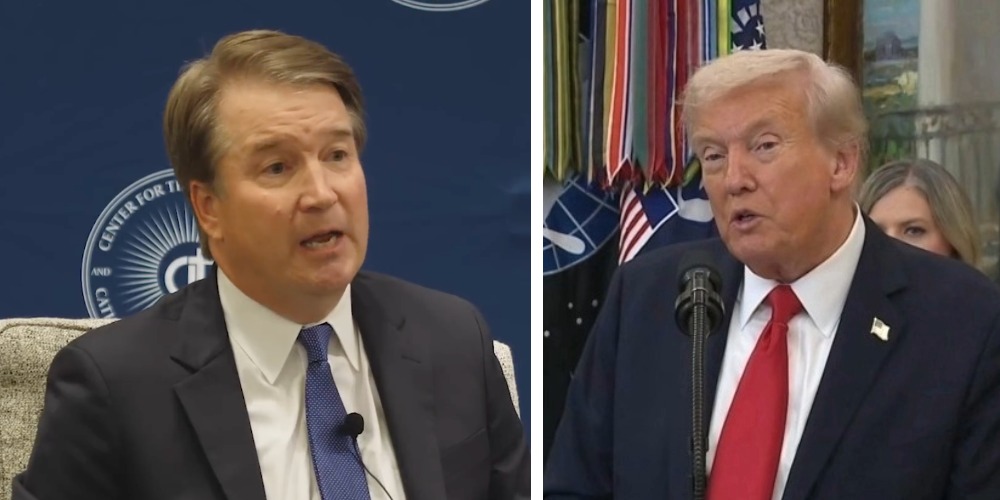
Justice Kavanaugh also got it right.
 thepostmillennial.com
Clarence Thomas listed a number of these issues in his dissent.
Justice Kavanaugh also got it right.
"For both the Nixon tariffs and the Ford tariffs upheld by this Court in Algonquin, the relevant statutory provisions did not specifically refer to 'tariffs' or 'duties,' but instead more broadly authorized the President to 'regulate … importation' or to 'adjust the imports.' Therefore, when IEEPA was enacted in 1977 in the wake of the Nixon and Ford tariffs and the Algonquin decision, Congress and the public plainly would have understood that the power to 'regulate… importation' included tariffs."
"If Congress wanted to exclude tariffs from IEEPA, it surely would not have enacted the same broad 'regulate… importation' language that had just been used to justify major American tariffs on foreign imports."
He said that the plaintiffs in the case and the Supreme Court "acknowledge that IEEPA authorizes the President to impose quotas or embargoes on foreign imports—meaning that a President could completely block some or all imports," however, "they say that IEEPA does not authorize the President to employ the lesser power of tariffs, which simply condition imports on a payment."
"As they interpret the statute, the President could, for example, block all imports from China but cannot order even a $1 tariff on goods imported from China."
He continued, "That approach does not make much sense. Properly read, IEEPA does not draw such an odd distinction between quotas and embargoes on the one hand and tariffs on the other. Rather, it empowers the President to regulate imports during national emergencies with the tools Presidents have traditionally and commonly used, including quotas, embargoes, and tariffs."
...
"If Congress wanted to exclude tariffs from IEEPA, it surely would not have enacted the same broad 'regulate… importation' language that had just been used to justify major American tariffs on foreign imports."
He said that the plaintiffs in the case and the Supreme Court "acknowledge that IEEPA authorizes the President to impose quotas or embargoes on foreign imports—meaning that a President could completely block some or all imports," however, "they say that IEEPA does not authorize the President to employ the lesser power of tariffs, which simply condition imports on a payment."
"As they interpret the statute, the President could, for example, block all imports from China but cannot order even a $1 tariff on goods imported from China."
He continued, "That approach does not make much sense. Properly read, IEEPA does not draw such an odd distinction between quotas and embargoes on the one hand and tariffs on the other. Rather, it empowers the President to regulate imports during national emergencies with the tools Presidents have traditionally and commonly used, including quotas, embargoes, and tariffs."
...
Kavanaugh blasts SCOTUS reversal of Trump tariff plan, warns of ‘serious practical consequences’
“One issue will be refunds. Refunds of billions of dollars would have significant consequences for the U.S. Treasury.”
thepostmillennial.com
Last edited:


