I really like it when you put your thoughts down in your own words rather than C&P. It helps me figure out where you are coming from.
You seem to think your guys are forthright and next to infallible. I just looked at the temp numbers for GISS US, unfortunately I haven't found a pre-1999 set that I trust, but the 2006(pre fix), 2007(post fix), 2007(post post fix) paint an odd story. Pre-1999 figures started low, corrected higher, then decreased again. Post-2000 figures started high, corrected lower, then increased again. Pretty much back to where they started from. I'll give actual figures when I can find a pre-1999 data set, unfortunately the Way Back machine only goes back to 2006 (or the name has been changed).
e said
you really haven't looked into those improvements much, have you? hahaha. It is hard to even know where to start on that subject. its another case of ineptitude being pointed out by outsiders and then climate science saying they found it and corrected the problem when it hasn't been fixed at all.
If only you had a thought of your own instead of parroting the crap from CON$ervative pundits.
A perfect example is your claim that "pre 1999 figures started low, corrected higher" and then you admitted you could find no pre 1999 figures so how could you possibly know where they started from or what direction they corrected to except by parroting what others fed you and you swallowed whole.
Thank you.
Actually, I said 'a pre-1999 data set that I trust'. I have found several graphs that show visual rather than numerical figures.
The story of the Y2K bug and subsequent fixes is much more complex and interesting than I thought.
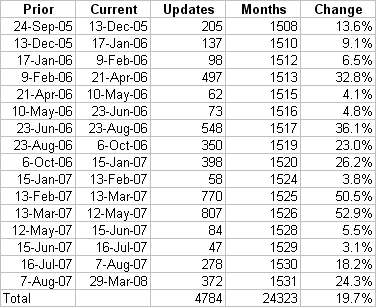
It certainly is not the story of NASA making a simple fix after being informed of the error. And it involves NASA going back and recalculating (pre-1999)data at least twice during 2007.
And the really strange part is that this year's GISS figures seem to have erased most of the post-2000 decreases and dropped early 1900's as well.
More later
Don't you deniers ever get tired of repeating the same lies over and over?????
There was only one change in August 2007 due to the error McIntyre found. A later update had nothing to do with McIntyre, and YOU know it!!!!!
Here again is the correction made for the error McIntyre found and the BS you deniers fabricated.
http://www.columbia.edu/~jeh1/mailings/2007/20070816_realdeal.pdf
This discontinuity can be removed by comparing USHCN and GHCN records just before 2000, and this correction was made to the GISS computer program on 7 August 2007 with a note to that effect made on the GISTEMP web page.]
How big an error did this flaw cause? That is shown by the before and after results in Figure 1. The effect on the global temperature record is invisible. The effect on U.S. average temperature is about 0.15°C beginning in 2000. Does this change have any affect whatsoever on the global warming issue? Certainly not, as discussed below.
What we have here is a case of dogged contrarians who present results in ways intended to deceive the public into believing that the changes have greater significance than reality. They aim to make a mountain out of a mole hill. I believe that these people are not stupid, instead they seek to create a brouhaha and muddy the waters in the climate change story. They seem to know exactly what they are doing and believe they can get away with it, because the public does not have the time, inclination, and training to discern what is a significant change with regard to the global warming issue.
The proclamations of the contrarians are a deceit, but their story raises a more important matter, usufruct. It is the most important issue in the entire global warming story, in my opinion. The players in the present U.S. temperature story, we scientists included, are just bit players. The characters in the main drama are big fish, really big fish. But before we get to that matter, I need to expose how the deceit works.
Instead of showing the impact of the flaw in our analysis program via a graph such as Figure 1, as a scientist would do (and as would immediately reveal how significant the flaw was), they instead discuss ranking of temperature in different years, including many false statements. We have thus been besieged by journalists saying they say that correcting your error caused the warmest year to become 1934 rather than a recent year, is that right!?
Hardly. First of all, many journalists had the impression that they were talking about global temperature. As you can see from Figure 1a, global warming is unaffected by the flaw. This realization should be enough to make most journalists lose interest, as global warming refers to global temperature.
But what if you are a chauvinist and only care about temperature in the United States? Did correcting the flaw in the program change the time of calculated maximum temperature to 1934? No. If you look at our 2001 paper, and get out your micrometer, you will see that we found 1934 to be the warmest year in the United States, by a hair, of the order of 0.01°C warmer than 1998, the same as the result that we find now. Of course the difference in the 1934 and 1998 temperatures is not significant, and we made clear in our paper that such years have to be declared as being practically a dead-heat.

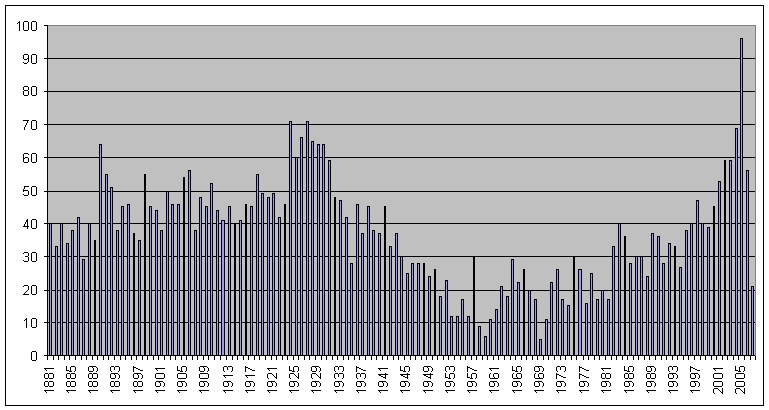
 08 GMT. Here it is: (PRE Y2K FIX)