We're within the deepest solar minimum since 1910-1912, which was solar cycle 14th and was only slightly longer over all then 23. Scienctist believe that events like the Maunder Minimum was the main negative forcing that helped make the little ice age that was -.8 to -1.0c below "todays" 1951-1980 avg...But didn't get that cold within one solar grand minimum, but many over 400 years. So it compounds into its self.
Lets say that this minimum we're in has already taken away -.1c, which makes sense that years like 2010 with weaker el nino's can rank with 1998, which was a beast and most powerful el nino in recorded history. To make matters clear area 3.4, which scientist measure these things in 1998 was near 2.8c, but march 2010 the peak of the last el nino was near 1.8c...One whole degree "C" below 1998, but this year kicked its ass. Why even within a solar minimum that can within a few years take -.1c off the earth's temperature can a weaker nino do that and why; you guessed it->.15c of global warming over the last decade. The question now lays on how strong la nina gets throughout the rest of this year rather we will see second place with 1998 had close to strong and we're strong now and growing in strength as the pacific cools...I think we will be close, but 2005 fall was much warmer so it might hold onto the record.
Sure the longer it last we will see compounding effects, which will mask the effects. I'd bet the compounding effects by 2020 "if" the solar minimum is still around then will be near .25c to .3c...Sure we could be seeing global records with weaker el nino's then, but the full effect will be masked. So when ever we get out of it and find out the true strength of global warming. Might come as a shock!
Wow! So wait a second, if an extra 200PPM CO2 is
THAT POWERFUL that it can overcome a solar minimum you should be easily able to demonstrate that effect in a laboratory setting right?
Grow a ******* sac, put on a lab coat and show us all how a 200PPM increase in CO2 raises temperature.
Real nice post you got there, but anyways how else do you explain the upwards forcing during a time when solar "flex" or output is at its lowest since 1910? The 1910 teens overall where the coldest decade of the 1880-2010 temperature because of this. It is clear as day the trend is slowly, but surely upwards. The question is why? PDO negative, ENSO negative, which clearly shows up as a cooling effect on our world.
The truth is co2 is a green house, evenso a very weak one, but still the extra co2 rising from 280 ppm to 390 ppm since 1750 is a pretty big increase. No other time within the last 500,000 years if you believe it or not has been this high...Sure it has been warmer 15 million years ago, 60 million years ago...You can't compare earth 100 million years ago or earlier to today because the sun was only putting out 75 percent of what it puts out today. So the period 15-60 million years ago is all the far back your going to want to go...But yes it is true that temperature don't perfectly follow it as there are tons of long term climate cycles from orbit of the earth, which can bring more solar forcing onto our planet, but in terms of a few hundred years this normally don't happen to often.
Here is some interesting reading about how co2 works and why it works the way it does...
"
The greenhouse effect is caused by certain gases (and clouds) absorbing and re-emitting the infrared radiating from Earth's surface. It currently keeps our planet 20°C to 30°C warmer than it would be otherwise. Global warming is the rise in temperatures caused by an increase in the levels of greenhouse gases due to human activity.
Water vapour is by far the most important contributor to the greenhouse effect. Pinning down its precise contribution is tricky, not least because the absorption spectra of different greenhouse gases overlap.
At some of these overlaps, the atmosphere already absorbs 100% of radiation, meaning that adding more greenhouse gases cannot increase absorption at these specific frequencies. For other frequencies, only a small proportion is currently absorbed, so higher levels of greenhouse gases do make a difference.
This means that when it comes to the greenhouse effect, two plus two does not equal four. If it were possible to leave the clouds but remove all other water vapour from the atmosphere, only about 40% less infrared of all frequencies would be absorbed. Take away the clouds and all other greenhouses gases, however, and the water vapour alone would still absorb about 60% of the infrared now absorbed.
By contrast, if CO2 alone was removed from the atmosphere, only 15% less infrared would be absorbed. If CO2 was the only greenhouse gas, it would absorb 26% of the infrared currently absorbed by the atmosphere.
A simplified summary is that about 50% of the greenhouse effect is due to water vapour, 25% due to clouds, 20% to CO2, with other gases accounting for the remainder."
So it works within its own wave length, which allows to warm our planet at even its low levels.
"Ice cores show that carbon dioxide levels in the atmosphere have remained between 180 and 300 parts per million for the past half-a-million years. In recent centuries, however, CO2 levels have risen sharply, to at least 380 ppm (see Greenhouse gases hit new high)
So what's going on? It is true that human emissions of CO2 are small compared with natural sources. But the fact that CO2 levels have remained steady until very recently shows that natural emissions are usually balanced by natural absorptions. Now slightly more CO2 must be entering the atmosphere than is being soaked up by carbon "sinks".
"The consumption of terrestrial vegetation by animals and by microbes (rotting, in other words) emits about 220 gigatonnes of CO2 every year, while respiration by vegetation emits another 220 Gt. These huge amounts are balanced by the 440 Gt of carbon dioxide absorbed from the atmosphere each year as land plants photosynthesise.
Similarly, parts of the oceans release about 330 Gt of CO2 per year, depending on temperature and rates of photosynthesis by phytoplankton, but other parts usually soak up just as much - and are now soaking up slightly more."
Human emissions of CO2 are now estimated to be 26.4 Gt per year, up from 23.5 Gt in the 1990s, according to an Intergovernmental Panel on Climate Change report in February 2007 (pdf format). Disturbances to the land - through deforestation and agriculture, for instance - also contribute roughly 5.9 Gt per year.
About 40% of the extra CO2 entering the atmosphere due to human activity is being absorbed by natural carbon sinks, mostly by the oceans. The rest is boosting levels of CO2 in the atmosphere.
How can we be sure that human emissions are responsible for the rising CO2 in the atmosphere? There are several lines of evidence. Fossil fuels were formed millions of years ago. They therefore contain virtually no carbon-14, because this unstable carbon isotope, formed when cosmic rays hit the atmosphere, has a half-life of around 6000 years. So a dropping concentration of carbon-14 can be explained by the burning of fossil fuels. Studies of tree rings have shown that the proportion of carbon-14 in the atmosphere dropped by about 2% between 1850 and 1954. After this time, atmospheric nuclear bomb tests wrecked this method by releasing large amounts of carbon-14."
Climate myths: Human CO2 emissions are too tiny to matter - environment - 16 May 2007 - New Scientist
"
The greenhouse effect is a process by which radiative energy leaving a planetary surface is absorbed by some atmospheric gases, called greenhouse gases. They transfer this energy to other components of the atmosphere, and it is re-radiated in all directions, including back down towards the surface. This transfers energy to the surface and lower atmosphere, so the temperature there is higher than it would be if direct heating by solar radiation were the only warming mechanism [1][2].
This mechanism is fundamentally different from that of an actual greenhouse, which works by isolating warm air inside the structure so that heat is not lost by convection.
The greenhouse effect was discovered by Joseph Fourier in 1824, first reliably experimented on by John Tyndall in 1858, and first reported quantitatively by Svante Arrhenius in 1896.[3]
If an ideal thermally conductive blackbody was the same distance from the Sun as the Earth, it would have an expected blackbody temperature of 5.3 °C. However, since the Earth reflects about 30%[4] (or 28%[5]) of the incoming sunlight, the planet's actual blackbody temperature is about -18 or -19 °C [6][7], about 33°C below the actual surface temperature of about 14 °C or 15 °C.[8] The mechanism that produces this difference between the actual temperature and the blackbody temperature is due to the atmosphere and is known as the greenhouse effect."
Greenhouse effect - Wikipedia, the free encyclopedia
Some great history on the discovery and why it is so.
"The Carbon Dioxide Greenhouse Effect
In the 19th century, scientists realized that gases in the atmosphere cause a "greenhouse effect" which affects the planet's temperature. These scientists were interested chiefly in the possibility that a lower level of carbon dioxide gas might explain the ice ages of the distant past. At the turn of the century, Svante Arrhenius calculated that emissions from human industry might someday bring a global warming. Other scientists dismissed his idea as faulty. In 1938, G.S. Callendar argued that the level of carbon dioxide was climbing and raising global temperature, but most scientists found his arguments implausible. It was almost by chance that a few researchers in the 1950s discovered that global warming truly was possible. In the early 1960s, C.D. Keeling measured the level of carbon dioxide in the atmosphere: it was rising fast. Researchers began to take an interest, struggling to understand how the level of carbon dioxide had changed in the past, and how the level was influenced by chemical and biological forces. They found that the gas plays a crucial role in climate change, so that the rising level could gravely affect our future. (This essay covers only developments relating directly to carbon dioxide, with a separate essay for Other Greenhouse Gases. Theories are discussed in the essay on Simple Models of Climate."
"One possible answer was a change in the composition of the Earth's atmosphere. Beginning with work by Joseph Fourier in the 1820s, scientists had understood that gases in the atmosphere might trap the heat received from the Sun. As Fourier put it, energy in the form of visible light from the Sun easily penetrates the atmosphere to reach the surface and heat it up, but heat cannot so easily escape back into space. For the air absorbs invisible heat rays (“infrared radiation”

rising from the surface. The warmed air radiates some of the energy back down to the surface, helping it stay warm. This was the effect that would later be called, by an inaccurate analogy, the "greenhouse effect." The equations and data available to 19th-century scientists were far too poor to allow an accurate calculation. Yet the physics was straightforward enough to show that a bare, airless rock at the Earth's distance from the Sun should be far colder than the Earth actually is. Tyndall set out to find whether there was in fact any gas in the atmosphere that could trap heat rays. In 1859, his careful laboratory work identified several gases that did just that. The most important was simple water vapor (H2O). Also effective was carbon dioxide (CO2), although in the atmosphere the gas is only a few parts in ten thousand. Just as a sheet of paper will block more light than an entire pool of clear water, so the trace of CO2 altered the balance of heat radiation through the entire atmosphere. (For a more complete explanation of how the "greenhouse effect" works, follow the link at right to the essay on Simple Models of Climate.)(1)
Arrhenius brought up the possibility of future warming in an impressive scientific article and a widely read book. By the time the book was published, 1908, the rate of coal burning was already much higher than in 1896, and Arrhenius suggested warming might appear wihin a few centuries rather than millenia. Yet here as in his first article, the possibility of warming in some distant future was far from his main point. He mentioned it only in passing, during a detailed discussion of what really interested scientists of his time — the cause of the ice ages. Arrhenius had not quite discovered global warming, but only a curious theoretical concept.(5)
An American geologist, T. C. Chamberlin, and a few others took an interest in CO2. How, they wondered, is the gas stored and released as it cycles through the Earth's reservoirs of sea water and minerals, and also through living matter like forests? Chamberlin was emphatic that the level of CO2 in the atmosphere did not necessarily stay the same over the long term. But these scientists too were pursuing the ice ages and other, yet more ancient climate changes — gradual shifts over millions of years. Very different climates, like the balmy age of dinosaurs a hundred million years ago, puzzled geologists but seemed to have nothing to do with changes on a human time scale. Nobody took much interest in the hypothetical future warming caused by human industry. "
These measurements and arguments had fatal flaws. Herr Koch had reported to Ångström that the absorption had not been reduced by more than 0.4% when he lowered the pressure, but a modern calculation shows that the absorption would have decreased about 1% — like many a researcher, the assistant was over confident about his degree of precision.(9*) But even if he had seen the1% shift, Ångström would have thought this an insignificant perturbation. He failed to understand that the logic of the experiment was altogether false.
The greenhouse effect will in fact operate even if the absorption of radiation were totally saturated in the lower atmosphere. The planet's temperature is regulated by the thin upper layers where radiation does escape easily into space. Adding more greenhouse gas there will change the balance. Moreover, even a 1% change in that delicate balance would make a serious difference in the planet’s surface temperature. The logic is rather simple once it is grasped, but it takes a new way of looking at the atmosphere — not as a single slab, like the gas in Koch's tube (or the glass over a greenhouse), but as a set of interacting layers. (The full explanation is in the essay on Simple Models, use link at right.)
<=Simple models
The subtle difference did not occur to anyone for many decades, if only because hardly anyone thought the greenhouse effect was worth their attention. After Ångström published his conclusions in 1900, the few scientists who had taken an interest in the matter concluded that Arrhenius's hypothesis had been proven wrong. Theoretical work on the question stagnated for decades, and so did measurement of the level of CO2 in the atmosphere.(10*)
=>Simple models
=>Radiation math
A few scientists dissented from the view that changes of CO2 could have no effect. An American physicist, E.O. Hulburt, pointed out in 1931 that investigators had been mainly interested in pinning down the intricate structure of the absorption bands (which offered fascinating insights into the new theory of quantum mechanics) "and not in getting accurate absorption coefficients." Hulburt's own calculations supported Arrhenius's estimate that doubling or halving CO2 would bring something like a 4°C rise or fall of surface temperature, and thus "the carbon dioxide theory of the ice ages... is a possible theory."(11) Hardly anyone noticed this paper. Hulburt was an obscure worker at the U.S. Naval Research Laboratory, and he published in a journal, the Physical Review, that few meteorologists read. Their general consensus was the one stated in such authoritative works as the American Meteorological Society's 1951 Compendium of Meteorology: the idea that adding CO2 would change the climate "was never widely accepted and was abandoned when it was found that all the long-wave radiation [that would be] absorbed by CO2 is [already] absorbed by water vapor."(11a)
More reading
The Carbon Dioxide Greenhouse Effect
Also this proves without a doubt that there where lab work done within the field of finding out how co2 works and it was shown to be so...No it is not a strong green house gas, but methane also doubled and it is.
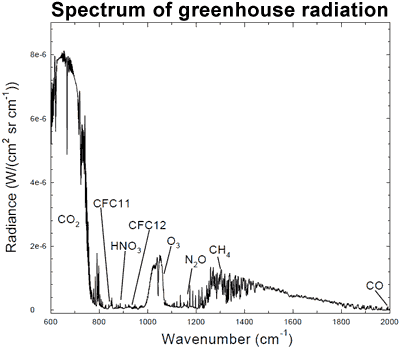
Figure 2: Spectrum of the greenhouse radiation measured at the surface. Greenhouse effect from water vapor is filtered out, showing the contributions of other greenhouse gases (Evans 2006).
Satellite measurements of outgoing longwave radiation
In 1970, NASA launched the IRIS satellite that measured infrared spectra between 400 cm-1 to 1600 cm-1. In 1996, the Japanese Space Agency launched the IMG satellite which recorded similar observations. Both sets of data were compared to discern any changes in outgoing radiation over the 26 year period (Harries 2001). The resultant change in outgoing radiation was as follows:
How do we know more CO2 is causing warming?
Yes say what you went, but at least it is real science backed up with real data. Says more then many other people that just like it cuss it out.

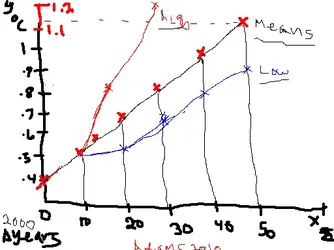
 Of course it could be lower...If solar output and AMO team up, but with what we know I think it is pretty good.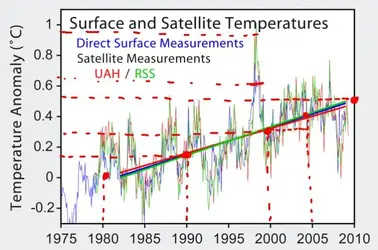

 There is a real world out there.............which dictates that, unless you're a fukking k00k, you're not going to voluntarily smash your head against a brick wall 100 times based upon some scientists prediction that it will rain in 127 days, 14 hours and 32 seconds!!!