Extent of surface melt over Greenland’s ice sheet on July 8 (left) and July 12 (right). Measurements from three satellites showed that on July 8, about 40 percent of the ice sheet had undergone thawing at or near the surface. In just a few days, the melting had dramatically accelerated and an estimated 97 percent of the ice sheet surface had thawed by July 12. In the image, the areas classified as “probable melt” (light pink) correspond to those sites where at least one satellite detected surface melting. The areas classified as “melt” (dark pink) correspond to sites where two or three satellites detected surface melting. The satellites are measuring different physical properties at different scales and are passing over Greenland at different times. As a whole, they provide a picture of an extreme melt event about which scientists are very confident. Credit: Nicolo E. DiGirolamo, SSAI/NASA GSFC, and Jesse Allen, NASA Earth Observatory
We are seeing the ice melt in Greenland and the Arctic Ocean. How does that happen without global warming?
You do realize why greenland was called greenland?
Yes, as a marketing device to get others to follow Eric the Red.
History of Greenland - Wikipedia, the free encyclopedia
Norse settlement[edit]
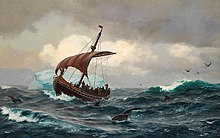 Summer in the Greenland coast circa year 1000
Jens Erik Carl Rasmussen (1841–1893)
Europeans became aware of Greenland's existence, probably in the early 10th century, when
Gunnbjörn Ulfsson, sailing from Norway to Iceland, was blown off course by a storm, and happened to sight some
islands off Greenland. During the 980s, explorers led by
Erik the Red set out from
Icelandand reached the southwest coast of Greenland, found the region uninhabited, and settled there. Eirik named the island Greenland (
Grænland in
Old Norse and modern
Icelandic,
Grønland in modern
Danish and
Norwegian) in effect as a marketing device. Both the
Book of Icelanders (
Íslendingabók, a medieval account of
Icelandic history from the 12th century onward) and the
Saga of Eric the Red(
Eiríks saga rauða, a medieval account of his life and of the Norse settlement of Greenland) state "
He named the land Greenland, saying that people would be eager to go there if it had a good name."
[7]
According to the sagas, Erik the Red was exiled from Iceland for three years for committing some murders.
[8] He sailed to Greenland, where he explored the coastline and claimed certain regions as his own. He then returned to Iceland to persuade people to join him in establishing a settlement on Greenland. The Icelandic sagas say that 25 ships left Iceland with Erik the Red in 985, and that only 14 of them arrived safely in Greenland.
[9] This date has been approximately confirmed by radiocarbon dating of some remains at the first settlement at
Brattahlid (now
Qassiarsuk), which yielded a date of about 1000. According to the sagas, it was also in the year 1000 that Erik's son,
Leif Eirikson, left the settlement to explore the regions around
Vinland, which is generally assumed to have been located in what is now
Newfoundland.


 Tune in next week when the left want to raise taxes due to the solar wind.