Solar variation and climate
Both long-term and short-term variations in solar activity are hypothesized to affect global climate, but it has proven extremely challenging to directly quantify the link between solar variation and the earth's climate.[54] The topic continues to be a subject of active study.
As discussed above, there are three suggested mechanisms by which solar variations may have an effect on climate:
1) Solar irradiance changes directly affecting the climate ("Radiative forcing"). This is generally considered to be a minor effect, as the amplitudes of the variations in solar irradiance are much too small to have significant effect absent some amplification process.[11]
2) Variations in the ultraviolet component. The UV component varies by more than the total, so if UV were for some (as yet unknown) reason having a disproportionate effect, this might explain a larger solar signal in climate.
3) Effects mediated by changes in cosmic rays (which are affected by the solar wind) such as changes in cloud cover.
Early research attempted to find a correlation between weather and sunspot activity, mostly without notable success.[5][14] Later research has concentrated more on correlating solar activity with global temperature.
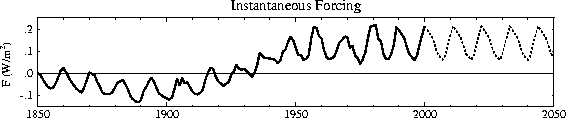
Crucial to the understanding of possible solar impact on terrestrial climate is accurate measurement of solar forcing. Unfortunately accurate measurement of incident solar radiation is only available since the satellite era, and even that is open to dispute: different groups find different values, due to different methods of cross-calibrating measurements taken by instruments with different spectral sensitivity.[1] Scafetta and Willson found significant variations of solar luminosity between 1980 and 2000.[55] But Lockwood and Frohlich[56] find that solar forcing has declined since 1987.
Effect on global warming
The Intergovernmental Panel on Climate Change (IPCC) Third Assessment Report (TAR) concluded that the measured magnitude of recent solar variation is much smaller than the amplification effect due to greenhouse gases but acknowledges in the same report that there is a low level of scientific understanding with respect to solar variation.[57][58]
Estimates of long-term solar irradiance changes have decreased since the TAR. However, empirical results of detectable tropospheric changes have strengthened the evidence for solar forcing of climate change. The most likely mechanism is considered to be some combination of direct forcing by changes in total solar irradiance, and indirect effects of ultraviolet (UV) radiation on the stratosphere. Least certain are indirect effects induced by galactic cosmic rays.[2]
In 2002, Lean et al.[59] stated that while "There is ... growing empirical evidence for the Sun's role in climate change on multiple time scales including the 11-year cycle", "changes in terrestrial proxies of solar activity (such as the 14C and 10Be cosmogenic isotopes and the aa geomagnetic index) can occur in the absence of long-term (i.e., secular) solar irradiance changes ... because the stochastic response increases with the cycle amplitude, not because there is an actual secular irradiance change." They conclude that because of this, "long-term climate change may appear to track the amplitude of the solar activity cycles," but that "Solar radiative forcing of climate is reduced by a factor of 5 when the background component is omitted from historical reconstructions of total solar irradiance ...This suggests that general circulation model (GCM) simulations of twentieth century warming may overestimate the role of solar irradiance variability." More recently, a study and review of existing literature published in Nature in September 2006 suggests that the evidence is solidly on the side of solar brightness having relatively little effect on global climate, with little likelihood of significant shifts in solar output over long periods of time.[11][60] Lockwood and Fröhlich, 2007, find that there "is considerable evidence for solar influence on the Earth's pre-industrial climate and the Sun may well have been a factor in post-industrial climate change in the first half of the last century," but that "over the past 20 years, all the trends in the Sun that could have had an influence on the Earth's climate have been in the opposite direction to that required to explain the observed rise in global mean temperatures."[61]
A paper by Benestad and Schmidt[62] concludes that "the most likely contribution from solar forcing a global warming is 7 ± 1% for the 20th century and is negligible for warming since 1980." This paper disagrees with the conclusions of a Scafetta and West study,[63] who claim that solar variability has a significant effect on climate forcing. Based on correlations between specific climate and solar forcing reconstructions, they argue that a "realistic climate scenario is the one described by a large preindustrial secular variability (e.g., the paleoclimate temperature reconstruction by Moberg et al.)[64] with the total solar irradiance experiencing low secular variability (as the one shown by Wang et al.).[65] Under this scenario, according to Scafetta and West, the Sun might have contributed 50% of the observed global warming since 1900.[10] Stott et al. estimate that the residual effects of the prolonged high solar activity during the last 30 years account for between 16% and 36% of warming from 1950 to 1999.[66]