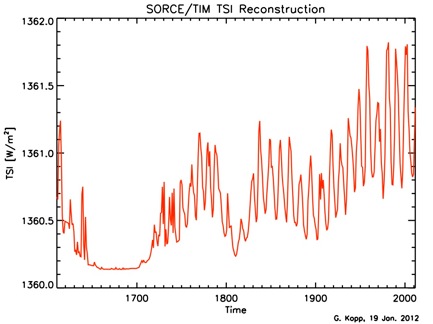
Here's the systems angle.. If you have storage in the system. and an imbalance in forcing persists at a constant level -- that storage element will integrate the forcing. What is the integral of a step function? It is a ramp. (or in generic terms a sloping line)
Is a solar step an imbalance? Check....
Are there storage and feedbacks in the system? Check..
So it is POSSIBLE to get the system to RAMP up.. Even if the input forcing remains at a constant imbalance.
You used to explain the "pause" (which I correctly pointed out never existed, but that's another story) as being because a step function usually creates a [1 - exp(-kt) ] type system response, which is asymptotic to a new equilibrium level.
And then the pause was debunked. And now your story is that a step function is creating a constant ramp response. Fine. That can work, if the "ramp" is just the beginning of the [1 - exp(-kt) ] curve.
Trouble is, if it's just beginning, we've got a long way to go. Many decades. Unless you think that ramping up is suddenly going to stop soon.
The problem with your theory is it's not disprovable. You can attribute any response to the sun. Oh wait, you can't attribute the stratospheric cooling to a solar increase. Only greenhouse gases explain that. Or why the outgoing longwave distribution changes to squeeze down in the GHG bands, or why the backradiation increases.