http://data.giss.nasa.gov/gistemp/
Current Analysis Method
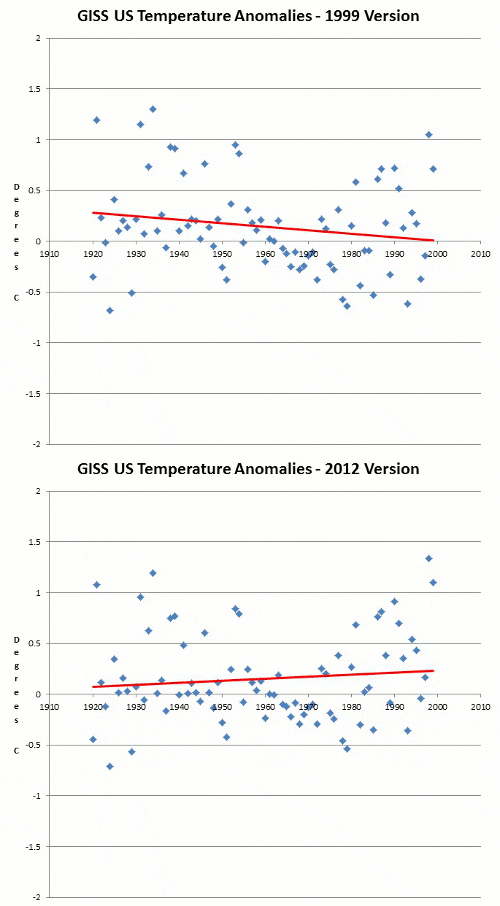
The current analysis uses satellite observed nightlights to identify measurement stations located in extreme darkness and adjust temperature trends of urban and peri-urban stations for non-climatic factors, verifying that urban effects on analyzed global change are small.
A paper describing the current analysis was published (Hansen et al. 2010) in Reviews of Geophysics in December 2010. The paper compares alternative analyses, and address questions about perception and reality of global warming. Alternative choices for the ocean data are tested. It is shown that global temperature change is sensitive to estimated temperature change in polar regions, where observations are limited. We suggest use of 12-month (and n×12) running mean temperature to fully remove the annual cycle and improve information content in temperature graphs. We conclude that global temperature continued to rise rapidly in the past decade, despite large year-to-year fluctuations associated with the El Niño-La Niña cycle of tropical ocean temperature. Record high global temperature during the period with instrumental data was reached in 2010. After that paper appeared, version 3 of the GHCN data became available. The current analysis is now based on the adjusted GHCN v3 data for the data over land. The ocean data are now based on NOAA ERSST for the sake of simplicity, replacing a prior concatenation of Hadley Center's HadSST1 and the satellite-based NOAA (Reynolds) OISST.
We maintain a running record of any modifications made to the analysis, available on our Updates to Analysis page.
Graphs and tables are updated around the middle of every month using the current adjusted GHCN-v3 and SCAR files. The new files incorporate reports for the previous month and late reports and corrections for earlier months.
The GHCNv3/SCAR data are modified to obtain station data from which our tables, graphs, and maps are constructed: The urban and peri-urban (i.e., other than rural) stations are adjusted so that their long-term trend matches that of the mean of neighboring rural stations. Urban stations without nearby rural stations are dropped.
The analysis is limited to the period since 1880 because of poor spatial coverage of stations and decreasing data quality prior to that time. Meteorological station data provide a useful indication of temperature change in the Northern Hemisphere extratropics for a few decades prior to 1880, and there are a small number of station records that extend back to previous centuries. However, we believe that analyses for these earlier years need to be carried out on a station by station basis with an attempt to discern the method and reliability of measurements at each station, a task beyond the scope of our analysis. Global studies of still earlier times depend upon incorporation of proxy measures of temperature change.
Programs used in the GISTEMP analysis and documentation on their use are available for download. The programs assume a Unix-like operating system and require familiarity with FORTRAN, C and Python for installation and use.
***************************************
Gosh, what an astounding lack of transparency.
ps: Iceland represents 2 ten-thousandths (0.02%) of the Earth's surface. It's climate is almost
totally dominated by the surrounding ocean. If GISS wanted to affect global trends, they picked a heck of a place to do it from.