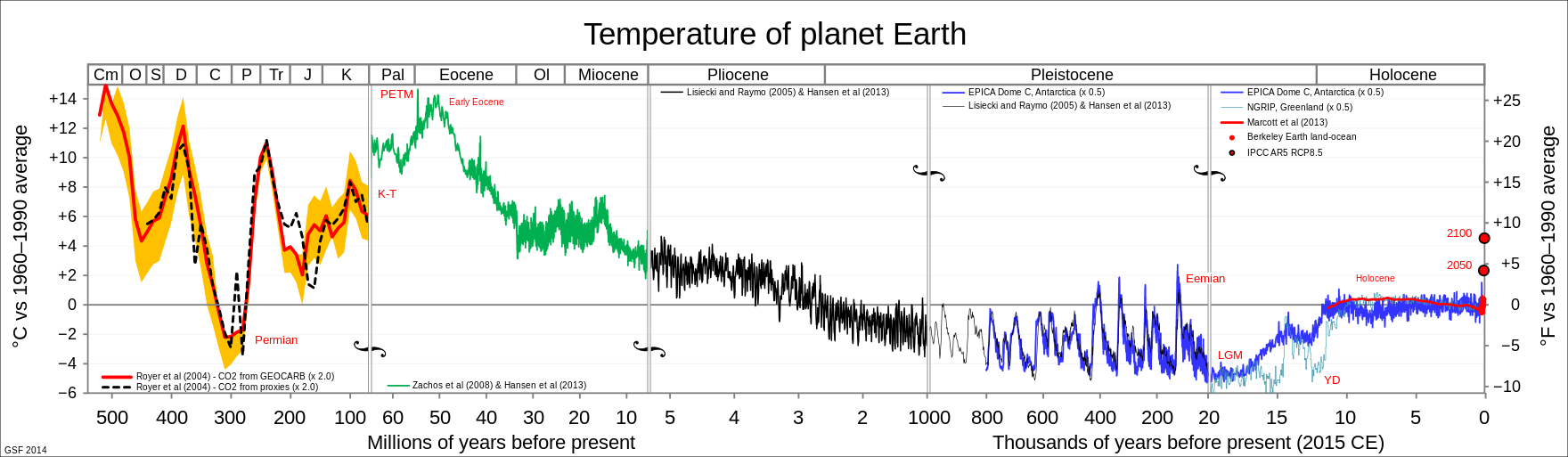
CO2 was higher in the late Ordovician
An argument used against the warming effect of carbon dioxide is that millions of years ago,
CO2 levels were higher during periods where large glaciers formed over the Earth's poles. This argument fails to take into account that solar output was also lower during these periods. The combined effect of sun and CO2 show good correlation with climate(
Royer 2006). The one period that until recently puzzled paleoclimatologists was the late Ordovician, around 444 million years ago. At this time, CO2 levels were very high, around 5600 parts per million (in contrast,
current CO2 levels are 389 parts per million). However,glaciers were so far-reaching during the late Ordovician, it coincided with one of the largest marine mass extinction events in Earth history. How did glaciation occur with such high CO2 levels? Recent data has revealed CO2 levels at the time of the late Ordovicianice age were not that high after all.
Past studies on the Ordovician period calculated CO2 levels at 10 million year intervals. The problem with such coarse data sampling is the Ordovician ice age lasted only half a million years. To fill in the gaps, a 2009 study examined strontium isotopes in the sediment record (
Young 2009). Strontium is produced by rock weathering, the process that removesCO2 from the air. Consequently, the ratio of strontium isotopes can be used to determine how quickly rock weathering removed CO2 from the atmosphere in the past. Using strontium levels, Young determined that during the late Ordovician, rock weathering was at high levels while volcanic activity, which adds CO2 to the atmosphere, dropped. This led toCO2 levels falling below 3000 parts per million which was low enough to initiate glaciation - the growing of ice sheets.
What the scientists have found.