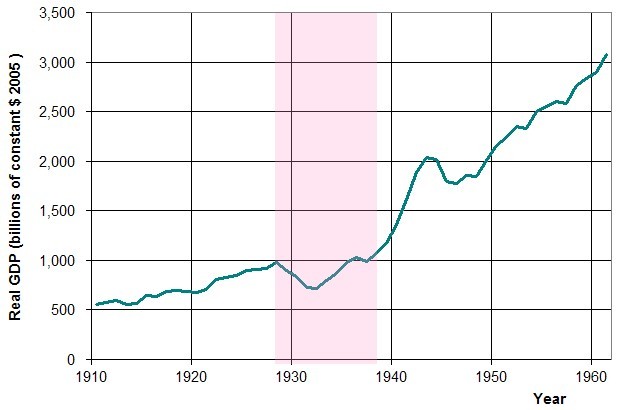
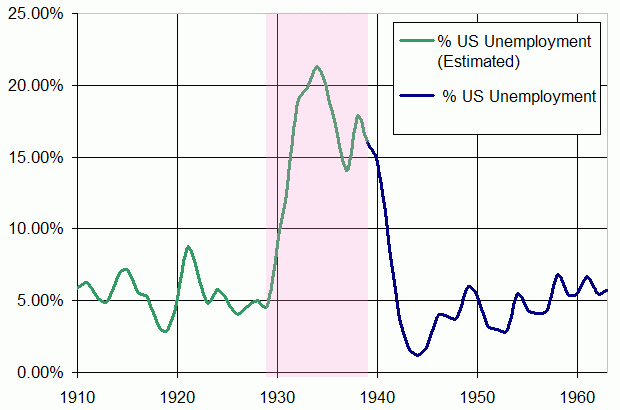
FDR policies lengthened the depression.
We can always count of the right wing parrots to mindlessly repeat the FALSE propaganda they are being spoon fed... you are more predictable that Pavlov's dogs.
Jesus, you're a dumb-ass.
The Depression started in 1929. Some countries started to recover in the mid 30s.
Not the United States. It took World War II to get us out of the depression.
The productivity you showed has no dates but I would be willing to bet it was war production in the 40s.
Let me find the real numbers.
Oh, holy shit look at that!!!
WHAT countries outperformed the USA? I want names, numbers and form of government; democracy, dictatorship??? America didn't start to recover in the early 1930's, FDR didn't take office until March 4, 1933.
Hey Einstein, can't you read a chart? The
Key is in the ledger. Each of those bars signify one term in office. You don't need dates because we know when each President served. The first bar represents FDR's First term, 19331937
The Hoover/Mellon austerity turned a recession into a depression. Secretary of the Treasury Andrew Mellon's formula: "Liquidate labor, liquidate stocks, liquidate the farmers, liquidate real estate."
FDR and the New Deal created the LARGEST increase in GDP in American history.
Gross Domestic Product (GDP)
Percent change from preceding period
GDP percent change based on current dollars
1930 -12.0
1931 -16.1
1932 -23.2
1933 -3.9 <-----FDR takes office. BUT, it is still Hoover's budget
1934 17.0 <-----FDR's FIRST budget year.
1935 11.1
1936 14.3
1937 9.7
1938 -6.3
1939 7.0
1940 10.0
1941 25.0
1942 27.7
1943 22.7
1944 10.7
1945 1.5 <-----FDR dies.
FDR had his own right wing regressives to contend with,
HERE is where that led.
The Recession of 19371938 was a temporary reversal of the pre-war 1933 to 1941 economic recovery from the Great Depression in the United States. Economists disagree about the causes of this downturn, but agree that government
austerity reversed the recovery. wiki
Gee, where did I hear austerity recently?
Tea party austerity plan: Would slashing US spending work?
Cutting $2.5 trillion in government spending over 10 years is the tea party's first step toward its 'small government' vision. Whether such measures will boost the economy or add jobs is a leap of faith, economists say.
Can America cut its way to prosperity by reducing government spending by hundreds of billions of dollars starting now and for each year to come for 10 years?
That's the assertion of tea party conservatives and fiscal hawks in Congress, whose economic plan would reduce government spending by a collective $2.5 trillion within a decade. Most nondefense government spending would get cut by 40 percent, and the share of the gross domestic product attributed to government would drop from 25 percent to 18 percent. The eventual benefit, supporters of the plan say, would be a reinvigorated private sector.
Contrast that with President Obama's competing vision for a renewed economy. His economic fix, as outlined Tuesday in the State of the Union address, is to invest in the education and energy sectors, hold the line for five years on so-called discretionary spending which has jumped 84 percent in the past two years and slash corporate tax rates, a strategy that helped kick-start the economy in the 1960s and mid-1980s. He offered a relatively modest $400 billion in spending cuts over five years (not including cuts in defense).
The Christian Science Monitor
Will blood letting make the patient better???
Mere parsimony (frugality, stinginess) is not economy. Expense, and great expense, may be an essential part in true economy.
Edmund Burke
300 Economists Warn Congress: Don't Kill Growth And Jobs In The Name Of Deficit Reduction
A small army of economists warned Congress on Thursday not to focus on deficit reduction instead of job creation or else risk a 1937-style double-dip recession.
"History suggests that a tenuous recovery is no time to practice austerity," says a statement signed by more than 300 economists and policy experts. "In the Great Depression, Franklin Roosevelt's New Deal generated growth and reduced the unemployment rate from 25 percent in 1932 to less than 10 percent in 1937. However, the deficit hawks of that era persuaded President Roosevelt to reverse course prematurely and move toward budget balance. The result was a severe recession that caused the economy to contract sharply and sent the unemployment rate soaring."
Democrats in Congress have had 1937 in mind since March 2009. "We're not going to let it happen again," vowed House Speaker Nancy Pelosi (D-Calif.) at the time.
Nevertheless, deficit hawks dominated the debate in Congress this summer as Democratic leaders struggled to reauthorize a series of programs created by the 2009 stimulus bill. Pelosi and her counterparts in the Senate have had seemingly little choice other than to sacrifice things like COBRA health insurance subsidies and enhanced unemployment benefits to win the support of deficit-hawkish Democrats and moderate Republicans.
"This is about a high road to recovery versus a low road to fiscal balance," said Bob Kuttner of the American Prospect and co-author of the statement, along with the Center for Economic and Policy Research's Dean Baker and the Robert Borosage and Roger Hickey from the Institute for America's Future. "The proper sequencing is: You get the recovery first, that requires increased public investment. And then the road to fiscal balance is much less arduous because people are working, businesses are investing, and tax revenues go up because you're back in recovery.
"There is also a low road to fiscal balance, where you have austerity and you get the budget balanced at the cost of whacking the real economy."
Click
HERE to download a PDF of the report.