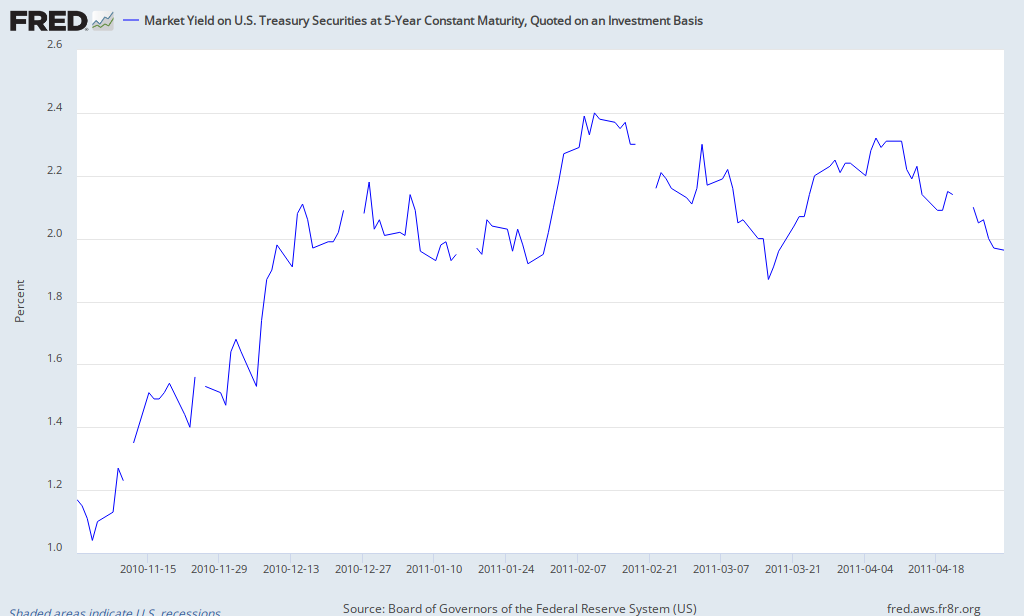
Are you saying demand does not affect price? The Fed is a massive buyer of securities. They make almost all of the other whales look like minnows. Buying increases the price. That's what the Fed is doing.
If you believe that the tbond is some indicator of growth, you are saying that the bond mkt is forecasting a decade of negative economic growth. I know no one in the bond mkt who believes that. When I talk to guys who buy bonds, they are first and foremost focused on what the Fed is doing. It's not some textbook theoretical construct.
That's exactly what I'm saying. If you want to talk about textbook constructs, I think you've gone ahead and implicitly assumed one: downward sloping demand curves. A demand curve only slopes downward, and so affects price, if utility from the good in question experiences
diminishing marginal returns. Does that assumption hold for a T-Bond?
What's the marginal benefit from a T-bond? The more or less standard approach is that it's the discounted expected future cash flows. Maybe that's where you disagree? I'm assuming that's the benefit from holding a bond, which is why we can can "value" bonds mathematically, something you can't do for say, apples. Given that, we discount it with the term structure plus any relevant premia. So the value of the bond doesn't depend on the quantity in circulation, just the parameters mentioned. Given those parameters, the demand curve for the bond is horizontal.
"If you believe that the tbond is some indicator of growth, you are saying that the bond mkt is forecasting a decade of negative economic growth."
That doesn't follow.
" When I talk to guys who buy bonds, they are first and foremost focused on what the Fed is doing"
Okay, what are they saying? I presume it's to get better estimates of expected future interest rates. If the Fed does more QE, it can be taken as a signal that they'll hold off on tightening for a while, so rates will stay at zero. If their demand curve slopes downward, why?