Trials conducted in Guinea, one of the West African countries most affected by an outbreak of Ebola that ended this year, show it offers 100% protection. The vaccine is now being fast-tracked for regulatory approval. Manufacturer Merck has made 300,000 doses of the rVSV-ZEBOV vaccine available for use should Ebola strike. GAVI, the global vaccine alliance, provided $5m for the stockpile.
Results, published in The Lancet medical journal, show of nearly 6,000 people receiving the vaccine, all were free of the virus 10 days later. In a group of the same size not vaccinated, 23 later developed Ebola. Only one person who was vaccinated had a serious side effect that the researchers think was caused by the jab. This was a very high temperature and the patient recovered fully. It is not known how well the vaccine might work in children since this was not tested in the trial.
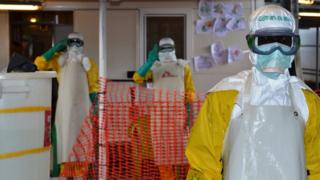
Health workers wearing protective gear at the Nongo Ebola treatment centre in Conakry, Guinea
Analysis - Tulip Mazumdar, Global Health Correspondent
Ebola has been around for 40 years now. But it wasn't until the height of the 2014 outbreak in West Africa that the world decided to invest some serious money into finding treatments and cures. I watched as families of those who had become infected were isolated in their homes. Often entire neighbourhoods were quarantined behind orange fencing. That was their best chance of not becoming infected and infecting others. But as hundreds of people continued to die, and cases started being exported to Europe and the US - the world decided to act. Now, two years later, we have a vaccine. It usually takes around 10 years.
There were some mild side effects reported in this trial, and the vaccine is only known to protect against one of the strains of Ebola, but it is the most deadly Zaire strain. Today's news is a very welcome and much needed breakthrough. However, as the WHO points out, more lives would be saved if countries invested in vaccines before outbreaks, rather during them. The director of British-based medical research institute the Wellcome Trust described the findings as "remarkable". "Had a vaccine been available earlier in the Ebola epidemic, thousands of lives might have been saved," Jeremy Farrar said. "We have to get ahead of the curve and make promising diagnostics, drugs and vaccines for diseases we know could be a threat in the future."
MORE