The Stefan-Boltzmann Law is this, and no more.
Clearly you are just plain stupid...
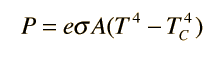
SSDD pretends that the S-B law has a second term. It doesn't. He made that up.
The above equation describes a black body radiating into a vacuum...Thanks for thinking I am smart enough to have derived the equation one uses when the object is not a black body and not radiating into a vacuum...but alas, I didn't .
The S-B Law, that one term, says the only thing controlling the radiation of matter is its own temperature and emissivity. There's jack in the S-B Law about the temperature of nearby matter. Nearby matter means nothing. Matter emits according to its own temperature, period.
Poor idiot...the equation above describes a black body radiating into a vacuum...nothing more...if that were all, then the SB law couldn't be applied to anything but a perfect black body (doesn't exist) in a perfect vacuum. Apparently this is all so far over your head that you have no hope of ever catching up.
By the way...a while back I had this discussion with Ian..I took a few minutes and wrote a note to a few top shelf scientists scattered across the globe. I admit that I played the part of the simpleton who doesn't understand such a basic concept rather than get them involved, by default, into this stupid discussion.
The text of my note went as follows:
Greetings Dr. XXXX
I am terribly sorry to bother you with such a basic question, but I am curious, but unable to find a satisfactory answer on the internet and would like an answer from a scientist of some stature if possible regarding the Stefan-Boltzman law. Does the following equation describe a perfect black body radiating into a vacuum, or just any radiator radiating anywhere?
I was under the impression that if the radiator was not in a vacuum (in the presence of any other matter) that the following form of the Stefan Boltzman law must be applied.
Again, sorry to bother you with such a basic question, but I really would appreciate a short answer if possible.
Thank You,
xxxxxxxxx
I got a couple of responses.
The first was from Dr Adrian Melott. His was the first note I sent and I only sent the first equation. I modified the note after sending his to add the second statement regarding the second equation.
Here is Dr. Melott's web page with the University of Kansas.
Adrian L. Melott at the University of Kansas
He states :
" If it were not in a vacuum, some modifications might be needed."
The second response was from Dr. Eric Poisson. He received the note above (as did all the rest that I sent) in its entirety.
Here is Dr. Poisson's web page from the University of Guelph
Eric Poisson
He states:
" Hi,
the second formula applies only when the radiator is immersed in a thermal bath at temperature Tc. The first formula applies in vacuum, but it also applies when the radiator is immersed in a medium that happens to be cold (Tc = 0K).
Cheers!
Eric
So you believe what you want hairball...but the fact is that you are wrong...always have been wrong and very likely will always be wrong...