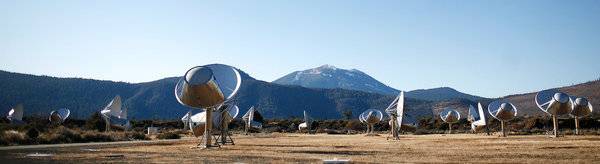
Operating on money and equipment scrounged from the public and from Silicon Valley millionaires, and on the stubborn strength of their own dreams, a band of astronomers recently restarted one of the iconic quests of modern science, the search for extraterrestrial intelligence SETI, for short which had been interrupted last year by a lack of financing. Early in December, a brace of 42 radio telescopes, known as the Allen Telescope Array, nestled here in the shadow of Lassen Peak, came to life and resumed hopping from star to star in the constellation Cygnus, listening for radio broadcasts from alien civilizations. The lines are now open, but with lingering financial problems, how long they will remain that way is anybodys guess. These should be boom times for those seeking out aliens, or at least their radio proxy.
Astronomers now know that the galaxy is teeming with at least as many planets the presumed sites of life as stars. Advanced life and technology might be rare in the cosmos, said Geoffrey W. Marcy, the Watson and Marilyn Alberts in the Search for Extraterrestrial Intelligence professor at the University of California, Berkeley, but surely they are out there, because the number of Earthlike planets in the Milky Way galaxy is simply too great. A simple howdy, a squeal or squawk, or an incomprehensible stream of numbers captured by one of the antennas here at the University of Californias Hat Creek Radio Observatory would be enough to end our cosmic loneliness and change history, not to mention science. It would answer one of the most profound questions humans ask: Are we alone in the universe?
The telescopes in the Allen Array in Hat Creek, Calif., came back to life in December, scanning for signals in the constellation Cygnus. Only 42 of the planned 350 antennas have been built.
Despite decades of space probes and billions of NASA dollars looking for life out there, there is still only one example of life in the universe: the DNA-based web of biology on Earth. In this field, said Jill Tarter, an astronomer at the SETI Institute in Mountain View, Calif., the number two is the all-important number. We count one, two, infinity. Were all looking for number two. But the story of SETI is the story of a dream deferred by politics, a lack of money and the technological challenges of searching what astronomers call the cosmic haystack: 100 billion stars in the galaxy and 9 billion narrow-band radio channels on which aliens, if they exist, might be trying to hail us.
Politics and the recession have crimped astronomers budgets and left the institutes scientists with a kind of siege mentality. Last spring, the University of California ran out of money to run the Hat Creek observatory, forcing the Allen telescopes into hibernation. In order to continue the search, astronomers are negotiating a deal to share the telescopes with the Air Force, which wants to use them to track satellites and space junk. No federal funds have been spent searching for radio signals from extraterrestrials since 1993. A recent visit to the SETI Institutes Mountain View offices found many of the cubicles empty and the corridors eerily quiet. Last summer, as the Allen telescopes slumbered, weeds grew around them.
998,000 Stars to Go