Donald Trump is the David Blaine of politics . . . a master of misdirection and fakery. Where other people have a soul, Trump has black hole

2022%2010%2031%20Trump%20in%20the%20mind%20of%20liberals-S.jpg
i'm not a liberal
 
"I want to talk to the Trump supporters for a minute. I don't know who you are, and I don't know why you like this guy...Here's what you're buying. He's a race-baiting, xenophobic religious bigot. He doesn't represent my party. He doesn't represent the values that the men and women who wear the uniform are fighting for."


"He doesn't have the temperament or judgement to control himself when he gets mad. This is kook land."

"I'm not gonna try to get into the mind of Donald Trump, because there's not a whole lot of space there. I think he's a kook. I think he's crazy. I think he's unfit for office. I'm a Republican, he's not. He's not a conservative Republican. He's an opportunist."


hes-a-highly-S.jpg
 
Donald Trump is, unarguably, a skilled “con artist”—the car salesman obsessed with getting you behind the wheel, whether the car is safe and affordable or not. Starting out as a local, grasping celebrity in earlier decades, he’d rely on such squalid artifices as pretending to be his own press agent whispering to columnists in a disguised voice how great he was in bed (really)—or enhancing the value of a Trump building by simply skipping floors 49 to 59 on the elevator’s button panel . . . small potatoes stuff compared to today.
 
We’ve had great presidents and awful ones. All had flaws. But never before has there been one so provably corrupt, impulsive, ignorant, incompetent, untruthful, work lazy, lacking empathy, antidemocratic, racist, sexist, ruthless, bullying, petty, arrogant, and endlessly self-centered and self-enriching. It’s not easy to meld all these different handicaps into one sentient human form. Yet in a feat worthy of a mass illusionist, the current Oval Office occupant has nonetheless convinced millions—though still a minority of Americans—to support him to spite themselves.
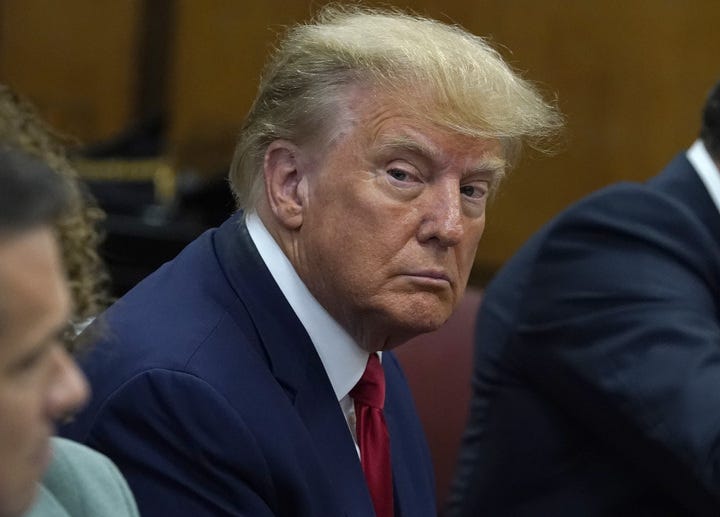
You’re a weird dude….
 
Trump has always seen himself as an outsider, and he is very insecure about not being accepted. This came partly from his father Fred Trump’s outsider status in New York business circles, with a real estate enterprise focused in Queens, rather than Manhattan. Fred Trump’s business reputation was not particularly good. (Fred’s father, Friedrich “Fritz” Trump, emigrated from Germany after dodging the draft, and he ran hotels in Washington State and Alaska that were rumored to provide prostitution services on the side.) Fred Trump was skittish around White Anglo-Saxon Protestant (WASP) businessmen who ran in Manhattan circles. The Trumps may have been Protestants, but old money WASPs often looked down on them as typical nouveau riches. (Trump’s name has been noted in society pages for its absence in the Social Register.) The Trumps’ German ancestry made them feel so insecure that Fred Trump pretended the family was Swedish in the years after World War II.

As the Trumps acquired more wealth, they were not the type to be invited to join country clubs. Once Donald took over the family real estate business, the Trumps built their own country clubs. They didn’t try to buy an apartment and gain admission to snobbish Upper East Side co-ops, which often discriminated against prospective buyers for a range of reasons. They built their own co-ops and condos.

Those who wanted to get along with the Trumps would join a Trump country club, live in a Trump building, or both—that is how Kellyanne Conway first met Donald Trump, for example.
 
yea how dare i talk about politics in a political forum? SOOO WEIRD!
Constantly flip-flopping on your politics and peppering half of your posts with homoerotic undertones is a little weird.

But you do you.
 
Constantly flip-flopping on your politics and peppering half of your posts with homoerotic undertones is a little weird.

But you do you.
i don't flip flop. i just criticize everyone equally. can you give examples of "homoerotic undertones"?
 
Social climbing for Donald Trump was not climbing someone else’s ladder but instead perching himself atop a pedestal, lowering a ladder from it, and inviting others to climb up the ladder toward him.

Perhaps there is something admirable in this singular focus on dictating one’s own definition of status and success rather than striving to meet someone else’s definition. But if anyone wonders where Donald Trump’s self-centeredness comes from, this is part of the story. Equally significant was his very deep suspicion of the establishment, whether it be establishment businessmen, social circles, country clubs, parties, or charitable boards of large Manhattan cultural institutions that he almost never joined. If America could ever create a billionaire who even in times of great business success (he had some) was still an anti-establishment outsider, Donald Trump was it.
 
Trump has always seen himself as an outsider, and he is very insecure about not being accepted. This came partly from his father Fred Trump’s outsider status in New York business circles, with a real estate enterprise focused in Queens, rather than Manhattan. Fred Trump’s business reputation was not particularly good. (Fred’s father, Friedrich “Fritz” Trump, emigrated from Germany after dodging the draft, and he ran hotels in Washington State and Alaska that were rumored to provide prostitution services on the side.) Fred Trump was skittish around White Anglo-Saxon Protestant (WASP) businessmen who ran in Manhattan circles. The Trumps may have been Protestants, but old money WASPs often looked down on them as typical nouveau riches. (Trump’s name has been noted in society pages for its absence in the Social Register.) The Trumps’ German ancestry made them feel so insecure that Fred Trump pretended the family was Swedish in the years after World War II.

As the Trumps acquired more wealth, they were not the type to be invited to join country clubs. Once Donald took over the family real estate business, the Trumps built their own country clubs. They didn’t try to buy an apartment and gain admission to snobbish Upper East Side co-ops, which often discriminated against prospective buyers for a range of reasons. They built their own co-ops and condos.

Those who wanted to get along with the Trumps would join a Trump country club, live in a Trump building, or both—that is how Kellyanne Conway first met Donald Trump, for example.

I voted for Trump twice.

I do not think I have ever typed this much about him, nor even thought about him as much as the above. Dude, I hired him to do a job, not fulfill--whatever.

In my life I have a lot of men who fill a lot of roles. Father. Husband. Son. Boss. Pastor. I don't need The Donald for any of them, so I don't look to him personally for anything. At all.

Starting to think the lack of strong, dedicated men in our society is the root of the obsession with Trump. We really do look to our politicians for much more than they should be/do. Sad. And disturbing.
 
Trump never had to work for anybody else but himself, and very briefly for his father. He avoided the draft during Vietnam (the unsubstantiated foot maladies). He became a very rich businessman (at times) and worked hard (at times), but he never had to work for an organization or play by someone else’s rules.

He worked for his father at a very young age, but within years of graduating from college, he was given millions in “start-up” capital (apparently about $15 million) and a great deal of autonomy to put together real estate deals in new places where his father had done very little business—at first mostly Manhattan, which his father had always avoided.

Most successful businesspeople have at some point worked in organizations where others make the rules. Law firms and investment banks have partners or managing directors. ( Michael Bloomberg was an employee and then a partner of Salomon Brothers before setting up his own company in midlife.) Corporations have boards of directors that hire and fire top officers. Most organizations—including all public corporations—are bound by disclosure rules requiring that financial books and records be available to investors, and often to the public. Under federal securities laws, executives can be imprisoned for inaccurate records. Accountability and transparency are required.

How well these transparency and accountability rules are enforced for public companies is arguable, but with private family-owned companies such as the Trump Organization, there are no such rules. Business records, including financial statements and the names of foreign and domestic investors and lenders, are kept private. The business owner runs the show.
 
Unable to muster the chaos on the streets he initially hoped for, Trump played it safe, saying nothing before the hearing and nothing of substance in court. Pro- and anti-Trump protesters, including a handful of elected officials, squabbled with one another outside the courthouse, but the scene was tame compared to the chaos of the January 6 riots.
 
15th post
Trump lives at the end of his nerves and at the top of his lungs

he's finished
 
Back
Top Bottom