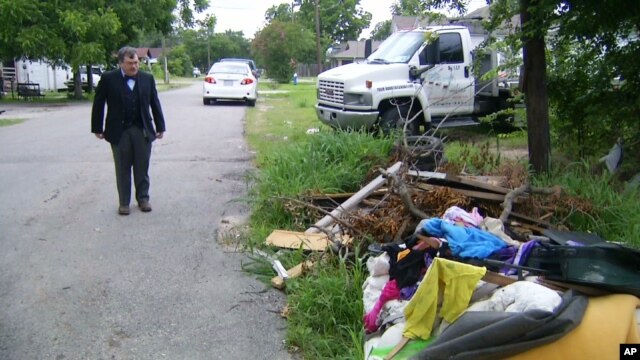
On a hot, humid day this month, Hotez pointed at one pile that included old tires and a smashed-in television with water pooling inside. It was a textbook habitat for the mosquitoes that carry and transmit the Zika virus, and one example of the challenge facing public health officials. "I'm showing you Zika heaven," said Hotez, the tropical medicine dean at Baylor College of Medicine. Hotez and other tropical disease specialists are most concerned about impoverished urban areas and along the Gulf Coast, where the numbers of the mosquito that spreads Zika are expected to spike. Texas already has dealt with dengue fever, transmitted by the same mosquito. Zika causes only a mild and brief illness, at worst, in most people. But it can cause fetal death and severe brain defects in the children of women infected during pregnancy.
So far, Texas officials have reported 48 people infected with Zika, all associated with travel. In one case, the virus was sexually transmitted by someone who had been infected abroad. Public health officials have spent months preparing for what they are certain will be at least some locally transmitted cases. "It's not a matter of if, it's a matter of when," said Dr. Umair Shah, the executive director of the Harris County public health department. Florida and other states in the South where the Aedes aegypti mosquito is present also are taking steps to prepare. In Florida, for example, Gov. Rick Scott used his emergency powers last week to authorize spending up to $26.2 million for Zika.
Dr. Peter Hotez, Dean of the Baylor College of Tropical Medicine, shows an Associated Press reporter and video journalist areas of Houston's 5th Ward that may be at high risk for mosquitoes capable of transmitting the Zika virus in Houston, Texas
His action comes as Congress remains stalemated on President Barack Obama's $1.9 billion proposal to fight the virus. A scaled-back $1.1 billion Republican-drafted measure was blocked in the Senate on Tuesday by Democrats opposed to its denial of new funding for Planned Parenthood clinics in Puerto Rico, where there already are more than 1,800 locally acquired cases, and to easing rules on pesticide spraying. In Texas, major cities have sophisticated mosquito screening programs and years of dealing with other mosquito-borne illnesses like dengue and West Nile virus. But local authorities in most of the state have limited or no mosquito surveillance. The mosquitoes they do capture are typically sent to outside labs, and getting results can take weeks. The smallest counties often have a single person driving around conducting surveillance — "Chuck in a truck," Hotez calls it.
The state health department has spent more than $400,000 since the start of the year to expand its lab capacity and to buy mosquito traps. It also launched a $2 million Zika awareness campaign. Shah said there are cuts that can be made, "but there comes a point where you stretch people too much." In Harris County, which encompasses Houston and is the third-most populous county in the U.S., officials aren't waiting for the federal government. They purchased their own testing machines and have retrofitted two labs to run tests only for Zika to get results faster. Mosquito traps are set out on lawns and inside sewers in more than 250 designated areas. Thus far, no mosquitoes have tested positive for Zika.
MORE