Not doing so, he said during a committee hearing on maritime security strategy in the Asia-Pacific, was “a dangerous mistake that grants de-facto recognition of China’s man-made sovereignty claims.” Pressed as to the last time U.S. Navy ships did enter the waters within 12 miles of the artificial islands, assistant secretary of defense for Asian and Pacific security affairs David Shear told McCain that had happened in 2012. Elsewhere in the South China Sea, he said, the U.S. had conducted “freedom of navigation operations” most recently last April. (Freedom of navigation operations are those that assert the navy’s rights to sail both within 200 nautical mile exclusive economic zones and 12 nautical mile territorial waters recognized under the U.N. Convention on the Law of the Sea.)
The Arleigh Burke-class guided-missile destroyer USS Mustin on patrol in the South China Sea
Shear stressed that carrying out such operations was just one tool available to the military “in fixing this issue.” “As we move forward we are going to consider freedom of navigation operations along with a variety of other options to ensure that both the Chinese and the region understands that we can operate, and we do operate, anywhere we can.” McCain retorted, “The best sign of respecting freedom of the seas is not to de-facto recognize a 12-mile limit, and the best way you can make sure that is not recognized is to sail your ships in international waters – which it clearly is, these are artificial islands – and pass right on by.” “We haven’t done that since 2012,” he said. “I don’t find that acceptable, Mr. Secretary, and with all the other tools you have in the toolbox, the most visible assertion of freedom of the seas is to peacefully sail inside the 12-mile limit of artificial islands.”
The littoral combat ship USS Fort Worth transits the South China Sea
McCain recalled that China had recently sailed navy vessels in U.S. territorial waters near Alaska – within 12 miles of the Aleutian Islands – as President Obama ended a visit to the state. Under the Law of the Sea, ships have the right of “innocent passage” through the territorial seas of a coastal state, so China’s actions were deemed not to have violated international law. McCain acknowledged that, but added “we have not been asserting our rights just as forcefully.”
‘The South China Sea is no more China’s than the Gulf of Mexico is Mexico’s’
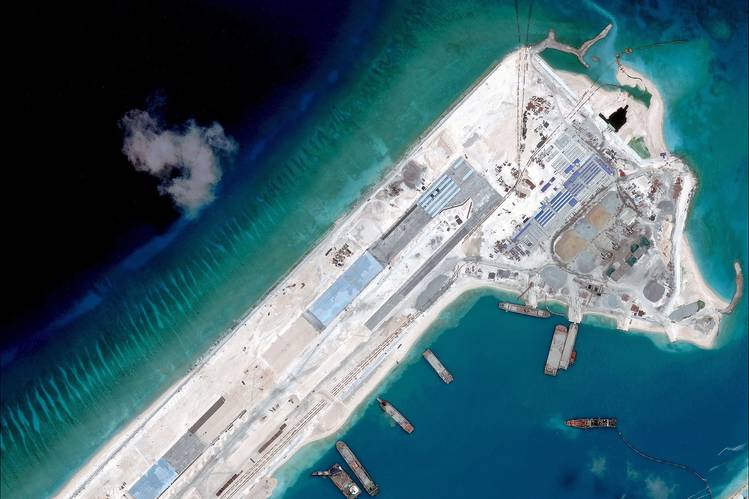
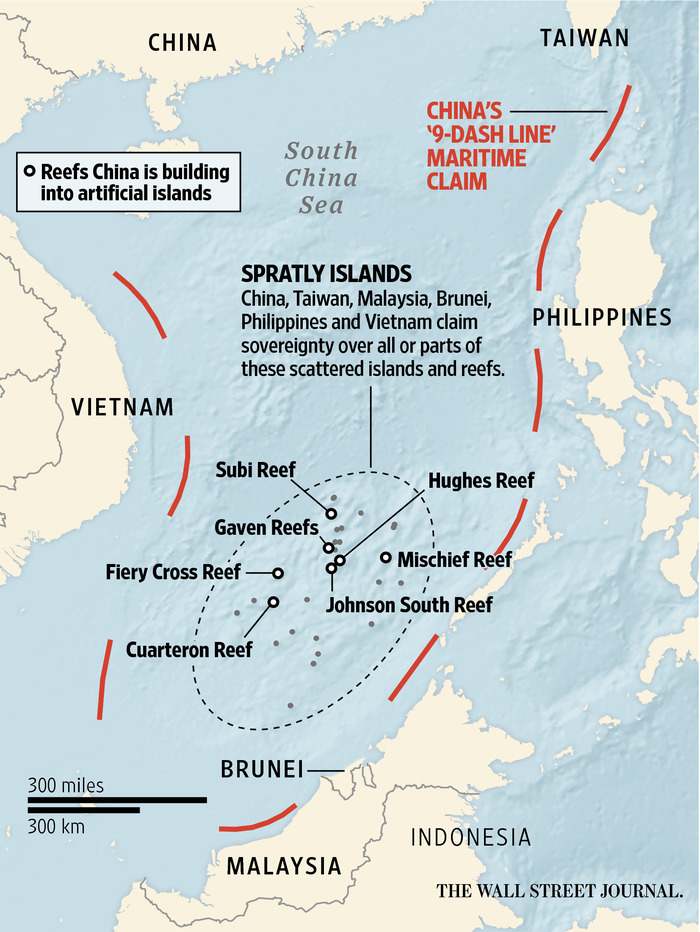
China is embroiled in territorial disputes with a handful of South-East Asia countries including Vietnam and the Philippines over resource-rich areas of the South China Sea, an area that includes some of the world’s most crucial shipping trade corridors. Chinese “land reclamation” projects in the area have expanded rocky outcrops into sizeable artificial islands. Early this week a Chinese admiral said in London that “the South China Sea, as the name indicates, is a sea that belongs to China.” Shear said he agreed with McCain that “the South China Sea doesn’t belong to China” and added that carrying out future freedom of navigation missions was “one of the array of options we’re considering –” “Well it’s an option that hasn’t been exercised in three years,” McCain interjected.
MORE