Tuesday, President Obama called the abductions "outrageous" and "heartbreaking'' and said Nigeria has agreed to accept U.S. law enforcement and military assistance. "We've already sent in a team to Nigeria. They've accepted our help through a combination of military, law enforcement and other agencies who are going in, trying to identify where in fact these girls might be and provide them help,'' Obama told ABC News. Distraught parents of the stolen children have charged that officials stalled on action to free them, and international condemnation has grown amid protests in major cities. Demands for action have increased on social media, especially through the Twitter hashtag #BringBackOurGirls.
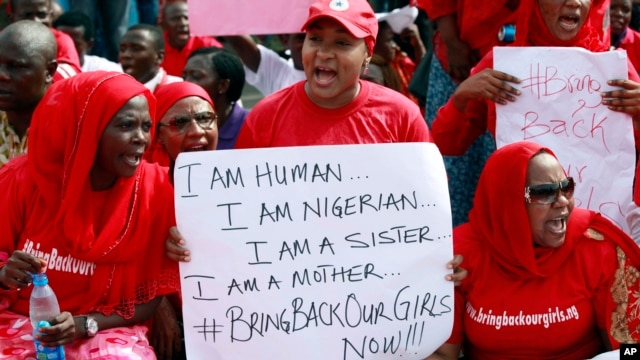
One of the mothers of the missing Chibok school girls wipes her tears as she cries during a rally by civil society groups pressing for the release of the girls in Abuja on Tuesday.
More than 300 girls were abducted. Of that number, 276 remain in captivity and 53 escaped. Tuesday, an additional eight girls were abducted from a village near a terrorist stronghold in the area. The schoolgirls have been held for three weeks by the Muslim terrorist organization Boko Haram, which has killed thousands of Christians and Muslims in an attempt to bring strict Islamic law to all of Nigeria. It declared plans to sell the girls or have them married to its members. "We've always identified them as one of the worst local or regional terrorist organizations there is out there,'' Obama told NBC News. "And I can only imagine what the parents are going through.'' U.S. House Minority Leader Nancy Pelosi, D-Calif., called the kidnappings an "unthinkable tragedy'' and "an offense to the conscience of the world.'' "The threat by Boko Haram's leader to sell them in the marketplace reflects the utter absence of humanity,'' Pelosi said.

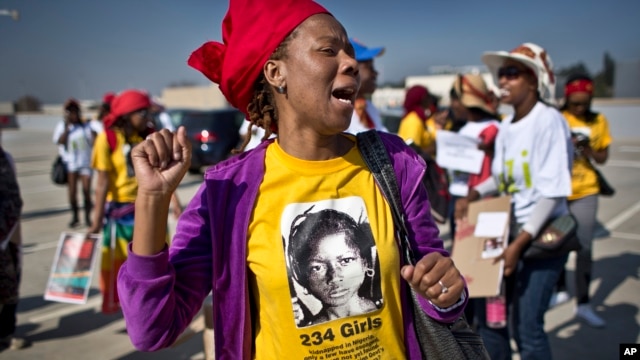
Mia Kuumba brandishes a wooden stick during a protest May 6 at the Nigerian Embassy in Washington against the kidnapping of 276 girls. Militants from the Boko Haram group kidnapped the teenage schoolgirls on April 14 in Chibok province, Nigeria.
Protesters have begged for international help, and some Nigerians blame their government. The government cannot sit back and watch how these little girls suffer. Their families are traumatized,'' said Nigerian Sen. Ali Ndume, who represents the region. "The government needs to do something extra, even if seeking external support, to ensure these girls are rescued." Edmond Keller, a UCLA political science professor specializing in Africa, said the episode is part of continuing low-intensity conflicts in the northeastern part of Nigeria, and Nigerians have regarded terrorist violence as commonplace. "It took something as dramatic as the kidnapping of these young women to really get people's attention,'' Keller said. "Nigerians themselves have been loudly complaining about the government not doing much, but they hadn't protested in the streets up until recently.''
Boko Haram leader Abubakar Shekau
He did not see racism as a factor in the slow international reaction to the kidnappings, but he said that in general, the West is more concerned about human rights in Ukraine, Syria and other world hot spots than in Africa. "There's a certain amount of racism involved in the tendency to look upon African conflicts as being normal and being a part of the way Africans behave, as opposed to something whites need to be concerned with,'' he said. Girls from the Chibok Government Girls Secondary School are the latest victims in a long-running Islamist militancy straining relations between a north dominated by Muslims and a Christian-centric south. Boko Haram is especially opposed to educating girls. Its name translates as "Western education is forbidden."
More
Nigerians beg for help for kidnapped girls