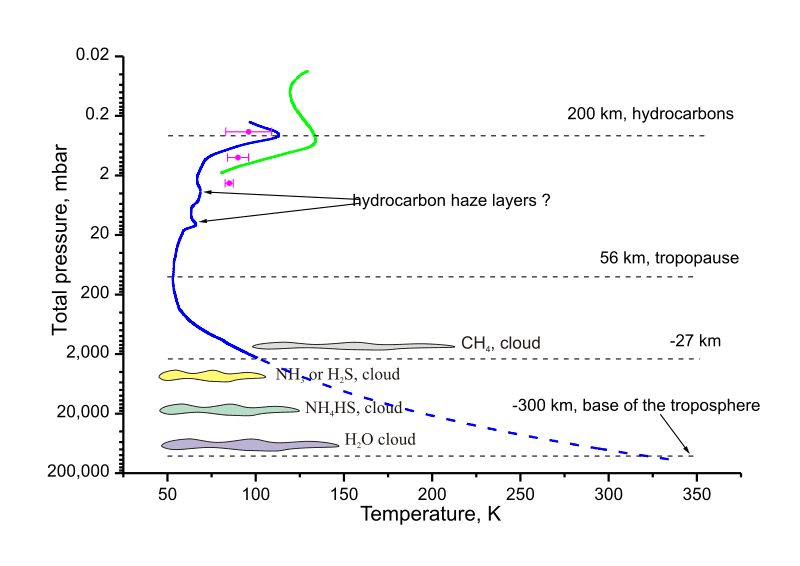
Why don't you explain, using the greenhouse hypothesis as described by climate science, why the base of the troposphere on Uranus is 33K warmer than the base of the troposphere on earth even though Uranus is 30X further away from the sun than earth and has an atmosphere composed almost entirely of hydrogen and helium.
From Wikipedia's article on Uranus:
It is the coldest planetary atmosphere in the Solar System, with a minimum temperature of 49 K (−224.2 °C), and has a complex, layered cloud structure, with water thought to make up the lowest clouds, and methane the uppermost layer of clouds. In contrast, the interior of Uranus is mainly composed of ices and rock.
...
The standard model of Uranus's structure is that it consists of three layers: a rocky (silicate/iron-nickel) core in the center, an icy mantle in the middle and an outer gaseous hydrogen/helium envelope. The core is relatively small, with a mass of only 0.55 Earth masses and a radius less than 20% of Uranus's; the mantle comprises its bulk, with around 13.4 Earth masses, whereas the upper atmosphere is relatively insubstantial, weighing about 0.5 Earth masses and extending for the last 20% of Uranus's radius. Uranus's core density is around 9 g/cm3, with a pressure in the center of 8 million bars (800 GPa) and a temperature of about 5000 K. The ice mantle is not in fact composed of ice in the conventional sense, but of a hot and dense fluid consisting of water, ammonia and other volatiles. This fluid, which has a high electrical conductivity, is sometimes called a waterammonia ocean.
According to research conducted at the University of California, Berkeley, the extreme pressure and temperature deep within Uranus may break up the methane molecules, with the carbon atoms condensing into crystals of diamond that rain down through the mantle like hailstones. Very-high-pressure experiments at the Lawrence Livermore National Laboratory suggest that the base of the mantle may comprise an ocean of liquid diamond, with floating solid 'diamond-bergs'.
...
Troposphere
The troposphere is the lowest and densest part of the atmosphere and is characterized by a decrease in temperature with altitude. The temperature falls from
about 320 K at the base of the nominal troposphere at −300 km to 53 K at 50 km. The temperatures in the coldest upper region of the troposphere (the tropopause) actually vary in the range between 49 and 57 K depending on planetary latitude.
The tropopause region is responsible for the vast majority of Uranus's thermal far infrared emissions, thus determining its effective temperature of 59.1 ± 0.3 K.
The troposphere is believed to possess a
highly complex cloud structure; water clouds are hypothesised to lie in the pressure range of 50 to 100 bar (5 to 10 MPa), ammonium hydrosulfide clouds in the range of 20 to 40 bar (2 to 4 MPa), ammonia or hydrogen sulfide clouds at between 3 and 10 bar (0.3 to 1 MPa) and finally directly detected thin methane clouds at 1 to 2 bar (0.1 to 0.2 MPa). The troposphere is a very dynamic part of the atmosphere, exhibiting strong winds, bright clouds and seasonal changes.
Now what was your question?