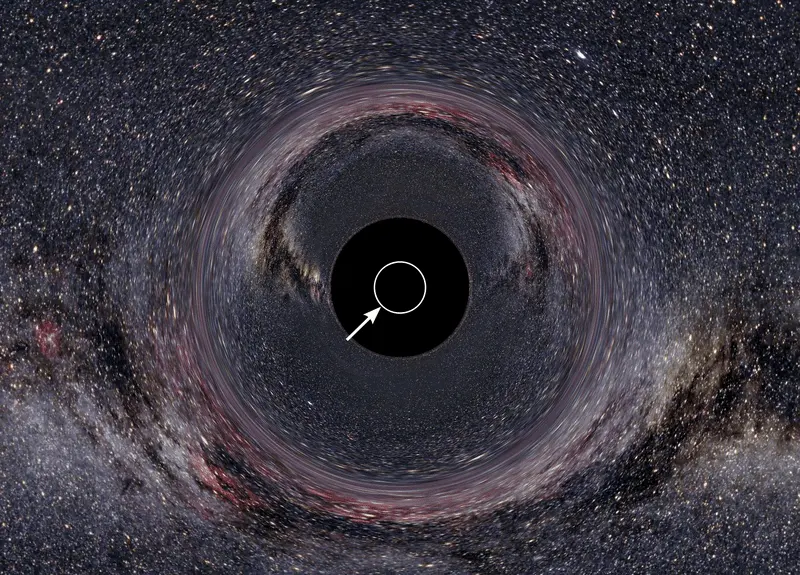
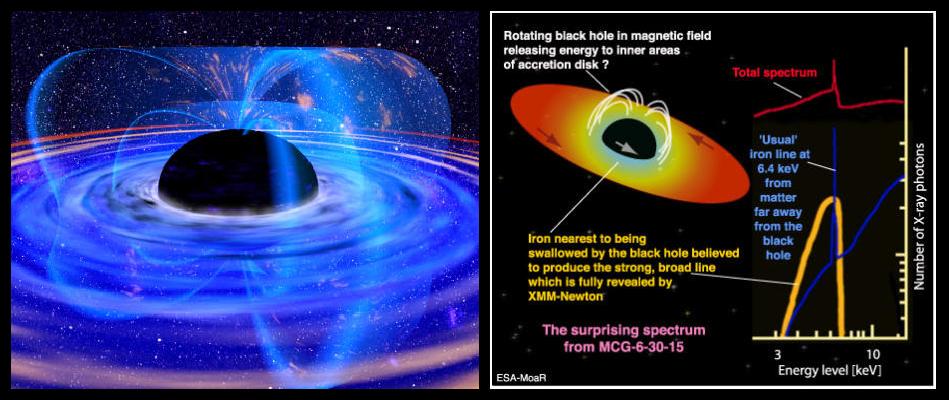
The best thing about Black Holes is ...
And, what makes it cooler is ... because of time dilation, the process literally goes on forever!
Woo Hoo!
I want to give you very long information that comes from a link in French that i will translate the best possible for you and the theory of spaghetti is part of it.
Suppose a person (Alice) observes a black hole at a great distance, safely, and sees an elephant inadvertently heading straight for that gravitational trap. She will see him approaching closer and closer to the horizon of events, slowing down due to the time dilation effects consistent with general relativity. However, she will never see him cross the horizon. Instead, she sees him stop at the edge, just as the poor pachyderm is vaporized by Hawking radiation and reduced to ashes that scatter in space. From Alice's point of view, all the information about the elephant is contained in these ashes.

And that's where the story is getting difficult. Alice suddenly realizes that her friend Bob was on the back of the elephant when it plunged to the black hole. When Bob himself crossed the horizon of events, the theory of relativity tells us that he did not even notice it. The horizon is not a brick wall in space. It is simply the point beyond which an observer outside the black hole can not see light escape. For Bob, who is in free fall, it looks like any other place in the universe; the attraction of gravity itself will not be sensitive to it for perhaps millions of years. Finally, when he approaches the singularity, where the curvature of space-time is taken furious madness, the gravitation master Bob, and he and his elephant will be scattered in a thousand pieces. But so far, from his point of view also the information will be preserved.

Neither story ends well, but which one is right? According to Alice, the elephant has never crossed the horizon; she saw him approach the black hole and merge with the Hawking radiation. According to Bob, the elephant passed through and continued to glide happily for eons until it
turned into spaghetti. The laws of physics require that both stories be true, yet they contradict each other. So where is the elephant, inside or outside?
Susskind's answer is - we'll have guessed it - both. The elephant is both inside and outside the black hole; the answer depends on who the pose. "What we have discovered is that we can not talk about what is behind the horizon AND what is ahead of the horizon," says Susskind. "Quantum mechanics always forces us to substitute the word AND by the word OR Light is a wave WHERE light is a particle, according to the experiment we realize.An electron has a position OR it has an impulse, according to the same thing happens with the black holes, or the matter is said to have fallen into a black hole, looking behind the horizon, or it is described in terms of the Hawking radiation coming out of it. ".

But, maybe there are two copies of the information? Maybe when the elephant crosses the horizon, a copy is made, and one version comes out as radiation while the other moves inside the black hole? No, because a fundamental law called the "impossibility of quantum cloning" theorem eliminates this possibility. If we could reproduce the information, we could avoid the principle of uncertainty, which nature forbids. As Susskind says, "there is no quantum photocopier". Also the same elephant must be in two places simultaneously: living inside the horizon and dead somewhere in a heap of radiant ash outside.
The consequences are quite disturbing, to say the least. Of course, quantum mechanics tells us that the position of an object can not always be exactly indicated. But this applies to electrons for example, not to elephants! And this usually involves tiny distances, not light-years! It is this large scale that is surprising, says Susskind. In principle, if the black hole were big enough, both versions of the same elephant could be separated by billions of light-years. "It has always been thought that quantum ambiguities are a very small phenomenon," he adds. "We discover that the greater the quantum gravity becomes, the more the scales in which these ambiguities intervene become enormous".
The fact is that the position of an object in space-time is no longer undeniable. Susskind calls this "a new kind of relativity". Einstein considered factors that were supposed to be invariable - the length of an object and the course of time - and proved that they were relative to the movement of the observer. The position of an object in space or time could only be defined relative to that observer, but its position in space-time was guaranteed. Henceforth this notion is annihilated, says Susskind, and the position of an object in space-time depends on the state of the observer's movement relative to a horizon.
And what's more, this new type of "non-locality" only concerns black holes. It occurs anywhere a boundary separates regions of the universe that can not communicate with each other. Such horizons are more common than one might think. Any object in acceleration - the Earth, the Solar System, the Milky Way - produces a horizon. There are regions of space-time from which light will never reach us. These inaccessible regions are beyond our horizon.
As researchers progress in their quest to unify quantum mechanics and gravitation, non-locality could point the way forward. For example, quantum gravitation should obey the holographic principle. This means that there may be redundant information and less large space-time dimensions in the theory. "This must be part of the understanding of quantum gravity," says Giddings. "It is possible that this paradox of black hole information leads to a revolution at least as profound as that generated by quantum mechanics".
And that's not all. The acceleration of space-time itself, that is to say the fact that the expansion of the universe is accelerating, also causes a horizon. Just as we might discover that an elephant is hiding inside a black hole by decoding the Hawking radiation, perhaps we could discover what exists beyond our cosmic horizon by decoding its emissions. How? According to Susskind, the cosmic microwave background that surrounds us could be even more important than we thought. Cosmologists study this radiation because its variations tell us about the early days of the universe, but Susskind speculates that it could be a kind of Hawking radiation from the edge of our universe. If that were the case, he could teach us some things about elephants on the other side of the universe ...
Théorie: un trou noir, son horizon des événements et... un éléphant