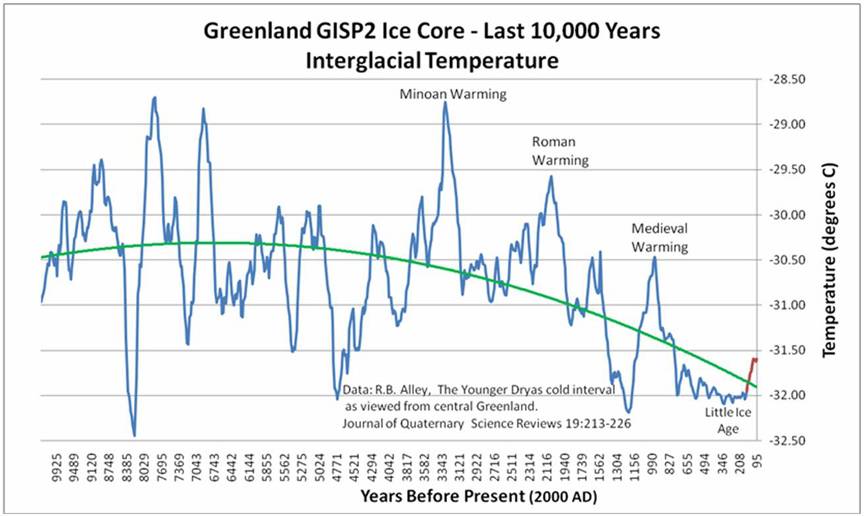
Now SSo DDumb, if there were a spike in temperature due to CO2, we would see a very slow return from that spike due to the residence time of CO2 in the atmosphere. Pretty damned obvious to anyone that understands the physics of CO2 in the atmosphere. If you need some tutoring in that;
The Carbon Dioxide Greenhouse Effect
There never has been, nor will there ever be a spike in temperate from CO2...and anyone who understands the physics of CO2 in the atmosphere would not claim that it can cause warming...the sensitivity of the climate to CO2 in the literature is well on its way to zero...only idiots, and truly dishonest people claim that CO2 can cause the temperature to increase.
And you are totally full of shit.
High-precision timeline for Earth’s most severe extinction
High-precision timeline for Earth’s most severe extinction
- Seth D. Burgessa,1,
- Samuel Bowringa, and
- Shu-zhong Shenb
Author Affiliations
- Edited by Dennis Kent, Rutgers University and Lamont-Doherty Earth Observatory, Palisades, NY, and approved January 2, 2014 (received for review September 18, 2013)
Abstract
The end-Permian mass extinction was the most severe loss of marine and terrestrial biota in the last 542 My. Understanding its cause and the controls on extinction/recovery dynamics depends on an accurate and precise age model. U-Pb zircon dates for five volcanic ash beds from the Global Stratotype Section and Point for the Permian-Triassic boundary at Meishan, China, define an age model for the extinction and allow exploration of the links between global environmental perturbation, carbon cycle disruption, mass extinction, and recovery at millennial timescales. The extinction occurred between 251.941 ± 0.037 and 251.880 ± 0.031 Mya, an interval of 60 ± 48 ka. Onset of a major reorganization of the carbon cycle immediately precedes the initiation of extinction and is punctuated by a sharp (3‰), short-lived negative spike in the isotopic composition of carbonate carbon. Carbon cycle volatility persists for ∼500 ka before a return to near preextinction values. Decamillenial to millennial level resolution of the mass extinction and its aftermath will permit a refined evaluation of the relative roles of rate-dependent processes contributing to the extinction, allowing insight into postextinction ecosystem expansion, and establish an accurate time point for evaluating the plausibility of trigger and kill mechanisms.
Full text available at the link.

 PROGRESSIVES CONTINUE THEIR ASTONISHING STREAK OF LOSE


 ......happens from time to time!!