At some point, in trying to read the thread, I just got lost in "If you take out these...", "but you can't take these out...." Yikes! Good job on some one's part, trying to keep it objective and just the numbers.
I got a sense that it had to do with the labor force. And the question being if the unemployment numbers are lower because people are dropping out of the labor force.
The straight up levels don't really mean much, not when the total population keeps increasing. So we have to do ratios.
The fact that unemployment, employment, and labor force ratios are based on an increasing population bothered me. There is this changing denominator and we don't visualize ratios with a changing denominator very well.
I was going to go with Emp/(Emp+Unemp) but that doesn't help because unemployment going down just shifts people to employment with no net change in labor force. And it doesn't give a sense of the issue that population is increasing so the real issue is if everything else is increasing proportionally or not.
So here is the labor force level.
So what's the problem? It looks like it has all the seasonality that we expect, and that seasonality is consistent over the years. The seasonal variation is huge, by comparison to the trend. But that is usually why seasonal adjustment is done, to try and see the trend beneath the variance.
Looks like it's been going up, not down, in the recent months.
I just don't see the "retirees" or "people dropping out", not since the beginning of 2011 anyways.
I get what some want it to be, that people are dropping out relatively faster than they should be and people aren't joining as fast as they should. And as such, the labor force is falling.
But, you know what, "should be" is always generally not even reality. Reality is what is, not what didn't happen.
The other thing is that, in fact, it isn't even that nefarious. In fact, the labor force to population falling is a natural outcome of the fact that the underlying population is increasing.
I'm still looking for a good single number that captures it all. The problems with all of the measures is that the population is growing underneath everything. If the labor force was perfectly flat, with no additions and no drop outs, then LF to CPOP ratio would decline simply because population is coming up underneath. For labor force to CPOP ratio to remain steady, LF level must increase.
That's why I prefer a ratio of whatever to civilian population. I'd rather use total population but the estimates just aren't as precise as civilian non-institutionalized population.
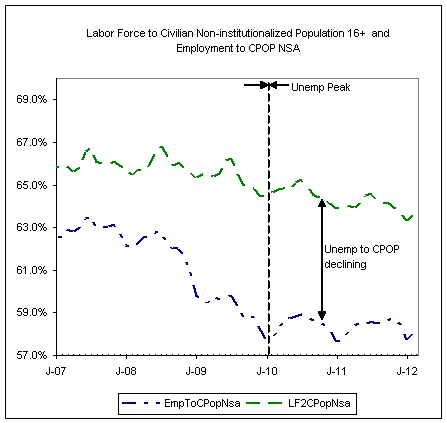
So here we have employment to CPOP.
It has been fairly flat since 2010. Yeah, it has this ever so slight downward trend from 2010 to 2011, then an ever slight upward trend from 2011 to 2012. The seasonal variance is huge compared to the trend. And it is pretty big by comparison.
At the very least, it says that jobs are keeping up with population growth. And there is no "dropping out" or "retiring" from the CPOP.
Here is the really odd effect. So employment to CPOP is steady because employment, as a percentage of CPOP is increasing at much as CPOP. CPOP increases by x%, employment increases by x%, and the ratio remains constant.
Now, unemployment as a percentage of CPOP has been decreasing. That's the difference between the green line and the blue line. That's the difference between the LF/CPOP and EMP/CPOP. The only way that can happen, if employment is keeping up with population and unemployment is declining, is for LF/CPOP to decline.
What's that mean? It means that LF/CPOP is declining because CPOP is coming up underneath it.
Sure, we would like LF/CPOP to remained steady or increased. Sure, we would like EMP/CPOP to increase. And we would like both of these while UNEMP/CPOP is declining. But they aren't all happening simultaneously. The fact that LF/CPOP is declining doesn't mean all that much. It just means that CPOP is getting bigger underneath it. People aren't entering the labor force as fast as the CPOP is increasing. (Find those numbers). That's the facts jack. We know because LF is increasing, not falling.
It's like this, algebraically
LF/CPOP = Unemp/CPOP + Emp/CPOP
or
LF/CPOP = Unemp/CPOP + Constant
and
LF/CPOP has to go down if Unemp/CPOP is going down.
Or look at it this way,
LF/CPOP - Unemp/CPOP = Constant
If unemployment as a percentage of CPOP is decreasing, then LF as a percentage of CPOP must decrease for Emp as a percentage of CPOP to remain constant. Sure, it would be better if LF/CPOP was constant and Emp/CPOP was increasing. But it isn't.
The net result is
(Sorry, should have changed that graph title)
Yes, employment/LF is increasing. And it's not because people are dropping out of the labor force in droves. It's just that employment and the labor force are both really a percentage of the total population and the labor force just isn't increasing as much as we would like it to. Employment as a level is going up and the labor force as a level isn't going up as quickly as we would like. But they are both going up.
So if you go and look at LF/CPOP, you may think that you've found something. But you haven't. It's just an awkward situation where EMP/CPOP is constant, UNEMP/CPOP is falling, LF/CPOP must fall.
There is nothing nefarious about it. It is odd because numbers that are based on a changing denominator are simply not intuitive. We don't do "intuitive" with a changing denominator. Nothing in our day to day experience is based on ratios with a changing denominator. We don't deal with ratios of things that are growing.
It's not like we are use to the slices of a pie where the pie keeps getting bigger. But that is basically what it is, CPOP is the whole pie, LF is a big section of it, and EMP plus UNEMP divides up LF. And as the pie is expanding, EMP is getting bigger with the pie. UNEMP is getting smaller, and LF just isn't growing as quickly as the pie. It's still getting bigger, just not as fast. (You can check the actual numbers.)
It's just this odd situation where the changes are right on the edge of where the ratios aren't intuitive.