As I said, "my knowledge of the world is greater than yours". Your reply to that statement indicates that what I said is true.
"Permission"? What are you talking about? Israel doesn't need my permission to do anything but Israel will pay the price and suffer the consequences for its Nazi behaviour. The Third Reich was crushed and Zionism will also be crushed.
Your hubris is greater than that of most here, but you still remain full of ignorance and bias of your own.
I'll get to your neo-Nazi and anti-Zion(Jew) issues later. For now, and for general information, some details on the swastika, from Wiki (which is often a better source for start than many realize.).
...
The
swastika (
卐 or
卍) is an ancient religious and cultural symbol, predominantly found in various
Eurasian cultures, as well as some
African and
American ones. In the
West it is more widely recognized as a symbol of the German
Nazi Party who
appropriated it from Asian cultures starting in the early 20th century. The appropriation continues with its use by
neo-Nazis around the world.
[1][2][3][4] The swastika never stopped being used as a symbol of divinity and spirituality in
Indian religions, including
Hinduism,
Buddhism, and
Jainism.
[5][6][7][8][1] It generally takes the form of a
cross,
[A] the arms of which are of equal length and perpendicular to the adjacent arms, each bent midway at a right angle.
[10][11]
The word
swastika comes from
Sanskrit:
स्वस्तिक,
romanized:
svastika, meaning 'conducive to well-being'.
[12][1] In
Hinduism, the right-facing symbol (clockwise) (卐) is called
swastika, symbolizing
surya ('sun'), prosperity and good luck, while the left-facing symbol (counter-clockwise) (卍) is called
sauvastika, symbolising night or
tantric aspects of
Kali.
[1] In
Jain symbolism, it represents
Suparshvanatha – the seventh of 24
Tirthankaras (
spiritual teachers and
saviours), while in
Buddhist symbolism it represents the auspicious footprints of the
Buddha.
[1][13][14] In several major
Indo-European religions, the swastika symbolises lightning bolts, representing the
thunder god and the
king of the gods, such as
Indra in
Vedic Hinduism,
Zeus in the
ancient Greek religion,
Jupiter in the
ancient Roman religion, and
Thor in the
ancient Germanic religion.
[15] The symbol is found in the archeological remains of the
Indus Valley Civilisation[16] and
Samarra, as well as in early
Byzantine and
Christian artwork.
[17][18]
Although used for the first time as a symbol of international antisemitism by far-right Romanian politician
A. C. Cuza prior to
World War I,
[19][20][21] it was
a symbol of auspiciousness and good luck for most of the Western world until the 1930s,
[2] when the German Nazi Party adopted the swastika as an emblem of the
Aryan race. As a result of
World War II and
the Holocaust, in the West it continues to be strongly associated with
Nazism,
antisemitism,
[22][23] white supremacism,
[24][25] or simply
evil.
[26][27] As a consequence, its use in some countries, including Germany, is prohibited by law.
https://en.wikipedia.org/wiki/Swastika#cite_note-29 However, the swastika remains a symbol of good luck and prosperity in Hindu, Buddhist and Jain countries such as Nepal, India, Thailand, Mongolia, Sri Lanka, China and Japan, and by some peoples, such as the Navajo people of the Southwest United States. It is also commonly used in Hindu marriage ceremonies and Dipavali celebrations.
...


Left: the left-facing sauwastika is a sacred symbol in the Bon and Mahāyāna Buddhist traditions. Right: the right-facing swastika appears commonly in Hinduism, Jainism and Sri Lankan Buddhism.[51][52]
...
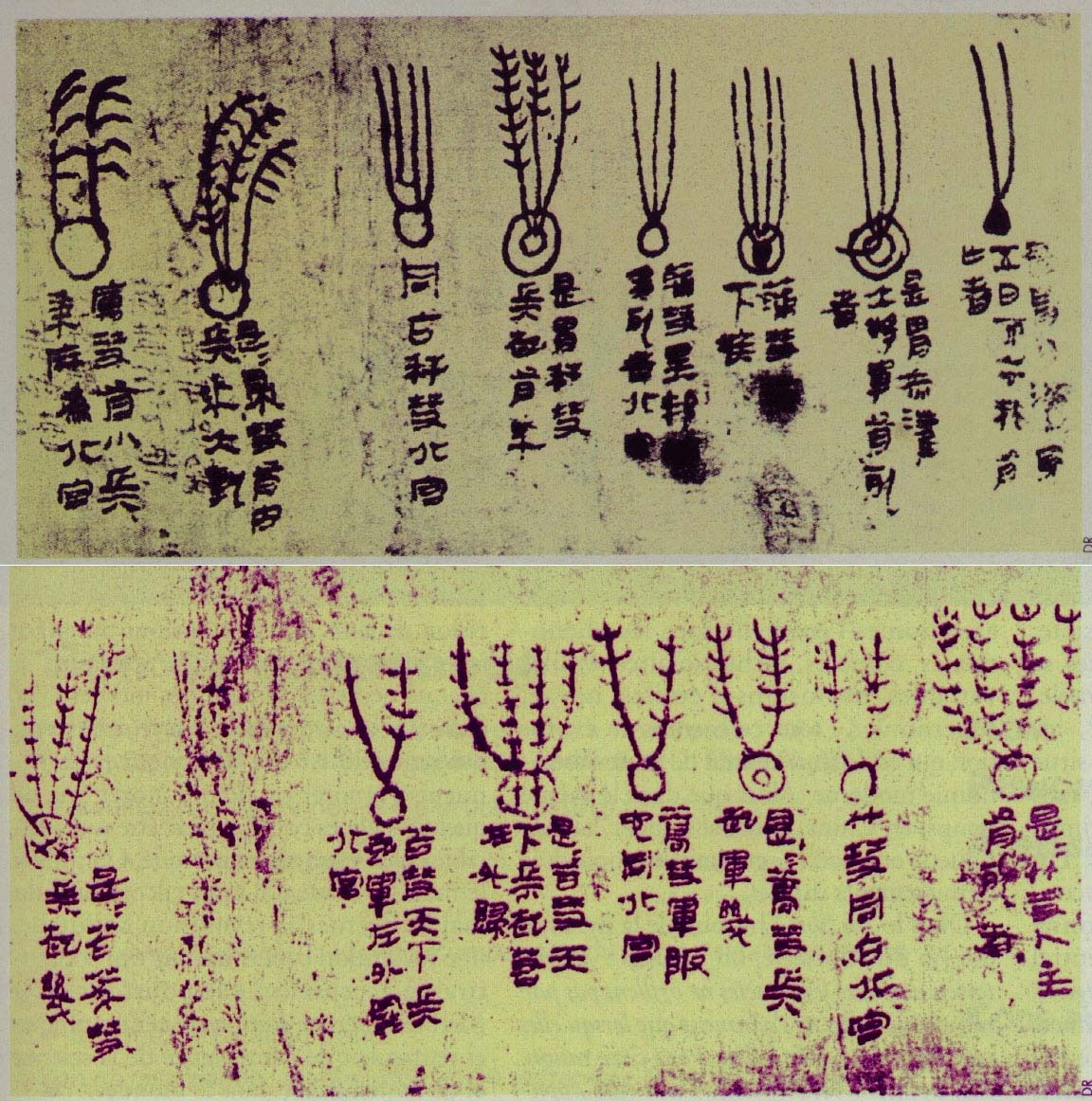
Comet
 Depiction of comets from the Book of Silk, Han dynasty, 2nd century BCE
In their 1985 book Comet, Carl Sagan and Ann Druyan argue that the appearance of a rotating comet with a four-pronged tail as early as 2,000 years BCE could explain why the swastika is found in the cultures of both the Old World and the pre-Columbian Americas. The Han dynasty Book of Silk (2nd century BCE) depicts such a comet with a swastika-like symbol.[65]
Bob Kobres, in a 1992 paper, contends that the swastika-like comet on the Han-dynasty manuscript was labelled a "long tailed pheasant star" (dixing) because of its resemblance to a bird's foot or footprint.[66] Similar comparisons had been made by J. F. Hewitt in 1907,[67] as well as a 1908 article in Good Housekeeping.[68] Kobres goes on to suggest an association of mythological birds and comets also outside of China.[66]
...

en.wikipedia.org