And the lowest paid workers are getting the highest wage increases in the Trump economy.
Seems to contradict the leftist fairy tale that only the rich benefited from Trump's tax cuts.
Trump lies. Do not believe him.
It is true that inflation-adjusted wages (
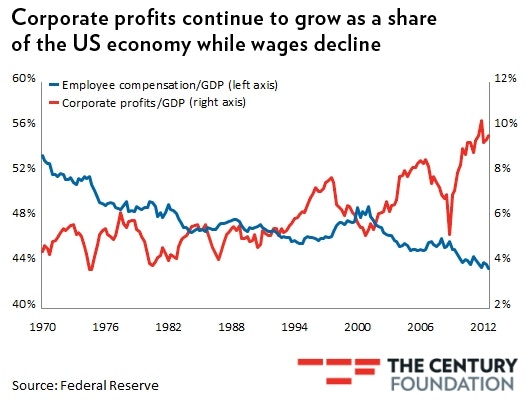
average weekly for production and nonsupervisory workers) peaked in February 1973 at $345.95, and then fluctuated but generally declined, hitting a low point of $263.73 in January 1996. They have again fluctuated since, but they’ve been on a general upward trend. They have increased 2.4% since Trump took office, from an average $308.21 per week to $315.74 per week in May, the most recent figures available from the Bureau of Labor Statistics. Technical note: All wage figures cited in this story from BLS are calculated in 1982-84 dollars – not current 2019 dollars.
During Obama’s last four years in office the average weekly earnings for production and nonsupervisory workers went up 4.9%. Over Obama’s entire two-term tenure, wages were up 4.2%.
Over President George W. Bush’s eight years in office, wages also increased by 4.2%, and under President Bill Clinton, they went up by 6.4%. (Real average weekly
earnings for all private sector employees, including supervisors, shows a similar trend, though BLS only has published statistics going back to 2006. Those figures are up 2.3% under Trump, 3.9% under Obama’s second term and 4% over his eight years in office.)
It is cool the way you cite an average wage number, to counter Diva's point about low end wages.
For a liberal, that was a pretty good argument. YOu actually were on a related issue. You managed to refrain from calling some one a racist, for one post in a row.
And that is all we can expect from you. You should knock off for the day. You don't want to over do it.
What's cool is that I have facts and links while Diva just spouts what Fox told her to say. Here's
more...
The faster growth at the bottom is probably being fueled in part by recent minimum-wage increases in cities and states across the country.
Research from the Economic Policy Institute, a liberal-leaning think tank, found that over the past five years,
wages for low-wage workers rose 13 percent in states that raised their minimum wages, compared with 8.4 percent in states that did not.
But minimum wages are only part of the story. Ernie Tedeschi, an economist at Evercore ISI,
estimates that the minimum-wage increases account for a quarter to a third of low-wage workers’ gains over the past three years. The rest is most likely a result of a tightening labor market that is forcing employers to raise pay even for workers at the bottom of the earnings ladder.
Ms. Gimbel noted that better-paying industries had experienced faster job growth in recent months, while the fastest wage growth had been in lower-paying industries. That could indicate that sectors like health care and manufacturing are snapping up workers, forcing retailers and restaurants to raise pay to compete.
Still, not everyone is benefiting equally. African-American workers
have seen smaller gains over the course of the recovery, for example. And wage growth remains slow in some parts of the country that were hit especially hard by the recession.