Advances in Computers thread

Samsung announces a curved-screen all-in-one and its thinnest laptop yet

d3s8991-copybw_24x24.jpg
by Dana Wollman | @danawollman | December 30th 2014 at 3:00 pm


We hope you like super skinny laptops, because you're going to be seeing a hell of a lot more of them in 2015. Samsung just took the veil off its new ATIV Book 9 Ultrabook, which comes in at just 0.45 inch thick and 2.09 pounds. That's insanely compact for a 12.2-inch machine and indeed, it's the thinnest and lightest notebook Samsung has released yet. (Given Sammy's history with razor-thin laptops, that's saying a lot.) Like so many other slim machines that have come out lately, the Book 9 uses one of Intel's new Core M processors, which were designed specifically to allow for skinnier designs.
 
Samsung Gear VR vs. Oculus Rift DK2
By Will Shanklin
Samsung Gear VR vs. Oculus Rift DK2
January 1, 2015

19 Pictures

Gizmag compares the features and specs of the consumer-friendly Gear VR and developers-only Oculus Rift DK2

Image Gallery (19 images)
In our product comparisons, we line up consumer gear and do our best to help you make up your mind ... but this one is a little different. The Oculus Rift Development Kit 2 (DK2) isn't a consumer product, but there could be value in seeing how the Samsung Gear VR, a virtual reality headset that is a consumer product, measures up with it. Read on for Gizmag's features and specs comparison.

Consumer product

In case we didn't hammer the point home hard enough yet, the Oculus Rift DK2 isn't meant for consumers (since it's made for developers, you can't even do basic things like return it if you aren't happy with it). And while the Gear VR is being sold to the general public, it earned that asterisk, as Samsung is branding it as an "Innovator Edition" for early adopters and (it too) developers.

Modern virtual reality is still laying down its roots, hence all the developer-focused gear we're seeing here. But it's also one of the most exciting new technologies we've tried in some time, due to its incredibly immersive nature. It sounds cliché, but you really do have to try it yourself to get it.

Software

If you're Samsung, and you want to get into VR on the ground floor, who do you turn to? You turn to Oculus VR, that's who. The young company (now owned by Facebook) provides the software for the Gear VR, as well as the SDK for the Rift development kit.

Host device

Neither headset is a standalone device, though the Gear VR looks like one. You'll need to slide a Galaxy Note 4 inside of it, to provide its screen, processing and ... well, pretty much everything but its lenses.

The Oculus Rift DK2 (and the upcoming consumer version) instead connects to a PC, opening the door to more advanced games.

Wireless

On the other hand, relying on a smartphone gives the Gear VR the advantage of being wireless. The Oculus Rift is wired and tethered to the PC.

Connections

Want some more specifics on that connection? Okay then, the Note 4 slides into a micro USB nub in the Gear VR headset, while the Rift connects via USB and HDMI (or DVI-D) cables.

Overheating

This is a big disadvantage for the Gear VR. VR games put a lot of strain on the Note 4, and it heats up pretty quickly – often going into underclocked (lower performance) mode after just 20 minutes or so.

We have some tips on delaying the Gear's overheating (or you could just put it down and take a 5 minute break every 20 minutes or so), but it's going to be a regular consideration when using the headset. If you fancy long, uninterrupted VR gaming sessions, then you might want to wait for the consumer Oculus Rift.

App sources

The ways that you get apps on each platform correspond with their mobile vs. desktop natures. Like mobile devices in general, the Gear VR gets apps through one store (in this case, the Oculus Home app on the Note 4). And like PCs in general, the Rift development kit can run any compatible app you install on your PC.

Field of view

The DK2 has a slightly wider field of view than the Gear VR.

Display size

The displays inside the headsets each measure 5.7 inches diagonally. Of course the Gear VR uses the Galaxy Note's screen, but in a way the Rift does too: it has a Galaxy Note 3's screen sitting inside.

Display resolution (per eye)

Because of that Note 3 screen in the DK2, it's noticeably less sharp, with 1080p overall resolution (or 960 x 1080 per eye). If we had to bet, we'd put our money on the first consumer version of the Oculus Rift having a Quad HD Note 4 screen inside.

Display type

Both displays use AMOLED technology, with deep blacks and rich colors.

Positional tracking

Just to avoid any confusion, both headsets respond to your head movement: turn your head all the way around, and you'll see everything in your 360-degree environment (it wouldn't really be virtual reality if you couldn't, would it?).

But the Oculus Rift adds an extra dimension. It includes a tiny camera that you can set near your PC or monitor, which tracks when you move forward or backward. This lets you "lean in" to zoom in on parts of your virtual environment.

The Gear VR only tracks your head's rotation, not leaning.

Latency

Latency describes how quickly the headset can respond to head movements (older Oculus Rift prototypes would get blurry when you moved your head quickly). Both of these devices, though, are capable of very clear <20 ms latency.

Adjustable focus

Both headsets have built-in wheels that let you adjust the focus, to make your virtual environment look as clear as possible for your eyes. The Rift includes two separate pairs of lenses: one for normal or slightly near-sighted users, another for more near-sighted folks.

Glasses underneath

Many people can get away with wearing glasses underneath the Oculus Rift DK2. You can't wear glasses with the Gear VR, but its adjustable focus range is wide enough that most people should have no problem finding a clear setting without using any prescription lenses.

Built-in controls

The Gear VR has a trackpad, back button and volume controls on its right side. With the Oculus development kit, you'll need to use your PC or an accessory.

For both headsets, you'll want to use a controller for any serious gaming. Any controller that works with your PC should work with the Rift, while many Android-compatible Bluetooth controllers will work just fine with the Gear.

Speaker

The Gear VR headset itself doesn't have any speakers, but if you aren't wearing headphones, you'll hear audio played through the Note 4. For the best experience, though, you'll want to plug in some headphones or earbuds.

Release date

The biggest reason that the Rift lags behind the Gear in display resolution is that it's an older product. Oculus still hasn't announced a launch date for the consumer Oculus Rift, but many believe that will happen sometime this year.

Price

At US$200, the Gear VR is cheaper, but of course you'll need to have a Note 4 (typically $700 full retail, $300 on-contract) to use with it. And, in case we didn't already stress it enough, the Oculus Rift DK2's pricing is mostly irrelevant to anyone that isn't a developer. At most, maybe it could be hinting at what the consumer version will eventually cost.

For more, you can read our full review of the Gear VR, and our hands-on impressions of the Oculus Rift Crystal Cove prototype (which the DK2 is largely based on).


Here is the full review of the gear... Samsung Gear VR review Oculus goes mobile


I've made up my mind that the second thread possible within the next few months will be named, "advances in computers and tech".
 
Last edited:
US Supreme Court moving to digital filing system in 2016
headshot_24x24.jpg
by Terrence O'Brien | @TerrenceOBrien | 14hrs ago


The Supreme Court of the US has stuck stubbornly to its ways. No cameras in the court room, a paper filing system, those robes... which are so last century. That may begin to change over the next couple of years however. In a year-end report released Wednesday night, Chief Justice John Roberts said that the court would begin accepting electronic filings as early as 2016. The court will have to first develop the system, then it will be rolled out in stages. At first paper documents will be used as the default, but those represented by attorneys in the court will also have to file the same documents electronically. Once that trial proves successful, digital documents will become the default for everyone. Though, paper filings will still be required. As Justice Roberts explained in the report, "Unlike commercial enterprises, the courts cannot decide to serve only the most technically-capable or well-equipped segments of the public... the courts must remain open for those who do not have access to personal computers."
 
CES 2015: Will this be the year of 4K TV?

IRVINE, Calif. — Is this the year 4K TV finally takes off with consumers?

Analysts thought it would happen in 2014, but it didn't happen, mostly due to the high prices of most the TVs. They're called 4K because they offer 4,000 pixel resolution, or about four times the resolution of 1080p high definition. You might see them marketed as "Ultra-HD."

This year analysts believe 4K will start to resonate, and we will see the results of this at the Consumer Electronics Show, which gets under way in Las Vegas this weekend.

There will be many more 4K models available, and they will be much cheaper, says Richard Doherty, an analyst with the Envisioneering Group.
 
I doubt 4k TVs will take off anytime soon. Eventually yes, but the transmission over the net or satellite ain't there yet.
 
WeMo Beefs Up Smart Home Lineup With Four New Sensors

1063768936381505828.jpg

Right now, piecing together a smart home, your very own domicile outfitted to perfectly fit your life, is a confusing cobweb of wireless standards, compatibility, and brands—lots and lots of brands. But the first step into this brave new connected world is just giving your home awareness, and that's what Belkin WeMo's new sensors, just announced at CES, are all about.

WeMo's philosophy isn't radically different from other stalwart smart home competition, primarily Samsung's own home automation arm SmartThings. Similar to what SmartThings introduced with its massively successful Kickstarter in 2012, WeMo offers a similar piecemeal approach to giving your house or apartment, whether brand new or decades old, a few more IQ points. WeMo already offers bunches and bunches of smart switches and plugs that can let you control sprinklers, lights, televisions, or whatever through WeMo's free app. These four new sensors improve WeMo's currently limited smarts to offer awareness of not only what's going on in your home but also the people who are living in it.
 
Oh Hell Yes: A Phone With Glasses-Free 3D and Joysticks Built In

awnlbssokajjwe1wywm7.jpg


The Obox W3D looks a little but like a PSP at first glance, but inside it's a completely different beast. Running Android 4.4, the W30 isn't just a gaming device, it's also an actual phone. It's best tricks have nothing to do with that though, and the leading one is a glasses free 3D screen.

With a front-facing, eye-tracking camera, the W3D is able to tell exactly how you're looking at it, and the effect is pretty convincing. From straight on, 3D images pop right out nicely, and thanks to that tracking, you don't have to hold the phone completely still to make sure they don't disappear. You have to turn it something fierce before the illusion breaks.
 
Ring wearable gesture device hands-on

Ring wearable gesture device hands-on - SlashGear
Ring is a wearable smart device that connects to your smartphone with Bluetooth. It wirelessly allows you to make gestures in the face of your phone to launch apps and perform certain functions. At CES 2015, we've seen this device do several things - take a photo, launch a basic music app, and even Tweet. Users are invited to work with the gestures already built in to the Ring controller app or to create their own and connect to apps like Facebook, Evernote, and Yo. And you know what that means - IFTTT connectivity as well.

This device connects with Bluetooth. You can have it several meters away from your smartphone and still use it, but the company recommends you stick within 2-meters for optimal functionality.

Seagate reveals wireless, ultra-thin, and personal cloud drives
Adam Westlake | Jan 4, 2015
0


Data storage firm Seagate has just announced three new personal storage products that will be on display this week at CES in Las Vegas. All three are hard disk drives, but offering unique features and with different purposes in mind. First up is the Seagate Seven, an ultra-thin hard drive for easy portability; then there's the Seagate Wireless, another portable device, but meant for wireless connections with smartphones and tablets; and finally the Seagate Personal Cloud, a device that can automatically back up your computers and make content accessible by multiple devices throughout the home.


Avy Android-powered smart speaker pumps up the jam
By David Szondy
January 4, 2015
26 Pictures

Tablets, smartphones and the like are a boon to people who like their life to have a soundtrack, but for all their advanced computing power, they often lack in the audio department – especially when earphones aren't an option. The result is often an inelegant combination of devices with add-on speakers making up for the mobile devices' lack of audio oomph. The Avy Smart Speaker, which makes its debut at CES 2015, is designed to combine an Android-based tablet with a Hi-Fi system for the audiophile.
 
Last edited:
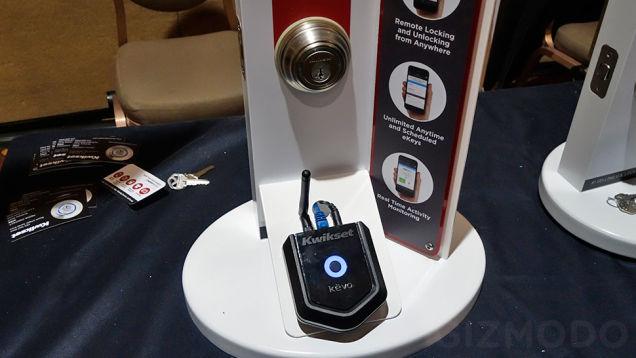
Unlock your front door from anywhere on Earth with Kwikset: http://gizmodo.com/unlock-your-front-door-from-anywhere-on-earth-with-kwik-1677439403…
Unlocking your front door from a smartphone app isn't a terribly new idea, you can even electronically send keys to people you want to have access to your home while you're away. But Kwikset is updating its Kevo Bluetooth front door lock with new hardware that lets you lock or unlock your front door from anywhere on earth you have mobile data on your smartphone.


Parrot RNB 6 brings Android Auto and CarPlay to any ol' car
No, you won't need a new car just to get Android Auto or Apple's CarPlay. Parrot's RNB 6 head unit will add both to any car you like.
Parrot RNB 6 brings Android Auto and CarPlay to any ol car - CNET
LAS VEGAS -- The dashboard is getting smarter, and smartphones are playing a huge part of making it happen. At this point, most manufacturers have pledged support for either Apple's CarPlay or Google's Android Auto, two systems that will bring the power of their mobile operating systems to the dashboard, but do it in a safe way that won't be too distracting.

But, if you have an older car, your options have been few. Pioneer's NEX line has added CarPlay, but now Parrot is getting in on the game too, adding support for both Apple's and Google's solutions to its upcoming RNB 6 head unit.

I want voice controlled windows, heat and locks. Heck, I want that for my room with the heater and lights!
 
Nvidia's new 'superchip' for mobile is the Tegra X1
Nvidia s new superchip for mobile is the Tegra X1 Android Central
The folks at Nvidia have been working hard over the last couple of years to blur the lines between their desktop class GPU architecture and their mobile GPU architecture, and at CES this year the company wants to show off how they have raised the bar. Their latest achievement has been dubbed the Tegra X1, bringing with it the power of Nvidia's Maxwell GPU. Just like last year, Nvidia hopes to prove that mobile devices powered by Tegra can visually compete with game consoles.


NVIDIA DRIVE CX brings a digital cockpit computer to your car
Jan 4, 2015
NVIDIA DRIVE CX brings a digital cockpit computer to your car - SlashGear
  • aslashgear-820x420.jpg

    This week NVIDIA is bringing the heat to the car industry with the NVIDIA DRIVE CX. This is a digital cockpit computer made with the NVIDIA Tegra X1. It's able to roll with 16.6 million pixels maximum resolution - more than one display - extremely dense displays, that is. With Drive CX, NVIDIA will be powering the future of mapping, creating a digital cockpit, and making the smart infotainment system in your vehicle all the more smarter in the near future - in a wide variety of vehicles.

    In just the same way NVIDIA works with game developers to make the next generation of gaming graphics a reality without forcing them to understand all the ins and outs of the technology they're using, NVIDIA's DRIVE CX has a developer program that works with car makers.

    cockpitslashgear-1280x853.jpg

    Drive Studio, as it's called, (as a reminder,) is Pushing the boundaries of what a car can do with graphics and media control via NVIDIA comes from this new system.

    IMG_9852slashgear-1280x693.jpg

    NVIDIA gave examples of what's possible with their system onstage at CES 2015. This system is able to work with full 3D graphics and graphics that replicate what we've seen in games over the past several years. Lighting around a car in a 3D mapping system. Live moving graphics without a hitch.

    IMG_9856slashgear-1280x853.jpg

    NVIDIA DRIVE CX Cluster - the entire collection of abilities shown off in full glory by NVIDIA before they're brought to final vehicles.

    Dynamic route creation, full-screen extra-sharp graphics, and utilization of advanced graphics the likes of which we've only otherwise seen appearing on NVIDIA graphics card-toting PCs and mobile devices. We'll see more of NVIDIA's automotive adventures later this week - stay tuned!
 
Last edited:
For the latest advances in computers, hard drives, ram, ect.


TDK sets new hard drive density record, paves the way for 6TB HDDs


TDK sets new hard drive density record, paves the way for 6TB HDDs - TechSpot News

Solid state drives are continuing to build momentum as a speedy and rugged replacement for traditional spinning drive. TDKÂ’s ongoing research into mechanical hard drives, however, suggests that we shouldnÂ’t give up on the legacy technology just yet. The company recently announced a new milestone that will increase recording density in future drives by 50 percent.

The team at TDK have managed to achieve densities of 1.5TB per square inch by improving the magnetic head and hard disk medium with help from Showa Denko K.K. In laymanÂ’s terms, this new advancement will allow a single platter in a 3.5-inch desktop hard drive to achieve 2TB of storage. Add more platters to the mix and youÂ’re now looking at hard drives reach 4TB and even 6TB in capacity.

Perhaps even more interesting is the impact it will have on 2.5-inch notebook drives. TDK says these smaller form factor HDDs will be able to achieve capacities of 1TB. This will allow users that arenÂ’t yet sold on cloud storage to have a larger amount of data on hand at all times without having to lug around an external storage drive.

TDK will be showcasing the new technology at CEATEC this week although volume production isnÂ’t expected to begin until sometime in 2014. At that point, one has to wonder just how far solid state drive technology will have come in terms of price versus capacity. This ratio has been the Achilles heel for SSDs thus far even as drives continue to be more affordable.
I just replaced my primary hard drive with a solid state drive. The performance improvement was amazing. The windows load time at start up went from 40 seconds to 5 seconds. Most programs load almost instantaneously. The only wait time I really have is on the Internet.
 
The faster the better,,,,Hp suppose to come out with a computer that comes on and loads as fast as you turn it on.


Dacor unveils voice commands for its Dual-Fuel Ranges at CES

Dacor unveils voice commands for its Dual-Fuel Ranges at CES - CNET
LAS VEGAS -- Dacor seems to be making a habit of pushing the smart capabilities of its ovens forward at CES. In 2013, it embedded an Android tablet into their wall oven to allow for cloud-assisted cooking assistance and in-depth controls. In 2014, it expanded the reach of this high-tech Discovery IQ line to Dual-Fuel ranges and updated the app to allow remote control from your Android phone. Now, in 2015, the premium appliance maker will add voice control to the mix.

iOS users will also get to join the fun via the Dacor IQ Remote app compatible with "any smart phone or tablet." Designed for the Discovery IQ Dual-Fuel Ranges released earlier this year, tech-happy cooks can turn the oven on or off, change settings, set timers or switch on oven lights all by simply speaking to the Dacor IQ Remote app once the update goes live this spring.
 
Toshiba announces high-end Portégé Z20t convertible with 17 hour battery life
By Chris Wood
January 6, 2015
10 Pictures

Toshiba’s Portégé Z20t convertible is designed to take on heavyweight offerings like the Microsoft’s Surface Pro 3 and Lenovo’s Yoga line. It’s targeted at business users, and offers a premium, fanless design and extensive battery life.

From budget tablets to high-end notebooks, there’s a huge variety of hardware form factors available to Windows users in 2015. Toshiba latest offering sits in the most versatile category of the lot, offering both tablet and laptop functionality.

Open up the new Portégé Z20t convertible and you’ll find a 12.5-inch 1,920 x 1,080 display, equating to 176 pixels per inch (PPI). That’s not quite as pixel dense as the 12-inch Surface Pro 3’s 216 PPI, but should be sharp enough for most users. It’s also an IPS panel, meaning viewing angles should be solid.
 
Wireless power system charges devices up to 20 feet away
Wireless power system charges devices up to 20 feet away ExtremeTech

A plethora of firms are racing to develop a feasible method for delivering power wirelessly, but thus far the best we’ve managed are short-range standards like Qi and PMA. A company called Energous is on hand at CES with a demo of its new wireless power system known amusingly as WattUp. It uses a mix of Bluetooth and RF to combine the convenience of wireless power with the security of a wireless network. If it all pans out, WattUp could juice up your phone from up to 20 feet (6.1 meters) away.

The heart of WattUp is a hub that’s basically a powerful RF transmitter station. Devices that want to receive power from the hub announce their presence via Bluetooth 4.0. WattUp then uses that connection to direct the wireless power signal to the device. It operates in the same unlicensed spectrum as WiFi, which makes me wonder about possible interference in busy wireless environments. Assuming the connection holds, though, the WattUp signal is absorbed and converted to DC power in the phone or tablet by a receiver chip.
 
15th post
Virtual reality comes to the desktop, thanks to HP and Zspace
Virtual reality comes to the desktop thanks to HP and Zspace ExtremeTech
The first time I donned a pair of special glasses and picked up a wired stylus to enter a virtual reality was over 25 years ago. It required extremely expensive hardware, and only allowed for a simple, low-resolution, experience of machining a part on a virtual lathe. But we were all sure that practical applications were just around the corner. It has taken much longer than most of us predicted, but with its new Zvr display, HP is bringing to market a practical and useful VR tool for educators, scientists, and other professionals that need to have accurate, simulated interactions with computer-generated models.


The heart of the Zvr (if you’ll forgive the pun) is a special-purpose display from VR startup Zspace, which incorporates four cameras for head-tracking, a fully gyroscopic stylus that allows for both precise pointing and true 3D manipulation of objects, and a 3D display that uses special glasses. HP is also offering Zview software for the sharing of 3D content suitable for use on the Zvr.

I got to use the Zvr to manipulate a model of a human heart, and was able to quickly and easily select different portions of the heart, and move it around simply by twisting my wrist — the way I would if I were actually holding it in my hand. The result was an experience that felt natural, and was also precise enough that I could imagine how powerful it could be as a learning tool for fields that require a detailed understanding of complex physical objects, such as anatomy or mechanical engineering.
 
Samsung's first portable SSD punches above its weight
By Adam Williams

Samsung has unveiled its first ever portable SSD at CES 2015, the SSD T1. Likened by the firm to the size of a business card, it weighs in at just 30 g (1 oz), and boasts transfer speeds of up to 450 MB per second and a maximum capacity of 1 TB.
When I worked with mainframe computers, 40 years ago, an IBM 3370 Direct Access Storage Device had about .5GB of storage, cost about $35,000 and was the size a washing machine. A TB of data would cost about 70 million dollars and would fill a warehouse. At this rate of progress, in 40 years, it will probably fit on the head of pin and cost .50 cents.

We've come a long way and hopefully have a long way to go.

IBM Archives IBM 3370 direct access storage device
 
Back
Top Bottom