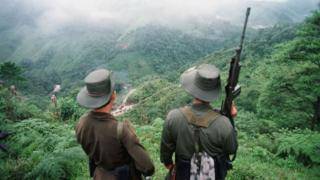
A decade ago, battles between paramilitary groups and their most bitter enemies, the Marxist rebels of the Revolutionary Armed Forces of Colombia (FARC), took place almost every week as the two sides fought for territorial control. The unrelenting violence prompted an exodus of thousands of villagers from the farmlands around the town of La Hormiga and across Putumayo during the peak of violence in early 2000s. "We were caught in the middle of the crossfire," Portillo, a farmer and father of two children, told the Thomson Reuters Foundation. "Once the FARC told us we had to leave as there would be a confrontation with the paramilitaries. They gave us two hours to leave. The whole village left, 80 to 100 people," he said, recalling the first of four times his family had to flee.
More than five decades of conflict have forced 6.7 million Colombians to flee their homes, many of them poor farmers like Portillo, making the country home to the second biggest internally displaced population after Syria. Some of the land left behind was abandoned, left idle for years as farmers sought refuge in nearby towns. Other land was seized by paramilitary forces with farmers often pressured by the armed groups to sell out at cut-rate prices. The government itself estimates that 6.5 to 10 million hectares of land - up to 15 percent of Colombian territory - have been abandoned or illegally acquired through violence, extortion and fraud.
HOMECOMING
Portillo is one of the lucky ones, back on his land as part of a 10-year government program launched in 2011 to return millions of hectares of land, address unequal land distribution and reduce rural poverty. The national effort to restore ownership and tenure is unfolding as peace talks, now in their third year, continue between the government and the FARC, the country's largest guerrilla group, in Cuba. How Colombia ensures those who were displaced can return safely to their lands and rebuild their lives is a measure of state territorial control and prospects for lasting peace in war-torn provinces like Putumayo, experts said. Under a historic land restitution law passed five years ago, the government of Juan Manuel Santos has handed back 200,000 hectares of land, together with land titles awarded by judges, benefiting about 20,000 Colombians. But this accounts for just a fraction of the millions of hectares of land stolen and abandoned.
Of the 80,000 land claims lodged so far with the government authorities less than half are currently being processed, hampered by bureaucratic red tape and sorting out who legally owns disputed and abandoned land. For Portillo, returning to his plot of land means the promise of a better future. Under the land restitution scheme, he has received a grant, fertilizer and seeds, and an agronomist visits the pepper farm every month to provide technical support. "When we came back everything was covered by the jungle. We lost everything. We had to start all over again," said Portillo, as he and his wife tend to rows of pepper trees surrounded by dense jungle where parrots and monkeys chatter. "The land is how I breathe, live and survive. Working the land is the only thing I know how to do. I can't survive in the city. I can only beg for food there." Portillo, 56, hopes the hip-high pepper trees will bear their first harvest in eight months time, bringing in an income of about 990,000 Colombian pesos (US$335) a month, nearly double the monthly minimum wage.
LINGERING FEAR