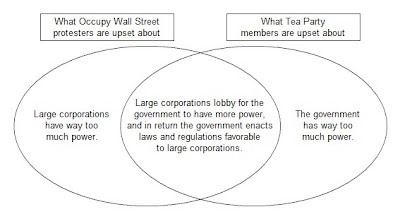
The problem with corporations, and the whole reason behind their existence, is that there is no personal accountability. They have "limited liability,' in order to protect the people at the top, perfectly exemplified by what happened with the economic collapse. They have no incentive to
Bingo.
They have no incentive to protect the economy or the public
in instances where higher profits hang in the balance. If they can make money off risky garbage that eventually blows up and destroys the economy, they will. Remember: uncle Milton said that
for efficiency sake corporations should
only be concerned with higher profits, not extra-market fluff like social consequences. This is seductive to a point, that is, I don't want my Dentist to save my soul, I just want him to focus on my teeth. But at what point does the methodical institutionalization of greed lead to perverse incentives? If profit is the
only incentive, what prevents him from lying or "doctoring" my diagnostic results? [The typical response is that regulations and self-interest will prevent this. Regarding regulations: what if the the anti-government revolution has largely destroyed government's ability to impose any rules - because the profit motive has spread to rule-makers, who need funding for re-election? that is, what if the Reagan Revolution has literally hollowed out the regulatory function of the state?]
Regarding self-interest: it is true that my Doctor has an interest in being honest and giving me good service. However, it is absurd to think the system cannot find a way around this, especially where higher profits are concerned. For instance, what if the medical institution - driven by a desire to expand their list of
marketable diseases - has set-up a system where drug companies routinely give Doctors an incentive to invent new diseases (in order to push high-margin drugs), e.g., what if the profit motive has lead to the expansion of standard depression into an encyclopedia of highly profitable mood disorders? At what point does profit - decoupled from social consequences
at every level - move the incentive away from the interests of patient and toward the wallet of the doctor and career of the politician, who depends on drug company campaign donations? Once we let greed fully out of the bottle and institutionalize it at every level, where does it stop?
Greed is good when it drives you to build live-saving technology. But - on the other side of the coin - it's bad when it causes you to rig regulations, create fraudulent financial products, bribe doctors to sell unnecessary drugs, and bribe politicians to rig laws and regulations. In short, we've been living on the other side of the coin for too long, that is, business and politics has colluded to screw the consumer; they have found a way to completely detach greed from positive social outcomes - now, tragically, the economy only serves the few, who fund elections and staff government with functionaries of their profit. We need a post-Reagan formula for regulating the corrupt side of greed. This means we have to redesign rules and regulations to more properly align incentives with job creation (rather than "get rich quick" derivatives and speculative garbage). Tragically, the proponents of unrestrained profit were able to convince us to design a system where massive profits could be made from risky garbage that added no value to the real economy of goods and services. We created a phantom Wall Street casino which functioned apart from Main Street. We see evidence of this when we compare the profits of the investor class to middle class wages and purchasing power over the past 30 years.
Reagan promised that the profits on top would trickle down, but we've seen solid jobs trickle away and wages remain stagnant. Tragically, talk radio is used by business to cover-up the reality of Reaganomics: rising profits & disappearing jobs.
The Limited Liability of the postwar years has shifted to
very Limited Liability since Reagan, who convinced us that diminishing the burden on capital would raise more profits and thus produce gains for the rest of us (in the form of innovation, jobs, and lower prices). Who would have though that reducing the burden would mean: taking regulators out of the room when Arthur Anderson did Enron's taxes? And who would have thought that putting those regulators back in the room - to ensure Enron didn't hide losses - would be called "socialism". In short, the initial logic of deregulation (which made some sense in transportation and communications) turned into a corrupt mess under energy and finance, where they put the Fox in the hen house.
How did they get away with creating such a hugely corrupt, inefficient, job destroying system, you might ask? Big business captured Conservative information sources and convinced voters of the most pernicious myth of all: no regulations would lift our boats even higher. Even minimal regulations, we are told, is socialism.
Don't you find it ironic that Limited Liability would not be possible without Big Government laws and protections? Tragically, the talk radio right doesn't see how dependent the market is on big brother. We are living the consequences of their ignorance.