3I/Atlas

Any 5 year old with Google can explain that.

Avi Loeb the fraud has to ignore the simple explanation, because thats how he pays his rent.


I looked up C/2014 UN271 and its anti-tail was NOTHING at all like 3I/Atlas. C/2014 was monstrous and began outgassing near Neptune! The perihelion will be near Saturn.

I knew that psu article was weak sauce from the first 2 paragraphs
 

Seriously? Because it didn't send us its interpretation of Zappa's Alien Orifice, that means it must be a natural comet
  1. Entered the solar system within 5 degrees of the ecliptic (.2%)
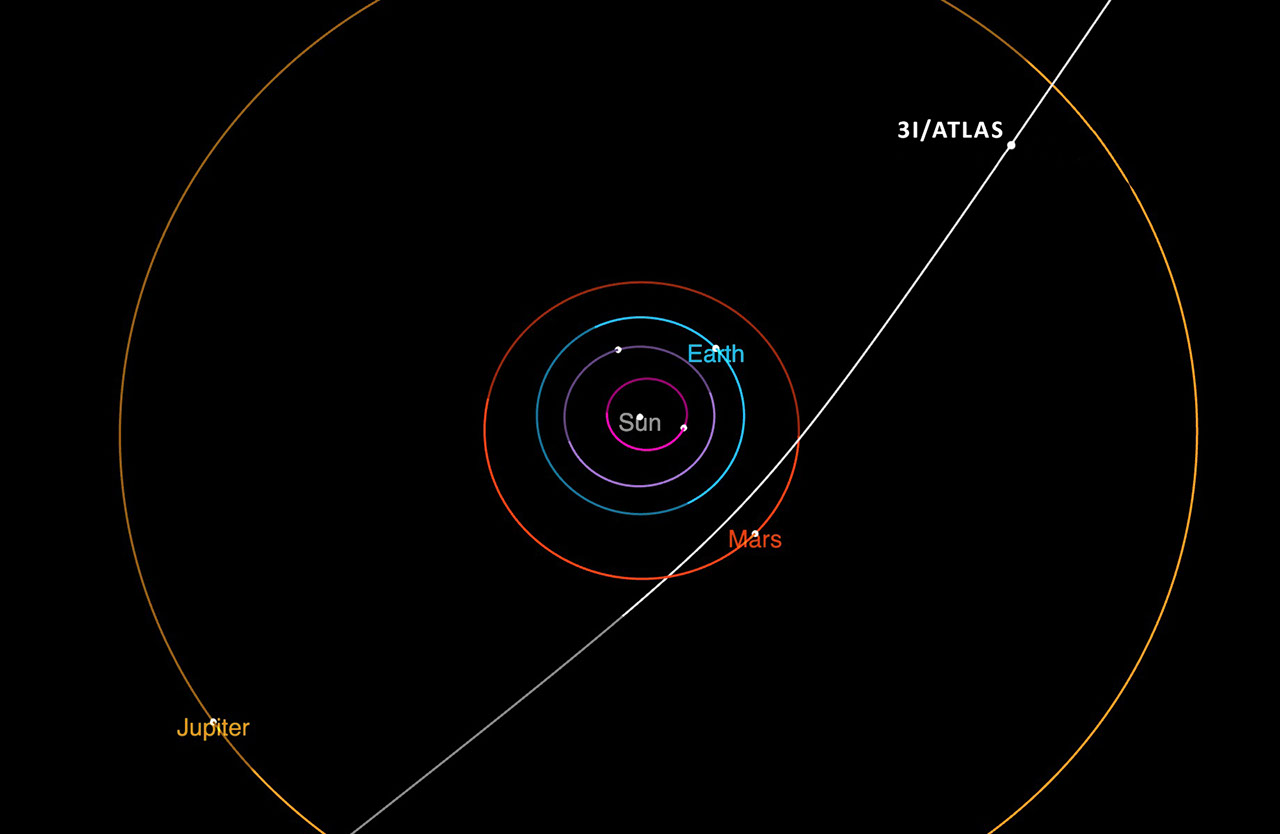
  2. It's path brings it relatively close to Mars, Earth and Jupiter
  3. It's non-gravitational acceleration (aka course correction) near perihelion will bring it to Jupiters Hill radius
  4. "Anti-tail" both before and after perihelion pointed toward the Sun 10 times longer than wide out to 1MM km, greater than any other observed natural comet
  5. Rotation axis aligned within 8 degrees sunward
  6. Pre-perihelion anti tail mean the base of the gas jet has to be 8 degrees from the Sun facing pole
  7. "The existence of a prominent jet towards the Sun on the way of 3I/ATLAS out of the solar system requires a similar coincidence near the opposite pole of the rotation axis. The fact that a tightly collimated jet appears as the sunward anti-tail both before and after perihelion (while reversing direction at perihelion relative to the direction of motion), has a tiny probability of occurring at random, equal to the square of 0.5% or 0.000025."

etc.

The odds of it being a "natural comet" displaying these anomalies are about 4 billion -1

But it didn't send us an alien cool jazz, so it can ONLY be natural
 
The odds of it being a "natural comet" displaying these anomalies are about 4 billion -1
That's ridiculous. Even what's his name put the odds at only 40%. But if you want believe aliens, go for it.
 
That's ridiculous. Even what's his name put the odds at only 40%. But if you want believe aliens, go for it.

The sum total of all of the anomalies make it virtually impossible that this is just an ordinary ball of ice
 
The sum total of all of the anomalies make it virtually impossible that this is just an ordinary ball of ice
It's not ordinary. It's interstellar of which there are only three examples that we know of. Were I1 and I2 aliens?
 
It's not ordinary. It's interstellar of which there are only three examples that we know of. Were I1 and I2 aliens?
1I did evidence non gravitational acceleration, but who knows

2I was a rock

3I is 1 million times larger that Oumuamua and 1,000 larger than 2I

3I always sunward facing “antitail”, by itself, defies natural explanation
 
1I did evidence non gravitational acceleration, but who knows

2I was a rock

3I is 1 million times larger that Oumuamua and 1,000 larger than 2I

3I always sunward facing “antitail”, by itself, defies natural explanation
Were I1 and I2 aliens? Yes or no.
 
Were I1 and I2 aliens? Yes or no.

1 and 2 were "normal, 1 was slightly weird in that it exhibited "non-gravitational acceleration" but not aliens. To me, aliens does not have to mean piloted by aliens, but that it's a designed craft, hence the nickel with no iron.

1*d1vCepLbA1RcoAGHU5EVeg.png


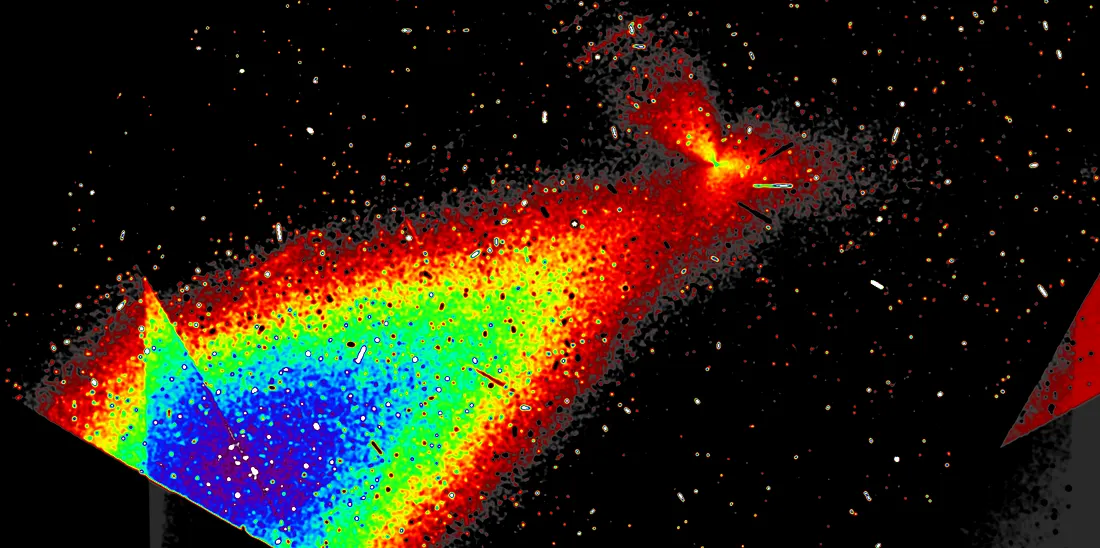
Image of 3I/ATLAS, taken on January 7th, 2026 by the Hubble Space Telescope processed through the Larson-Sekanina rotational gradient filter, showing a triple jet structure with a prominent anti-tail jet in the direction of the Sun, towards the lower left corner of the image. The anti-tail extends to a scale of order the Earth-Moon separation. (Image credit: Toni Scarmato, based on data released by NASA/ESA/STScI here)

There's nothing natural about 3I
 
There's nothing natural about 3I
3I/ATLAS is considered by the vast majority of the scientific community, including NASA, to be a completely natural interstellar comet. Its characteristics, color, speed, and behavior are consistent with those expected from a natural comet.
The idea that there might be nothing natural about 3I/ATLAS stems from claims made by a small group of scientists, most notably Harvard professor Avi Loeb, who has pointed to several "anomalies" that he suggests could potentially indicate an artificial, technological origin.

Evidence for Natural Origin0
  • Cometary Characteristics: Observations have confirmed that 3I/ATLAS has a coma (a cloud of gas and dust) and an icy nucleus, which are classic features of a comet.
  • Hyperbolic Trajectory: Its path through our solar system is hyperbolic, meaning it is moving too fast to be captured by the Sun's gravity, which is expected of an object originating from another star system.
  • Radio Observations: Scans by the SETI Institute and other observatories, such as the MeerKAT radio telescope, have not detected any artificial radio signals or "technosignatures". The detected radio signals are consistent with the presence of natural hydroxyl (OH) molecules, a sign of water ice sublimating.
  • Scientific Consensus: Most astronomers and planetary scientists view 3I/ATLAS as a natural object. They argue that comets are naturally diverse and "anomalous" behaviors are common, making claims of alien technology lack sufficient evidence.
There's no iron in 3I/ATLAS, an interstellar object, because its nickel is likely forming volatile nickel carbonyls (Ni(CO)4) due to the presence of carbon monoxide (CO) and low temperatures, while iron carbonyls (Fe(CO)5) are less volatile and harder to sublimate, explaining the detection of nickel but not iron early on as the comet neared the Sun. This unusual chemical separation, a signature of industrial processes on Earth, challenges natural formation theories, with some researchers suggesting exotic interstellar chemistry or even artificial origins for the object.

Why It's Surprising
  • Natural Comets: In our solar system, iron and nickel are generally found together because they're formed in supernovae and are abundant in rocky bodies like comets and asteroids.
  • 3I/ATLAS Anomaly: This object shows nickel outgassing but not iron, a decoupling that's extremely rare in nature.
Proposed Explanations
  1. Carbonyl Chemistry: The leading natural explanation suggests that carbon monoxide (CO) in the comet's icy nucleus reacts with nickel to form volatile nickel carbonyl (Ni(CO)4), which easily vaporizes.
  2. Iron's Behavior: Iron, however, might form less volatile compounds or remain locked in the nucleus, preventing its detection as gas until the comet gets much closer to the Sun and heats up significantly, releasing it later.
  3. Exotic Origins: The consistent absence of iron alongside nickel has led some scientists, like Avi Loeb, a Harvard physicist, to hypothesize that 3I/ATLAS could be an artificial object, as nickel refining on Earth uses similar chemical processes to separate nickel from iron.
Current Status
  • Observations continue to track 3I/ATLAS as it nears the Sun, with later observations potentially detecting iron as temperatures rise, but the initial nickel-without-iron signature remains a significant mystery.
 
3I/ATLAS is considered by the vast majority of the scientific community, including NASA, to be a completely natural interstellar comet. Its characteristics, color, speed, and behavior are consistent with those expected from a natural comet.
The idea that there might be nothing natural about 3I/ATLAS stems from claims made by a small group of scientists, most notably Harvard professor Avi Loeb, who has pointed to several "anomalies" that he suggests could potentially indicate an artificial, technological origin.

Evidence for Natural Origin0
  • Cometary Characteristics: Observations have confirmed that 3I/ATLAS has a coma (a cloud of gas and dust) and an icy nucleus, which are classic features of a comet.
  • Hyperbolic Trajectory: Its path through our solar system is hyperbolic, meaning it is moving too fast to be captured by the Sun's gravity, which is expected of an object originating from another star system.
  • Radio Observations: Scans by the SETI Institute and other observatories, such as the MeerKAT radio telescope, have not detected any artificial radio signals or "technosignatures". The detected radio signals are consistent with the presence of natural hydroxyl (OH) molecules, a sign of water ice sublimating.
  • Scientific Consensus: Most astronomers and planetary scientists view 3I/ATLAS as a natural object. They argue that comets are naturally diverse and "anomalous" behaviors are common, making claims of alien technology lack sufficient evidence.
There's no iron in 3I/ATLAS, an interstellar object, because its nickel is likely forming volatile nickel carbonyls (Ni(CO)4) due to the presence of carbon monoxide (CO) and low temperatures, while iron carbonyls (Fe(CO)5) are less volatile and harder to sublimate, explaining the detection of nickel but not iron early on as the comet neared the Sun. This unusual chemical separation, a signature of industrial processes on Earth, challenges natural formation theories, with some researchers suggesting exotic interstellar chemistry or even artificial origins for the object.

Why It's Surprising
  • Natural Comets: In our solar system, iron and nickel are generally found together because they're formed in supernovae and are abundant in rocky bodies like comets and asteroids.
  • 3I/ATLAS Anomaly: This object shows nickel outgassing but not iron, a decoupling that's extremely rare in nature.
Proposed Explanations
  1. Carbonyl Chemistry: The leading natural explanation suggests that carbon monoxide (CO) in the comet's icy nucleus reacts with nickel to form volatile nickel carbonyl (Ni(CO)4), which easily vaporizes.
  2. Iron's Behavior: Iron, however, might form less volatile compounds or remain locked in the nucleus, preventing its detection as gas until the comet gets much closer to the Sun and heats up significantly, releasing it later.
  3. Exotic Origins: The consistent absence of iron alongside nickel has led some scientists, like Avi Loeb, a Harvard physicist, to hypothesize that 3I/ATLAS could be an artificial object, as nickel refining on Earth uses similar chemical processes to separate nickel from iron.
Current Status
  • Observations continue to track 3I/ATLAS as it nears the Sun, with later observations potentially detecting iron as temperatures rise, but the initial nickel-without-iron signature remains a significant mystery.
I kept up on the various card tricks the "Scientific community" have done to avoid a serious discussion of 3I.

To me, the cameras suddenly not working or losing contact or sending back low-res grainy photos that are at least matched by ground based telescoped is telling
 
I kept up on the various card tricks the "Scientific community" have done to avoid a serious discussion of 3I.

To me, the cameras suddenly not working or losing contact or sending back low-res grainy photos that are at least matched by ground based telescoped is telling
So you believe it's a government conspiracy to cover up the existence of an advanced alien race. It could be but I don't think that's likely.
 
So you believe it's a government conspiracy to cover up the existence of an advanced alien race. It could be but I don't think that's likely.

It's beyond obvious at this point
 
Atlas 31 is just a comet formed in a different environment than one in our solar system. The radio telescope got the expected hydroxyl radio signals from the water breaking in oxygen and hydroxyl molecules. Such silly WAGS ignore the fact that at 130,000 mph, it took billions of years to travel between stars. Not what an interstellar civilization would do.


Remember, the "it came from billion and beeeeeeeeeeeeeelions of light years away" only stems from the idea that this is a "natural" comet
 
I disagree. There is no definitive proof.

Left up to the space agencies there might never be.

3I made a course correction around perihelion that now puts it on a track to the Hill Radius at Jupiter; that's a pretty specific point for an iceball to aim at.

NASA was asked to retask the Juno probe to get a better view of 3I as it approaches closest in March. NASA's response? The work Juno is doing, measuring Jupiter, which will be there for the next billion years, outweighs whatever information might be gleaned from getting a better look at this anomalous transient
 
15th post
Left up to the space agencies there might never be.

3I made a course correction around perihelion that now puts it on a track to the Hill Radius at Jupiter; that's a pretty specific point for an iceball to aim at.

NASA was asked to retask the Juno probe to get a better view of 3I as it approaches closest in March. NASA's response? The work Juno is doing, measuring Jupiter, which will be there for the next billion years, outweighs whatever information might be gleaned from getting a better look at this anomalous transient
NASA didn't retask Juno for 3I/ATLAS due to a combination of factors: a potential U.S. government shutdown affecting non-essential operations, the mission's primary focus on Jupiter, Juno's aging state, inherent technical challenges (like orbital mechanics and fuel), and the differing goals of investigating Jupiter vs. a fast-moving interstellar object. While scientists proposed the idea, diverting Juno would have been complex, costly, and detracted from its primary, long-term Jupiter science.
Key Reasons:
  1. Government Shutdown (October 2025): A shutdown caused furloughs, delaying data processing and halting non-essential activities, making complex mission changes difficult.
  2. Budget & Priorities: Juno wasn't a "presidential priority" during the shutdown, and diverting it would be an extra expense, conflicting with its Jupiter-focused mission.
  3. Mission Focus (Jupiter): Juno is designed to study Jupiter; diverting it significantly would compromise that core mission for a chance encounter with 3I/ATLAS.
  4. Technical & Orbital Hurdles:
    • Juno's highly elliptical orbit around Jupiter wasn't perfectly aligned for a quick intercept.
    • Significant engine burns (∆V) would be needed, potentially straining its aging systems.
    • The comet's high speed made tracking difficult, requiring substantial fuel just to get a glimpse.
  5. Cost vs. Benefit: Diverting an aging, expensive spacecraft for a brief look at a fast, distant object wasn't deemed a good trade-off by NASA leadership compared to continued Jupiter study.
In essence, while an exciting thought experiment (proposed by scientists like Avi Loeb), the practicalities and mission mandates made it unfeasible.
 
NASA didn't retask Juno for 3I/ATLAS due to a combination of factors: a potential U.S. government shutdown affecting non-essential operations, the mission's primary focus on Jupiter, Juno's aging state, inherent technical challenges (like orbital mechanics and fuel), and the differing goals of investigating Jupiter vs. a fast-moving interstellar object. While scientists proposed the idea, diverting Juno would have been complex, costly, and detracted from its primary, long-term Jupiter science.
Key Reasons:
  1. Government Shutdown (October 2025): A shutdown caused furloughs, delaying data processing and halting non-essential activities, making complex mission changes difficult.
  2. Budget & Priorities: Juno wasn't a "presidential priority" during the shutdown, and diverting it would be an extra expense, conflicting with its Jupiter-focused mission.
  3. Mission Focus (Jupiter): Juno is designed to study Jupiter; diverting it significantly would compromise that core mission for a chance encounter with 3I/ATLAS.
  4. Technical & Orbital Hurdles:
    • Juno's highly elliptical orbit around Jupiter wasn't perfectly aligned for a quick intercept.
    • Significant engine burns (∆V) would be needed, potentially straining its aging systems.
    • The comet's high speed made tracking difficult, requiring substantial fuel just to get a glimpse.
  5. Cost vs. Benefit: Diverting an aging, expensive spacecraft for a brief look at a fast, distant object wasn't deemed a good trade-off by NASA leadership compared to continued Jupiter study.
In essence, while an exciting thought experiment (proposed by scientists like Avi Loeb), the practicalities and mission mandates made it unfeasible.

But Jupiter will still be there in April and beyond while 3I will be looking back at us in the rearview.
 
But Jupiter will still be there in April and beyond while 3I will be looking back at us in the rearview.
I think the key points were:
  • Juno's highly elliptical orbit around Jupiter wasn't perfectly aligned for a quick intercept.
  • Significant engine burns (∆V) would be needed, potentially straining its aging systems.
  • The comet's high speed made tracking difficult, requiring substantial fuel just to get a glimpse.
 
Back
Top Bottom