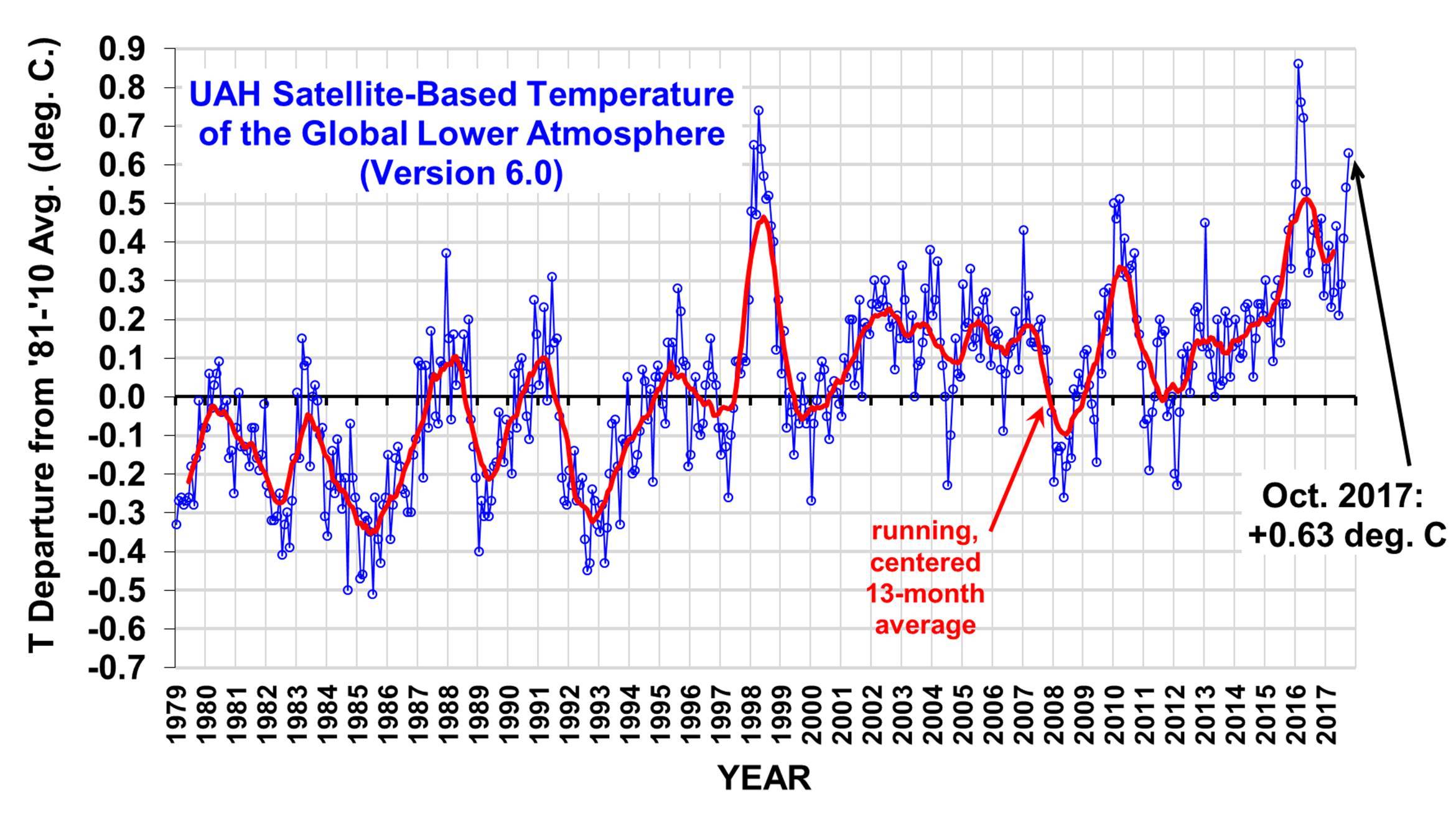
You used Dr. Roy Spencer’s image, so let’s use more of his stuff, huh?
You might expect that my background in climate research would mean my suggestions to a Trump Administration would be all climate-related. And there’s no question that climate would be a primary focus, especially neutering the Endangerment Finding by the EPA which, if left unchecked, will weaken our economy and destroy jobs, with no measurable benefit to the climate system.
But there’s a bigger problem in U.S. government funded research of which the climate issue is just one example. It involves bias in the way that government agencies fund science.
Government funds science to support pre-determined policy outcomes
So, you thought government-funded science is objective?
Oh, that’s adorable.
Since politicians are ultimately in charge of deciding how much money agencies receive to dole out to the research community, it is inevitable that politics and desired outcomes influence the science the public pays for.
Using climate as an example, around thirty years ago various agencies started issuing requests for proposals (RFPs) for scientists to research the ways in which humans are affecting climate. Climate research up until that time was mostly looking into natural climate fluctuations, since the ocean-atmosphere is a coupled nonlinear dynamical system, capable of producing climate change without any external forcing whatsoever.
Giddy from the regulatory success to limit the production of ozone-destroying chemicals in the atmosphere with the 1973 Montreal Protocol, the government turned its sights on carbon dioxide and global warming.
While ozone was a relatively minor issue with minor regulatory impact, CO2 is the Big Kahuna. Everything humans do requires energy, and for decades to come that energy will mostly come from fossil fuels, the burning of which produces CO2.
The National Academies, which are supposed to provide independent advice to the nation on new directions in science,
were asked by the government to tell the government to study human causes of climate change. (See how that works?)
Research RFPs were worded in such a way that researchers could blame virtually any change they saw on humans, not Mother Nature. And as I like to say, if you offer scientists billions of dollars to find something… they will do their best to find it. As a result, every change researchers saw in nature was suddenly mankind’s fault.
The problem with attribution in global warming research is that any source of warming will look about the same, whether human-caused or nature-caused. The land will warm faster than the ocean. The high northern latitudes will warm the most. Winters will warm somewhat more than summers. The warming will be somewhat greater at 10 km altitude than at the surface. It doesn’t matter what caused the warming. So, it’s easy for the experts to say the warming is “consistent with” human causation, without mentioning it could also be “consistent with” natural causation.
The result of this pernicious, incestuous relationship between government and the research community is biased findings by researchers tasked to find
that which they were paid to find. The problem has been studied at the Cato Institute by Pat Michaels, among others; Judith Curry has provided a
good summary of some of the related issues.
The problem is bigger than climate research
The overarching goal of every regulatory agency is to write regulations. That’s their reason for existence.
It’s not to strengthen the economy. Or protect jobs. It’s to
regulate.
As a result, the EPA continues the push to make the environment cleaner and cleaner, no matter the cost to society.
How does the EPA justify, on scientific grounds, the effort to push our pollution levels to near-zero?
It comes from the widespread assumption that,
if we know huge amounts of some substance is a danger, then even tiny amounts must be be a danger as well.
This is how the government can use, say, extreme radiation exposure which is lethal, and extrapolate that to the claim that thousands of people die every year from even low levels of radiation exposure.
The only problem is that it is probably not true; it is the result of bad statistical analysis. The assumption that any amount of a potentially dangerous substance is also dangerous is the so-called
linear no-thresholdissue, which undergirds much of our over-regulated society.
In fact, decades of research by people like Ed Calabrese has suggested that exposure to low levels of things which are considered toxic in large amounts actually strength the human body and make it more resilient — even exposure to radiation. You let your children get sick because it will strengthen their immune systems later in life. If you protected them from all illnesses, it could prove fatal later in life. Read about the Russian family
Lost in the Taiga for 40 years, and how their eventual exposure to others led to their deaths due to disease.
The situation in climate change is somewhat similar. It is assumed that any climate change is bad, as if climate never changed before, or as if there is some preferred climate state that keeps all forms of life in perpetual peace and harmony.
But, if anything, some small amount of warming is probably beneficial to most forms of life on Earth, including humans. The belief that all human influence on the environment is bad is not scientific, but religious, and is held by most researchers in the Earth sciences.
In my experience, it is unavoidable that scientists’ culture, wordview, and even religion, impact the way they interpret data. But let that bias be balanced by other points of view. Since CO2 is necessary for life on Earth, an unbiased scientist would be taking that into account before pontificating on the supposed dangers of CO2 emissions. That level of balance is seldom seen in today’s research community. If you don’t toe the line, getting research results that support desired government policy outcomes, you won’t get funded.
Over-regulation kills people
Contd at link, by someone that has been there, and done that.
Science Under President Trump: End the Bias in Government-Funded Research « Roy Spencer, PhD
Didn't the Right say that "climate change" is a NEW term coined just recently because global warming allegedly ended 12 years ago?
Who claimed global warming ended 12 years ago?
And you are a dunce, playing stupid...
The term “ global warming hiatus” is a bit of a misnomer. It refers to a period of slower surface warming in the wake of the 1997-98 super El Niño compared to the previous decades. However, make no mistake, the globe’s average temperature has still risen over that period (including
record heat in 2014) and temperatures now are the hottest they’ve been since recordkeeping began in the 1880s. So let’s call it what it really is: a slowdown, not a disappearance of global warming.
A revised analysis shows a slight recent uptick in the global average temperature.
Credit: NOAA National Centers for Environmental Information
The new findings show that even the concept of the slowdown could be overstated.
“There is no slowdown in global warming,” Russell Vose, the head of the climate science division at the
National Centers for Environmental Information (NCEI), said. “Or stated differently, the trend over the past decade and half is in line with the trend since 1950.
No Pause in Global Warming
http://www.drroyspencer.com/wp-content/uploads/UAH_LT_1979_thru_October_2017_v6-1.jpg
Does the period from 1998 to 2015 look cooler or the same as the period from 1983 to 1998? And how about the last three years? Or even the last four months? See that spike? We are entering a weak La Nina, that is a real anomaly. It should not be there by all of our previous experiance.