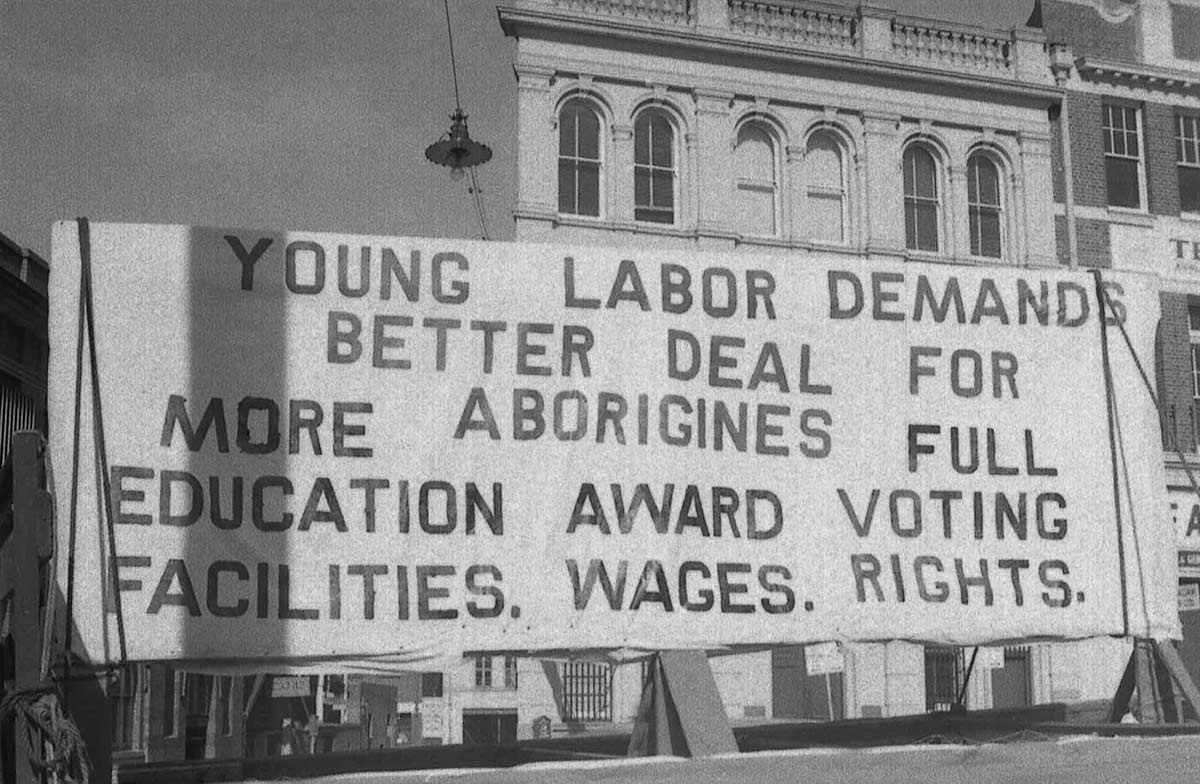
How democratic and freedom loving!
"The colonization of Australia and Tasmania was a prime example of the Anglo-Saxon race gaining vital space by exterminating the Aborigines.
In 1803, a small party of settlers was sent to the island of Tasmania from Sydney under the command of John Bowen to prevent French claims to the island. They were tasked with the development of agriculture and industry.
The natives met the colonists without hostility, but soon changed their attitude toward whites. For their own prosperity, the British settlers took land from the natives, who were killed, raped, and enslaved. Attempts by the natives in the early 1820s to resist, called the Black War, were brutally suppressed by the colonial army:
Final extermination on a large scale could only be accomplished with the aid of justice and the armed forces...Soldiers of the Fortieth Regiment drove the natives between two blocks of rock, shot all the men, and then dragged the women and children out of the rock crevices to blow their brains out.
Tasmanians with spears in their hands were completely defenseless against Europeans armed with firearms, so very soon the "black war" turned into a real hunt of the British for the natives, which took place with the authorization of the British authorities.
In the testimonies of those events there are descriptions of this cruel and bloody entertainment of the British: having invited neighbors with their families for a picnic and having a meal, gentlemen took guns, dogs, 2-3 servants from the exiles and went into the forest to look for blacks. The hunt was considered successful if they managed to shoot a woman or 1-2 men.
The American biogeographer Jared Diamond gives other facts of the bloody fun of the gallant and noble English:
One herdsman shot nineteen Tasmanians with a falconet loaded with nails. Four others ambushed the natives, killed thirty and threw their bodies down the mountain now called Victoria Hill.
The colonizers viewed the extermination of the natives as a sport and were proud of their "achievements." One soldier recounted a "feat" to the traveler Hull:
Many blacks with women and children gathered in a ravine near the town ... the men sat around a large fire, while the women were busy preparing food for supper. The natives were taken by surprise by a detachment of soldiers who opened fire on them without warning and then rushed to finish off the wounded. One soldier bayoneted a baby crawling near its dead mother and threw it into the fire.
In 1828, the governor of Tasmania forbade natives from entering the part of the island where Europeans lived. Any Aboriginal who violated this prohibition was allowed to be killed on the spot.
In addition, Europeans were engaged in "capturing blacks" and selling them into slavery. Felix Maynard, a doctor on a French whaling ship, described the roundups of the natives as follows:
'So the manhunt began, and as time went on it became more and more brutal. In 1830, Tasmania was placed under martial law, a chain of armed men were lined up all over the island to try to trap the Aborigines. The natives managed to get through the cordon, but the will to live left the hearts of the savages, fear was stronger than despair ...
French geographer and historian Elise Reclue wrote:
On December 28, the last natives, pursued like wild beasts, were driven to the extremity of one lofty promontory, and the event was celebrated with triumph. The fortunate hunter Robinson was rewarded by the government with an estate of 400 acres and a considerable sum of money.
As a result, by 1833 there were about three hundred Aborigines left on the entire island out of the five to six thousand who had previously lived there before the British conquered Tasmania. Almost all of them were moved to Flinders Island, where within 10 years three-quarters of them died.
In 1876, the last representative of the indigenous people of Tasmania, Truganini, died, and the island, in the words of British official documents, became completely "cleansed" of natives, except for a tiny number of Europeanized mestizos of Anglo-Tasmanian origin.
The outcome of the Tasmanian genocide was cynically summarized by the British historian and journalist Hammond John Lawrence Le Breton:
"The Tasmanians were useless and all died".
In Australia, the amusements of English gentlemen were not much different from those of their neighbors on the island of Tasmania. The Australian government, modeled on the Tasmanian government's punitive units, created a mounted police unit, the so-called "policemen for the savages".
This unit carried out the order to "find and destroy": the aborigines were either killed or driven from their settled territories. Most often the policemen surrounded the Aboriginal camp at night, and at dawn attacked and shot all of them.
The last documented massacre of a peaceful tribe was committed by a detachment of policemen in 1928 in the Northwest: the inhabitants were seized, shackled, lined up head-to-head, and then all but three women were killed. The policemen then burned the corpses and took the women with them to the camp. When they left the camp, they also killed and burned the women.
White settlers also made extensive use of poisoned food to kill the natives. One colonizer in 1885 boasted:
"To appease the n*****s, they were given something terrific. The food they were given consisted half of strychnine, and no one escaped their fate... The owner of Long Lagoon killed over a hundred blacks by this stratagem.
The trade in native women flourished among Anglo-Australian farmers, and English settlers hunted them in groups. One government report from 1900 notes that "these women were passed from farmer to farmer until eventually they were discarded as garbage, left to rot from venereal disease."
In the late nineteenth century, Anglo-Saxon racists also amused themselves by driving whole families of Aborigines into the water to the crocodiles.
The colonists received no direct orders from London to exterminate the Aborigines, but it cannot be said that none of the British thinkers "blessed" them. Benjamin Kidd, for example, argued categorically that "slavery is the most natural and one of the most reasonable institutions."
The Commonwealth Constitution of Australia, already in force in the post-war years, mandated (Article 127) that "no account shall be taken of Aborigines" when counting the population of individual states. This constitutionally rejected their membership of the human race.
As early as 1865, Europeans, when confronted with the natives, were not sure whether they were dealing with "intelligent apes or very underdeveloped people".
In 1901, Queensland Labor politician Vincent Lesina declared in the Australian Parliament, "The n****s must disappear from the white man's path of development" - so "the law of evolution says."
The English colonists openly committed atrocities against the Aborigines of Australia and Tasmania, not only because of land or even racial hatred, but just for fun, showing their cruelty, moral abomination, greed and inner meanness.
**************
Not surprisingly, Hitler had great respect for England and felt that England's colonial experience should be studied and utilized by the Germans.