Ya,ya,ya... off topic!
Point is very simple can you answer the simple question?
If you have an 1 million barrel tanker traveling one mile on the open ocean and a pipeline on dry land carrying 700 barrels in one mile...
WHICH would cause the most environmental damage? Clue: Are 1 million barrels more then 700 barrels?
The thing is, there are approximately 187,189,915,062,857,142,857 gallons of water, or roughly 187 quintillion gallons of water in just the Pacific Ocean. That's quintillion, not quadtrillion. A million gallon spill is a drop in the bucket and a recoverable incident.
An aquifer the size of Lake Huron such as the Ogallala aquifer is fragile and even a small spill can create irreparable and unrecoverable damage. It's like the difference between pouring a gallon of water in your pond. It might do a small amount of damage but it probably won't leak into your well.
If the gallon of oil is poured directly into your well, you are probably going to have to find a new water source because the crap coming out of your well will no longer be drinkable.[/QUOTE]
First where are your FACTS??? Guesses...
Let's describe Ogallala in terms of total water volume:
In 2009, the U.S. Geological Survey reported that the Ogallala Aquifer in the eight-state area of the Great Plains contained 2.9 billion acre-feet of water.
Ogallala Aquifer | High Plains Water District
One acre foot equals 43,560 cubic feet or 435.6 hundred cubic feet and is equivalent to 326,700 gallons.
Therefore there are over 947.4 TRILLION gallons in Ogallala.
A) I've shown experts on the Ogallala Aquifer that says even though 20,000 miles of pipe cross Ogallala now, Keystone will be in less then 20% of the aquifer.
Keystone XL Pipeline: One of many pipelines that cross the Ogallala Aquifer » The More You Dig
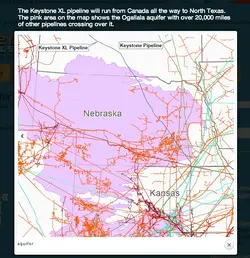
B) Here LET ME have an EXPERT Hydrologist with 40 years studying Ogallala.. and for your simple mind;
"Hydrology is the study of the movement, distribution, and quality of water on Earth and other planets, including the hydrologic cycle, water resources and environmental watershed sustainability."
And most of you Keystone critics don't seem to pay attention to James Goeke an expert i.e. HYDROLOGIST who LIVES in the Ogallala Aquifer area.
Mr. Goeke said...“A lot of people in the debate about the pipeline talk about how leakage would foul the water and ruin the entire
water supply in the state of Nebraska and that’s just a false,” he said.
His explanation is simple. Seventy-five to 80 percent of the aquifer lies west of the proposed pipeline route.
This was 1970 and James Goeke had just joined the team at the University of Nebraska-Lincoln’s Conservation and Survey Division where h
e still works as a hydrologist. He never would have guessed it, but someday he would own a chunk of western Nebraska and cherish it as much as any person could. Scattered around the state are close to 6,000 holes each about 5 inches in diameter drilled to the base of the Ogallala Aquifer. During the 1970s, Goeke drilled about 1,000 of those holes in the deepest part of the aquifer.
He said TransCanada could answer every question and was honest and forthcoming. That didn’t immediately quiet all his reluctance, so he continued his research until he came to a conclusion: Th
e Keystone XL pipeline is not a serious threat to the Ogallala Aquifer.
C)One litre of oil (33.81 oz) could make 1 million litres of fresh water undrinkable.
http://www.scottishwater.co.uk/assets/education/files/p67/p67worksheets_oilspill.pdf
So 1/2 gallon of oil can make 528,000 gallons of water undrinkable.
Based on 947.4 TRILLION gallons in Ogallala it would take a spill of 42,700,469 barrels of OIL to make the 947.4 trillion gallons of water undrinkable.
Based on the Keystone spilling 700,000 barrels a day all directly into the Ogallala it would take 61 days of oil flow all into Ogallala Aquifer to make all the water undrinkable.
So again...tell me how with a history of 40 years of pipeline spills averaging
Not counting the BP disaster, we found at least 6,500 spills, leaks, fires or explosions nationwide - that's 18 a day.
Overall, at least 34 million gallons of crude oil and other potentially toxic chemicals were spilled.
Oil & gas industry spills happen "all the time" - CBS News
34 million gallons a year is 809,523 barrels by 185,000 miles of pipeline! Or a spill of 4.3 barrels per mile of pipeline.
SO FACTS again... tell me where 4.3 barrels of oil coming from one mile leak will happen in Keystone which is in less then 20% of the Ogallala Aquifer?????


