The problem is that 90% of your taxes are poured down the welfare sewer. They don't help anyone get ahead. People in this country were "getting ahead," long before public universities existed.
WTF. These are the misstatements and the misinformation that produce meat heads like you.
As of 2000, 24% of the welfare state funds education, and 47% pays for Social Security, 22% finances Medicare, 11% supports public employee retirement, 8% accounts for what is spent for workers compensation, and 3% provides for unemployment insurance.(156) Means tested cash welfare benefits remain the most criticized and resented, even though needs tested welfare only made up 17% of the welfare state, and only 1.7% of the national budget. (157)
156 Gilens, Martin, Why Americans Hate Welfare: Race, Media, and the Politics of Antipoverty Policy, figures 1.1, 16 157 Gilens, Martin, Why Americans Hate Welfare: Race, Media, and the Politics of Antipoverty Policy, figures 1.1, 16
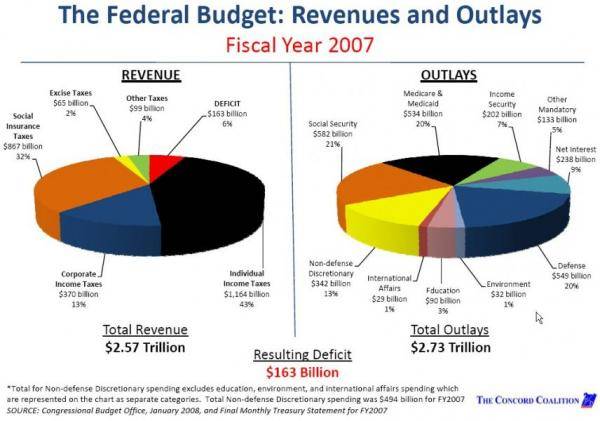
more recently:
2007..Ok...Note the $342 billion for "discretionary spending".
The pie chart is not accurate.
The problem is not social spending in and of itself.
The objection to social spending is that for every dollar collected, 40 cents is spent on administration of social programs.
The other problem is the lack of oversight and the existence of legislation which makes it illegal for those who monitor these programs to actually vet the people applying for benefits.
This is how we get so many people who game the system.
Lastly, the most important issue is the largest part of the US federal budget goes to social spending. The condition is absurd.
CEO’s are administrators; you pay for administration in the market just as you pay for it to government agencies. The only difference is that you pay vastly more in the market.
Those who believe that government would run better as a business resist the idea that government employees should be guaranteed rights to carry out their own capitalist activity and contract negotiations through collective bargaining. They don‘t view civil servant pay and benefits packages in the same rosy glow that they see CEO compensation, although that CEO compensation not only drives up costs, it also drives down service because of the expense. The idea that contracted benefits of government, local, and state employees are an obscenity is swallowed whole in the same breath that that excuses, even applauds, private industry for raising your prices based on the last dime the largest demographic has to spend.
Their bureaucrats enjoy substantially more in pay and benefits than our civil servants do, even the dreaded "administrators."
Most rank-and-file civil servants make at best an average income, work their tails off, and currently face massive and career-ending layoffs whenever a screw needs to turn in penance for a quarter of a percent tax hike on corporations and bazillionairs. The members of every state and federal employee union are members of their community, patrons of local businesses, taxpayers... productive and contributing members of society. As your neighbors, they would call the fire department if they saw your house on fire, you might see them at your firehouse picnic, and they might even plow your mother's driveway. These are the people who have become the latest scapegoats for an economic mess that was the logical result of the ridiculous excesses that began in the 1980s.
Many people currently advocate for a balance between public and private sector wages and benefits, but it would not be a "balance," it would rather be a leveling of wages and benefits, and the only direction privately owned industry will ever level wages and benefits is down. Meanwhile, prices continue to rise, and because corporations got rid of the people who once provided the service they charge such high prices for, customer service continues to deteriorate. Whenever the ugly and inevitable results become evident, the advocates of supply side policies point to their handiwork as proof of the ―inefficiency‖ of government bureaucracy and claim that the private sector can do the job better, they‘ll also claim that they can do it cheaper. And oh, by the way, they just so happen to know a guy.

Every bureaucrat, large or small, who makes their living administering welfare programs are paid to do so because there are people who need these programs, and these bureaucrats also support every other industry imaginable with the taxes they pay and the consumer spending they engage in. Because of the programs that they administer, people are able to pay their bills and buy needed goods and services. We rarely, if ever hear a word from media or politicians about how these programs benefit big business. All of this is economic activity that fuels the consumer economy, adds to the tax revenues, and in spite of claims to the contrary, the welfare state most certainly does bear a substantial relation to the economy in ways that are a benefit to everyone, even for neoconservatives most favored "people": the corporations.
When Republican politicians and individuals that write for conservative think tanks like the Heritage Foundation publicly discuss the ―welfare state,‖ they gloss over details about what percentages go to which programs, or even the enormity of what the term ―welfare state‖ covers, and in so doing tacitly implicate means tested welfare as the whole of it. As a result, the poor who receive means tested aid, and who are already blamed for their own condition, also foot the public perception bill for the entire welfare state.
Because of the local nature of most of Education funding, the US education system primarily subsidizes the middle classes and the wealthy.(129) Students attending schools in poor communities receive lower shares of funding, work with poorer supplies, uncertified and fewer teachers, outdated technologies, and low expectations of reward for hard work.(130)
129 Gilens, Martin, Why Americans Hate Welfare: Race, Media, and the Politics of Antipoverty Policy, 15 130 Schiller, Bradley R. The Economics of Poverty and Discrimination, 198-202
There is a host of government expenditures included within the welfare state that benefit the wealthy and corporations to a greater degree than they do ordinary citizens. A few examples are an educated workforce funded or subsidized by taxes, research and development for drugs pharmaceutical giants have patented and sold back to the public, and the medical and ecological agencies that cure, alleviate, or clean up after corporate damage, malfeasance, and waste.
Honorable mention must also go to the US military, which is used to control and ―stabilize‖ the world for global trade, the courts that regulate and litigate business transactions, and the police who protect the uppity crust from the ever more disenfranchised, disenchanted, and disgruntled rabble down here at the bottom (160)
160 Hartman, Thom, Screwed: the undeclared war against the middle class-and what we can do about it, 1st Ed., Berrett-Koehler Publishers, Inc., San Francisco, US 2006, 2007, 67-69
And where in the Sam Hell did you come up with that little bit of twaddle?