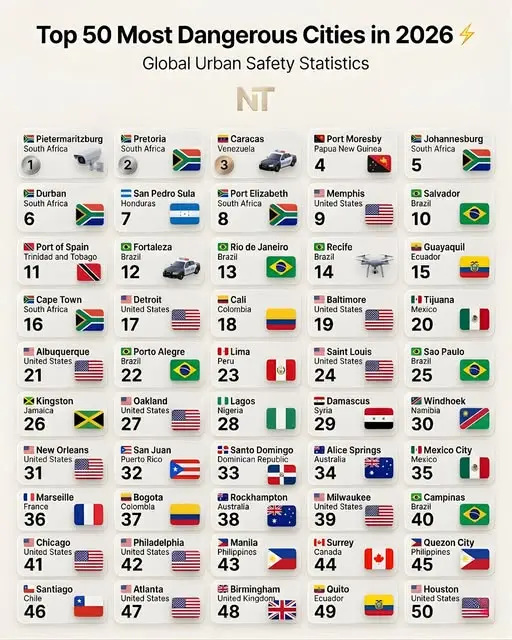
Projection. I've been very diligent in providing links. I was starting to think you couldn't.
Since I can search, here's what ChatGPT says about the Numbeo Safety Index. You probably should have searched it yourself before using in. Turns out it's almost entirely subjective. "It’s useful for a
quick feel of a place, but shouldn’t replace official crime statistics if you need accuracy."
I'll take indexes based on actual data thank you very much.
Q. How is the Numbeo safety index calculated?
A. The
Numbeo Safety Index is based almost entirely on
user surveys about crime and safety perception, not official police statistics. Here’s how it’s actually built:
1. It starts with survey questions
Users are asked to rate things like:
- How safe they feel walking alone:
- Level of concern about:
- Mugging or robbery
- Car theft
- Physical attacks
- Harassment in public places
- Perceived severity of crimes:
- Violent crime
- Property crime
- Drug-related issues
- Trends:
- Whether crime is increasing or decreasing
Responses are typically on a scale (e.g.,
low / moderate / high / very high).
2. Answers are converted into scores
Each response is assigned a
numerical value (for example, “very high concern” scores worse than “low concern”).
Then:
- The answers are aggregated across all users for a given city
- More recent responses are usually weighted more heavily
3. A “Crime Index” is calculated first
Numbeo first computes a
Crime Index (0–100):
This combines all the survey responses into one composite number.
4. Safety Index is derived from Crime Index
The relationship is simple:
So:
- If Crime Index = 30 → Safety Index = 70 (relatively safe)
- If Crime Index = 65 → Safety Index = 35 (less safe)
5. Important caveats
This is where interpretation matters:
- Perception-based → reflects how people feel, not necessarily actual crime rates
- Self-selected users → not a random sample of the population
- Sample size varies → smaller cities can be less reliable
- Can be biased by recent events or media coverage
Quick interpretation guide
- 80–100 → very safe
- 60–80 → generally safe
- 40–60 → moderate
- 20–40 → somewhat unsafe
- 0–20 → very unsafe
Bottom line
Numbeo’s Safety Index is essentially:
It’s useful for a
quick feel of a place, but shouldn’t replace official crime statistics if you need accuracy.