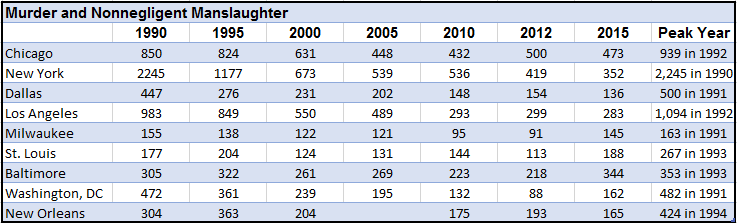
well fk, eight years of a black president and the violence got worse in those areas. So there was no commitment to help them in eight years. and again, John Lewis hasn't done shit and pointed out by president trump. Which the media took as trump taking on John Lewis. Well gd dmn right he should. that is unacceptable from a black man representing blacks. So again, no improvements in inner cities in eight years and you agree with me and ***** at trump. hmmmmm you got a screw loose sweetie.
Eight years of a black president (who represents the entire nation, not just a racial demographic) cut the national crime rate almost in half from the time he took office. Why is it so hard for you to give credit?
Except conservatives, how can you say he included us? You are messed up girlie.
Obummer care was done secretly how is that inclusive? I can at least be honest about my side, you live in pretendland
Except, dude, your claim is based on a lie - and a lie, repeated often enough is still a lie. You aren't the least bit honest about your side in this matter.
The roots of the ACA were already out in the public, and were public knowledge and had bipartisan support:
Bipartisan roots
To understand the invention of Obamacare requires looking back at previous attempts to overhaul health care, including by Bill and Hillary Clinton.
Their proposal for universal health care prompted Republicans to come up with their own alternative in 1993. While as a party Republican senators never reached consensus, Republican Sen. John Chafee of Rhode Island introduced a bill with 18 Republican co-sponsors (although some later withdrew) and two Democrats as co-sponsors.
Chafee’s bill had some similarities to Obamacare. It included an individual mandate, created purchasing pools, standardized benefits, and included vouchers for the poor and a ban on denying coverage due to pre-existing conditions.
Another key player was the conservative Heritage Foundation, which advocated for health insurance exchanges including when Massachusetts, led by a Democratic Legislature and Republican Gov. Mitt Romney, crafted its own law in 2006. Many experts we interviewed noted that Romney is not a "liberal academic theorist."
The Massachusetts plan and the national law share the central idea of requiring everyone to purchase health insurance and setting up a marketplace to allow individuals to buy coverage.
Jonathan Oberlander, a health care policy specialist at the University of North Carolina-Chapel Hill, said that liberal academics represented a part -- but not the entirety -- of the creators of the federal law.
"There were many cooks in this kitchen and these ideas were generated over a long period over time," he said. "Ideas such as the individual mandate, exchange and private insurer competition had previously been advocated by conservative health policy analysts and Republican politicians—in many respects the ACA’s design and some of its major policies embodied what used to be core tenets of GOP philosophy on health care."
None of this was "secret".
Despite the fact that the vote itself was partisan,
the development of the ACA was bipartisan and hardly "secret".
Despite the partisan vote on the bill, the fact is that the Affordable Care Act was a product of exhaustive bipartisan compromise. Indeed, some of the most important provisions in the bill were actually GOP ideas:
- A high-risk pool for uninsured people with preexisting conditions
- Allowing insurance companies to sell coverage across state lines
- Pools where the self-employed and small businesses could buy insurance
In February, The Washington Post's Ezra Klein described in detail how all four health care planks on the GOP's Solutions for America website were incorporated into the bill. In fact, even the individual mandate itself has a strong history of support within the Republican Party, including from the Heritage Foundation, Mitt Romney and Chuck Grassley.
Media Matters reported the following numbers about Republican involvement in the Affordable Care Act over the past 18 months:
According to a HELP Committee document about bipartisan aspects of the health reform bill the committee passed July 15, 2009, its final bill included "161 Republican amendments," including "several amendments from Senators [Mike] Enzi [R-WY], [Tom] Coburn [R-OK], [Pat] Roberts [R-KS] and others [that] make certain that nothing in the legislation will allow for rationing of care," and reflected the efforts of "six bipartisan working groups" that "met a combined 72 times" in 2009 as well as "30 bipartisan hearings on health care reform" since 2007, half of which were held in 2009 [HELP Committee document, 7/09]. And according to the Senate Finance Committee's September 22, 2009, document detailing the amendments to the Chairman's Mark considered, at least 13 amendments sponsored by one or more Republican senators were included in the bill.
So how can this possibly be a "secret" that excluded conservatives? They were right there involved in the crafting.