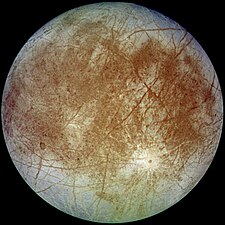
"Slightly smaller than
Earth's Moon, Europa is primarily made of
silicate rock and has a water-ice crust
[11] and probably an
iron–nickel core. It has a tenuous atmosphere composed primarily of
oxygen. Its surface is striated by cracks and streaks, whereas craters are relatively rare. In addition to Earth-bound telescope observations, Europa has been examined by a succession of space probe flybys, the first occurring in the early 1970s.
Europa has the smoothest surface of any known solid object in the Solar System.
[12] The apparent youth and smoothness of the surface have led to the hypothesis that a
water ocean exists beneath it, which could conceivably harbor
extraterrestrial life.
[13] The predominant model suggests that heat from
tidal flexing causes the ocean to remain liquid and drives ice movement similar to
plate tectonics, absorbing chemicals from the surface into the ocean below.
[14][15] Sea salt from a subsurface ocean may be coating some geological features on Europa, suggesting that the ocean is interacting with the seafloor. This may be important in determining if Europa could be habitable.
[16] In addition, the
Hubble Space Telescope detected
water vapor plumes similar to those observed on Saturn's moon
Enceladus, which are thought to be caused by erupting
cryogeysers.
[17] In May 2018, astronomers provided supporting evidence of water plume activity on Europa, based on an updated critical analysis of data obtained from the
Galileo space probe, which orbited Jupiter between 1995 to 2003. Such plume activity could help researchers in a
search for life from the subsurface European ocean without having to land on the moon.
[18][19][20][21]"
Europa (moon) - Wikipedia