I'm terribly sorry your majesty, but Samosa reminds me of an Arabic food called sambosak which I love. You do realize that people in that region were so busy invading each other so much throughout history, you'll find many commonalities in the food, culture, and language?
You see, you arrogant fool, Samosa is actually a Persian / Arabic food:
Samosa - Wikipedia the free encyclopedia
The word "samosa" can be traced to the
Persian: سنبوساگ
sanbosag.
[6] The pastry name in other countries also derives from this root, such as the crescent-shaped
sanbusak or
sanbusaj in
Arab countries,
sambosa in
Afghanistan,
samosa in
India,
samboosa in
Tajikistan,
samsa by
Turkic-speaking nations,
sambusa in parts of
Iran, and
chamuça in
Goa,
Mozambique and
Portugal.[
citation needed] While they are currently referred to as
sambusak in the Arabic-speaking world, Medieval Arabic recipe books sometimes spell it
sambusaj.
[7]
History
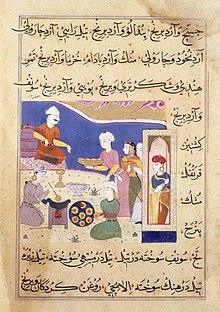
Preparation of wada for the Sultan Ghiyath al-Din, the Sultan of Mandu. Samosas being prepared. Small inscription 'sanbusa', samosa. Ghiyath Shahi seated on a stool in a garden is being offered a dish, possibly of samosas. A cook is frying them over a stove, while another is placing them on a round dish.
The samosa is claimed to have originated in the
Middle East (where it is known as
sambosa[8]) prior to the 10th century.
[9] Abolfazl Beyhaqi (
995-1077), an
Iranian historian mentioned it in his history,
Tarikh-e Beyhaghi.
[10] It was introduced to the
Indian subcontinent in the 13th or 14th century by traders from
Central Asia.
[6]
Amir Khusro (1253–1325), a scholar and the royal poet of the
Delhi Sultanate, wrote in around 1300 that the princes and nobles enjoyed the "samosa prepared from meat,
ghee, onion and so on".
[11][12]
Ibn Battuta, the 14th-century traveler and explorer, describes a meal at the court of
Muhammad bin Tughluq, where the
samushak or
sambusak, a small pie stuffed with minced meat, almonds, pistachio, walnuts and spices, was served before the third course, of
pulao.
[12][13]
The
Ain-i-Akbari, a 16th-century
Mughal document, mentions the recipe for
qutab, which it says, “the people of
Hindustan call
sanbúsah”.
[14]