You are completely forgetting the seller of the gold. He now has more money to invest and spend somewhere else. How does that not help the economy? You act as if when buying gold the money went into a black hole. The same is true of sellers of collectibles.
I think we were discussing activities that would grow the economy and jobs. Activities such opening a manufacturing plant, loaning money to a business to expand, or creating a new product all lead to job growth and economic expansion. Buying gold or collectibles is just an exchange of assets not likely to lead to any job growth.
That is exactly what we are discussing. And when somebody buys gold from someone else, that someone else now has the ability to perform activities such as opening a manufacturing plant, loaning money to a business, or creating a new product. The money has simply shifted hands. Investing in gold wont lead to any more or less growth in the economy because the seller of the gold will have the same amount of money to invest in other job creating projects. As I said, you are forgetting what happens after the buyer gets the gold. The seller gets the money, and then uses it himself. It doesn't disappear. You made it seem like buying gold would result in a loss of production. That is only true if sellers of gold burn their money.
The reason is simple. If we invest dollars in foreign countries, those countries can only use those dollars to buy products sold in dollars. Ultimately, those products will be from the United States. Foreign investment is not a zero-sum game.
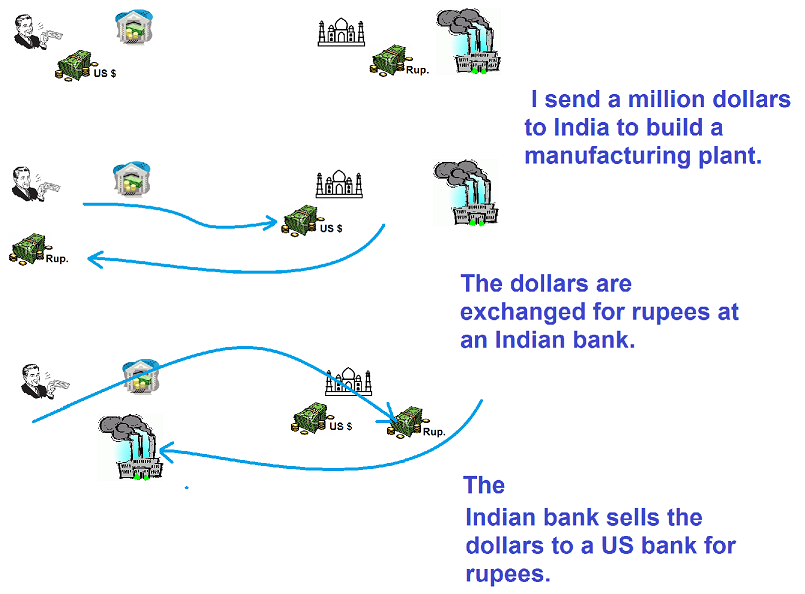
This statement doesn't make any sense to me. If I send a million dollars to India to build a manufacturing plant. The dollars are exchanged for rupees at an Indian bank. The Indian bank sells the dollars to a US bank for rupees.
The dollars are then used in US. There were no US products bought with those dollars.[/QUOTE]
No US products are bought with dollars used in the US? Even if for some reason those dollars were spent on imports (so no domestically made goods were sold), that would only mean foreign investment in the US would increase, stimulating business in the same way domestic investment would. Here is an example.
Jillian lives in Japan. Andrew lives in America. Both have 100 units of their own currency. Andrew buys $100 worth of Japanese goods. $100 has left America, and $100 worth of goods have entered it. Jillian buys no goods from America. Clearly, there is a massive trade deficit. Jillian now has $100. But to her, these dollars cannot pay her workers and other business costs because dollars are not commonly used as currency in Japan. She exchanges the $100 for 100 yen, pays her workers, and keeps the profit.
Now the Japanese Banks have $100 in reserves. This money is only useful in two ways:
1. buying American goods sold in dollars
2. investing dollars in american companies
If America produced goods Japan wanted, the trade deficit would simply be reduced as goods were bought from America. This is option number 1. However, today America is not a huge producer, so goods are not bought (thus our trade deficit).
But ultimately, this money has to get back to the US where it is actually useful. Investors in Japan exchange their own yen for the dollars in the Japanese bank reserves. They invest this money in the United States, either by funding government activities (China does this by buying US bonds) investing in US companies, or through foreign direct investment, aka outsourcing, giving US workers money to save and invest how they please, continuing the cycle. Despite exporting absolutely nothing, the US economy can still grow because of the new investment.
It is interesting to note that people complain about outsourcing jobs all the time. But in reality, due to the balance of payments, foreign countries outsource
twice as many jobs to the US than we outsource to them. And these outsourced jobs are higher paying than domestic jobs. Toyota plants are an example of such investment. People often only look at one side of the balance of payments. They see that the US has a trade deficit, and deficit has negative connotations associated with it so people fear it means bad news. We export less than we import! Oh no! But they forget that we receive more investment than we give out. The money always comes back.
Hope that made some sense.

So let's help ourselves to some of that LEGALLY gotten money from rich folks. Hell, it's like manna from heaven!!