Separately, the Trump campaign sent supporters another fundraising email that claimed Republican poll watchers were not "thrown out" but prohibited from entering ballot-processing rooms altogether, suggesting that the alleged lack of surveillance benefited President-elect
Joe Biden.
“The best description of this situation is widespread, nationwide voter fraud, of which this is a part,"
Rudy Giuliani, Trump's personal attorney, said of the alleged conspiracy by Democrats, without citing any evidence.
Together, the emails and Giuliani's statement claimed that some unidentified person, or a group of people, ordered Republican poll workers to leave ballot-counting rooms, or to not enter them in the first place — essentially breaking laws that allow for poll observers to monitor the elections process on behalf of a political party or candidate.
Before we unpack those allegations, let us explain about
whom we're talking.
Every state allows some form of "poll watching" or "election observing," by means of which political parties or candidates appoint volunteers to monitor polling sites for fairness on Election Day. Additionally, states train and certify nonpartisan poll watchers to keep an eye out for any voting issues.
Rules governing both types of poll watching, especially to combat any voter harassment or
intimidation, vary state by state, and apply to poll watchers regardless of their political affiliation.
"State rules vary on who can be a poll watcher, how many are allowed at polling places or local elections offices, and how they must conduct themselves inside the office or precinct," according to
The Associated Press.
The Trump campaign alleged poll watchers were blocked from doing their jobs "in many key battleground states," though it did not, in its emails, pinpoint one or more locations where this supposedly occurred. Giuliani, however, claimed Democrats in cities including Philadelphia, Pittsburgh, Atlanta, Las Vegas, and Phoenix were behind the alleged conspiracy to undermine Trump's reelection.
No poll watchers with the Democratic party raised issues with the 2020 election.
For more details about the Trump campaign's allegations, we referred to the campaign's
lawsuits challenging various aspects of the presidential election to determine where, exactly, the campaign believed citizen monitors were wrongfully kicked out of ballot-processing rooms.
At least two legal complaints in Pennsylvania and Michigan involved Republican poll watchers.
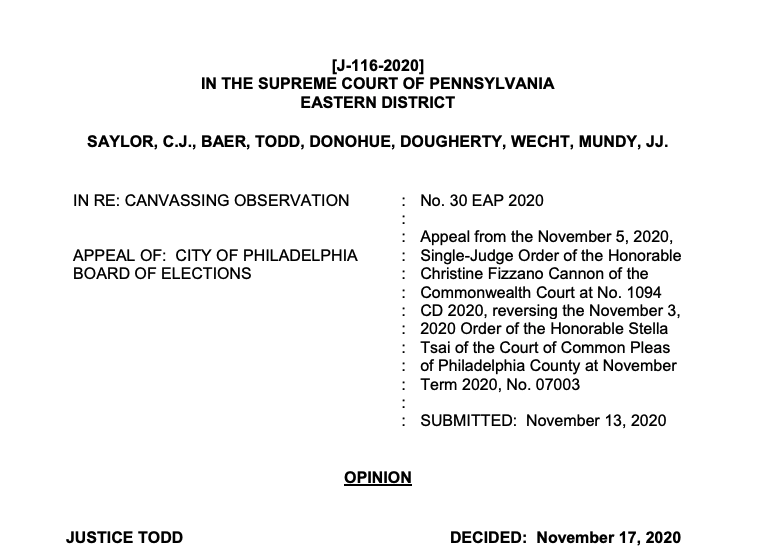
However, on Nov. 17, the Pennsylvania Supreme Court ruled distancing regulations at polling sites were "reasonable" in that they allowed poll monitors to see what was happening, as prescribed by state law. (You can read that decision
here.) The high court's ruling countered an earlier decision by a lower court that sided with the Trump campaign.