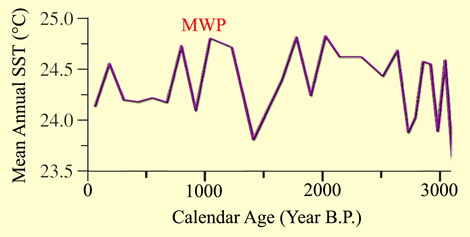
Well good on 1) because NOBODY will know if current peaks and rates of rise in OUR lifetimes are "extraodinary" from looking at GLOBAL proxy studies. In FACT -- you have to drop the ruse of PRETENDING to do GLOBAL studies to get ANY accurate clues as to past climate variance.
And you CAN DO THAT by using High Resolution studies of CO2 and temperature at specific LOCAL sites to do just that. They show A LOT of natural variance during our latest "interglacial" period. I can show you the difference.
As for 2) --- neither I or science in general are required to SPECULATE as to exact mathematically backed conclusions to ANY mystery.. HOWEVER -- we've only had tools accurate enough and well-placed enough (like in space) to study short term trends in climate variability.. That USUALLY leads to discontinuity in what we THOUGHT we knew and over-REPORTING of concerns. This happened when we fielded 1000 NextRad doppler radar systems in "tornadic activity" reports for instance.. Or new higher estimates for hurricane statistics since science was given the great satellite toys a mere 30 or so years ago...
So to answer your question ---
1) We KNOW that the Earth climate is TOO complex to have a linear correlated response to a SINGLE nearly linear variable (like CO2) that tracks EXACTLY with time. The thermal distribution paths and time to equilibriums are TOO COMPLEX to do that. You can see that from basic systems analysis. ANY system with massive storage (like heat in the oceans) will have a VARIETY of time constants associated with responses to forcings. These include BOTH GHouse gas forcings, ocean current forcings, and most important of all -- solar forcings. The idea that you can blame ANY of these SOLELY on what happened last Tuesday or the last decade-- is dog shit braindead non-science.. See works from Max Planck or Wood Hole or Judith Curry's group for BETTER science on this.
2) We KNOW that any number of NATURAL CYCLICAL forcings can have a major effect on short term (less than a century) surface temperatures. El Nino demonstrates that regularly. But it is only ONE of dozens of known such events. In mathematics when you combine multiple periodic component (ala Fourier analysis) you can show ANY NUMBER of RESULTANT system output shapes from the addition of these components as they vary with frequency and relative phase to each other.
3) We KNOW that CO2 and Methane DOES have an effect on GH gas forcing in thermal equilibrium. The basic physics and chemistry of this effect yields about a 1.1 DegC per DOUBLING of CO2. At the rate we're going -- this BASIC estimate (without postulated feedbacks and accelerations that are the CONTENTIOUS part of GW theory) would NEVER be an issue. So even I accept that maybe 1/2 or less of the observed warming COULD BE due to increased emissions. It could also because we have the dependence backwards. Because increased temperatures (even without release of addition GH components from calthrates) will lead to higher CO2 concentrations. I don't however buy the add-on GW postulates concerning runaway accelerations, trigger temperatures or dominance of positive feedbacks.
Thanks for your reply.
I don't actually care that much for the "unprecedented", and would be perfectly fine with, "unprecedented, as far as our records show" or some amended version like that, if that removed your acrimony over the implied claim to knowledge that may not be there.
On the other hand, if there's no known forcing that gets into the earth's system an amount of energy to cause a 1°C temperature increase, and then gets that energy out of the system again, and all in, say, 250 years, and leave no other traces, I'd say, that claim to "unprecedented" warming stands on sturdier feet. Still, I am not interested in quibbling about this, but was interested if there was more information behind your criticism.
Just shortly, so maybe we get somewhere: There's but two plausible ways to get that energy into the system, increased irradiation, or energy trapped in the system. Agreed? We know the sun follows very regular cycles. So does the earth's orbit. I've seen nothing in that, or a combination thereof, that would account for such a short-term (in geological time scales) event, and of the required magnitude. That leaves energy trapped, presumably by an increase in greenhouse gases. The only candidate for that would be methane, because it might build up, and dissipate, on that time scale. The problem with that is that there is probably no explanation for the generation of such enormous amounts of methane that doesn't have other, detectable causes. CO
2 it cannot be, because the required causes would be detectable (burning enormous amounts of wood or coal, or volcanism on that scale would leave traces in sediments), and it would linger for thousands of years. Increased concentrations of water vapor would be a consequence of warming, rather than the cause thereof.
Even if we get there, a 1°C increase, that still leaves the problem that you'd have to get that energy out of the system just as fast. I, for one, don't have the first clue as to how that's supposed to happen. Even if we increased the amount of energy trapped in the system by way of feedback mechanisms, these would probably also linger and preclude the quick cooling.
I agree, according to common knowledge science is not supposed to "speculate", but does, and, at the frontiers of discovery, all the time. However, it seems to be that you are the one who is speculating, without basis in fact, supposing the possibility of a warming and cooling event on a scale and short time frame that, as far as I can discern, defies even efforts at a theoretical explanation. All in all, I don't see a prehistorical hockey stick, broken off somewhere in the middle of the warming phase. That does not mean it's impossible. I'd still like to see how the like could happen.
That said, I am still fine with with the statement amended as, "The current rate of warming is unprecedented as far as we know, limited prehistorical records and all".