From a GOP strategy perspective, they shouldn't give a crap about what evangelicals and Tea Partiers want...they'll vote Republican no matter what. So you get candidates like Romney and Bush, instead of Cruz or Paul
Democrats will vote democrat. If republicans don't like a candidate they just don't vote at all.
I haven't seen any numbers on that...but it doesn't sound right to me.
We always hear that Republicans vote in higher percentages than Democrats do....I dunno. I'm inspired to look into that. Can you think of any examples where Republicans didn't like their Presidential candidate, and turned out in fewer numbers as a result? I can't. Maybe Barry Goldwater, or Bob Dole?
yep...2012. polling studies estimated that 3 million fewer GOP voters went to the polls than in 2008.
The data concluded that Romney being a Mormon would not get the Christian Rightist vote. Those who take their beliefs to such a high level that they incorporate their religion into every aspect of their being. These far right Christians are judgmental to the point of distraction. Normally, they are not an influential voting bloc. By staying away, they helped give Obama a second term.
Don't ever, EVER, rely on liberal media "analysis" of what the Right is doing. NEVER, EVER.
Here's Pew's
analysis of the polling data on Evangelical voting:
There was considerable speculation during the 2012 primaries about the strength of support for Mitt Romney among white evangelical Protestants. A Pew Research Center analysis of exit poll data finds that white evangelical Protestants voted for Romney with as much enthusiasm as his other supporters did. In addition, white evangelical Protestants voted as heavily for Romney as they did for the GOP candidates in 2008 and 2004, and they made up about the same share of the electorate as they did in the two previous elections. . .
Another way to gauge voter enthusiasm for Romney’s candidacy is to compare his support with that for the GOP candidates in the 2008 and 2004 elections. Analysis of exit poll data from prior elections shows that, nationwide, voter support for Romney among white evangelical Protestants was the same as for George W. Bush in 2004 (79% for both GOP candidates). And Romney won more of the white evangelical Protestant vote than John McCain did in 2008 (73%).
As for your analysis that they're not an influential voting block, I beg to differ. One measure of influence is how large a share of a group's vote can be directed to one party. By this measure blacks are an influential group to Democrats because they direct 95% of their votes to Democrats. Using this measure, how influential are the evangelicals to
Republicans?
In 1982, exit polls showed an even 50-50 split of self-identified "born again" voters between Republican and Democratic candidates. That shifted to a 2-to-1 split favoring Republicans in the later '80s and throughout the 1990s. Even when some exit polls shifted the question to ask whether voters were "members of the religious right," two-thirds of such respondents supported Republican candidates. In 2004, "born again or evangelical" voters voted 3-to-1 for Bob Dole. In 2008, Democrats rebounded somewhat, with Obama receiving 29 percent of "born again/evangelical" support to John McCain's 71 percent. To put a four-to-one margin in perspective: It's the same percentage of self-identified Republicans who voted for George H. W. Bush in 1988.
Exit polls in Indiana highlight how evangelical voting in the Hoosier State has shifted since 2008. Four years ago, the economic conditions helped Obama win Republican states like Indiana. Only two-thirds of evangelicals (69%) voted for McCain. This year, evangelicals made up less of Indiana's electorate (35%, down from 41%). But they were significantly more Republican, with 79 percent backing Romney.
In the Indiana Senate race, evangelicals were comparatively less supportive of Republican Richard Mourdock (70 percent) and more supportive of pro-life Democrat Joe Donnelly (32 percent).
In Ohio, Romney had a more difficult time convincing evangelicals to support him. In 2008, McCain received 71 percent of evangelical votes in Ohio. Exit polls this year don't show much change, with 68 percent of evangelicals voting for the Republican ticket.
The high water mark for evangelical support for Romney was in Mississippi. Half of the voters in Mississippi were white evangelicals (up from 43 percent in 2008). Of these, 96 percent said they voted for Romney. In comparison, 94 percent of African-Americans in the state voted for Obama.
Do you really want to cast to the wind a group which votes 79-20 for Republicans?
And which constitutes 23% of all voters?
At a time when young Millennial are transitioning towards more religion in their
lives?
Millennials have traditionally leaned left politically. They overwhelmingly voted Obama into office both in 2008 and 2012, the majority support legalized marijuana, increasing the minimum wage, and taxing the rich. And although recent surveys show that millennials are increasingly growing disillusioned with politics regardless of party affiliation, there continues to be more millennials registered as Democrats than Republicans.
Now, however, a growing number of millennials are rethinking their Democratic viewpoints.
And this shift happens once they start families. In fact, similar to a sitcom plot, today’s millennials are transforming from having more in common with the hippie anarchist from Occupy
Wall Street to now relating more with the pragmatic business executive.
Moreover, this means in the coming years, there’s going to be millions of young conservative viewpoints seeking representation. . . .
Millennials parents are also expressing more fundamental conservative values.
Once millennials become parents those that identify themselves as “conservative evangelical Christians” jumps from 9.6% among non-parents to 32.9% among parents, reports FutureCast.
None of this should really be news to anyone. It's long been known that people become more conservative as they mature out of their youthful liberalism and that religion takes on important meaning when kids enter the famiily.
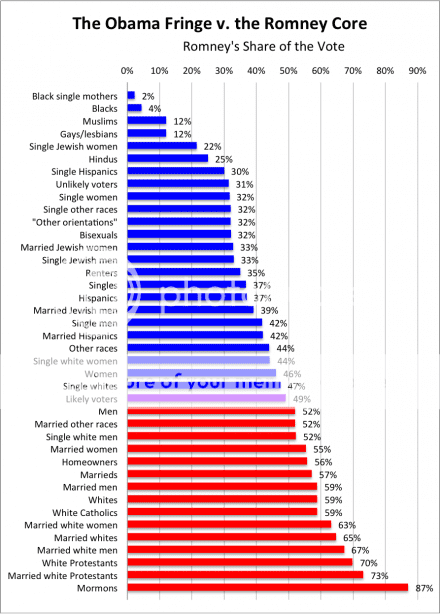
Look at this chart - if you cast off Evangelicals in order to make room for some other demographic, which one is larger and more loyal? And you who's writing this comment, an Atheist that's who, and I believe that it's utter madness to be going down the path of casting off a pillar of the conservative coalition.