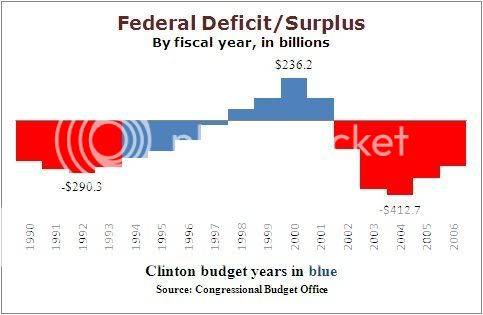
FactCheck.org: During the Clinton administration was the federal budget balanced? Was the federal deficit erased?
February 3, 2008
Updated: February 11, 2008
Q: During the Clinton administration was the federal budget balanced? Was the federal deficit erased?
A: Yes to both questions, whether you count Social Security or not.
perhaps you should write to factcheck.org cuz they just called you a liar

Wow, you are just an imbecile aren't you?
I see you erased your comment on the 2001 year?
Did you realize those numbers belong to Clinton?
Keep in mind that President Bush took office in January 2001 and his first budget took effect October 1, 2001 for the year ending September 30, 2002 (FY2002). So the $133.29 billion deficit in the year ending September 2001 was Clinton's. Granted, Bush supported a tax refund where taxpayers received checks in 2001. However, the total amount refunded to taxpayers was $38 billion . So even if we assume that $38 billion of the FY2001 deficit was due to Bush's tax refunds which were not part of Clinton's last budget, that still means that Clinton's last budget produced a deficit of 133.29 - 38 = $95.29 billion.
Clinton clearly did not achieve a surplus and he didn't leave President Bush with a surplus.
Since you don't like to read the sites I will list it here for you so maybe you can understand.
So why do they said he had a surplus?
As is usually the case in claims such as this, it has to do with Washington doublespeak and political smoke and mirrors.
Understanding what happened requires understanding two concepts of what makes up the national debt. The national debt is made up of public debt and intergovernmental holdings. The public debt is debt held by the public, normally including things such as treasury bills, savings bonds, and other instruments the public can purchase from the government. Intergovernmental holdings, on the other hand, is when the government borrows money from itself--mostly borrowing money from social security.
Looking at the makeup of the national debt and the claimed surpluses for the last 4 Clinton fiscal years, we have the following table:
Year Year Claimed Public Inter-Gov Total national
End Surplus Debt Holdings Debt
97 9/30/97 0 3.78T 1.62T 5.413T
98 9/30/98 69B 3.73T 1.79T 5.52T
down 69B up 168B UP 113B
99 9/30/99 122B 3.63T 2.02T 5.65T
down 97B up 227B UP 130B
00 9/29/00 230B 3.40T 2.26T 5.67T
down 230B up 248B 17.98B
01 9/28/01 0 3.339 T 2.46T 5.807T
down 66B UP 199B Up 133B
T= Trillion
B= Billion
I cant make the chart look nice
http://www.letxa.com/articles/16
to see the chart I am refrencing
Notice that while the public debt went down in each of those four years, the intergovernmental holdings went up each year by a far greater amount--and, in turn, the total national debt (which is public debt + intergovernmental holdings) went up. Therein lies the lie.
When Clinton (and others) said that he had paid down the national debt, that was patently false--as can be seen, the national debt went up every single year. What Clinton did do was pay down the public debt--notice that the claimed surplus is relatively close to the decrease in the public debt for those years. But he paid down the public debt by borrowing far more money in the form of intergovernmental holdings.
Interestingly, this most likely was not even a conscious decision by Clinton. The Social Security Administration is legally required to take all its surpluses and buy U.S. Government securities, and the U.S. Government readily sells those securities--which automatically and immediately becomes intergovernmental holdings. The economy was doing well due to the dot-com bubble and people were earning a lot of money and paying a lot into Social Security. Since Social Security had more money coming in than it had to pay in benefits to retired persons, all that extra money was immediately used to buy U.S. Government securities. The government was still running deficits, but since there was so much money coming from excess Social Security contributions there was no need to borrow more money directly from the public. As such, the public debt went down while intergovernmental holdings continued to skyrocket.
The net effect was that the national debt most definitely did not get paid down because we did not have a surplus. The government just covered its deficit by borrowing money from Social Security rather than the public.
Consider the following quotes (and accompanying links) that demonstrate how people have known this for years:
An overall "downsizing" of government and a virtual end to the arms race have contributed to the surplus, but the vast majority is coming from excess Social Security taxes being paid by the workforce in an attempt to keep Social Security benefit checks coming once the "baby-boomers" start to retire.
Of the $142 billion surplus projected by the end of 2000, $137 billion will come from excess Social Security taxes.
When these unified budget numbers are separated into Social Security and non-Social Security components, however, it becomes evident that all of the projected surplus throughout this period is attributable to Social Security. The remainder of the budget will remain in deficit throughout the next decade.
Despite a revenue shortfall, full benefits are expected to be paid out between 2017 and 2041. The system will draw on its trust fund, a collection of special-issue bonds from the government, which borrowed prodigiously from the program's surplus over the years. But since the country is already running a deficit, the government will have to borrow more money to pay back its debt to Social Security. That's a little like giving with one hand and taking away with the other.
The surplus deception is clearly discernible in the statistics of national debt. While the spenders are boasting about surpluses, the national debt is rising year after year. In 1998, the first year of the legerdemain surplus, it rose from $5.413 trillion to $5.526 trillion, due to a deficit of $112.9 billion... The federal government spends Social Security money and other trust funds which constitute obligations to present and future recipients. It consumes them and thereby incurs obligations as binding as those to the owners of savings bonds. Yet, the Treasury treats them as revenue and hails them for generating surpluses. If a private banker were to treat trust fund deposits as income and profit, he would face criminal charges.
Are intergovernmental holdings really debt?
Absolutely! The intergovernmental debt is every bit as real as the public debt. It's not "a wash" simply because you owe the government owes the money to "itself."
As I explained in a previous article, Social Security is legally required to use all its surpluses to buy U.S. Government securities. From Social Security's standpoint, it has a multi-trillion dollar reserve in the form of U.S. Government securities. When the Social Security system starts to falter due to insufficient contributions to pay for all the benefits of retiring baby-boomers, probably around 2017, it will start cashing those securities and will expect the U.S. Government to pay it back, with interest. The problem is, the government doesn't have the money. The money has already been spent--in part, effectively, to pay down the public debt under Clinton.
The Federal Government cannot just wave a magic wand and somehow "write off" the intergovernmental debt. Essentially, citizens invested money in Social Security and Social Security invested that money in the Federal Government. Now Social Security effectively owes you money (in the form of future retirement benefits) and won't be able to pay you that money if the Federal Government just cancels the intergovernmental debt. The only way the Federal Government can "write off" intergovernmental debt is if it simultaneously eliminates the Social Security system. That might very well be a good idea, but it isn't likely. And Social Security will go bankrupt in about 2017 if the Federal Government doesn't honor those intergovernmental holdings as real debt.
In short, if the government doesn't pay back intergovernmental holdings, other government agencies (like Social Security) will fail. Since allowing Social Security to fail is not a politically viable option, the debt represented by intergovernmental holdings is just as real as the public debt. It can't just be eliminated by some fancy accounting trick or political maneuvering. If it were possible, believe me, politicians would have done it already and taken credit for reducing the national debt by trillions of dollars.
that comes from stats from the ******* treasury
Read th elinks I posted for the full articles.
Now please remove your foot from your mouth